Boston Terrier Grooming
One of the genuinely easy coats on the site, attached to a face that is not
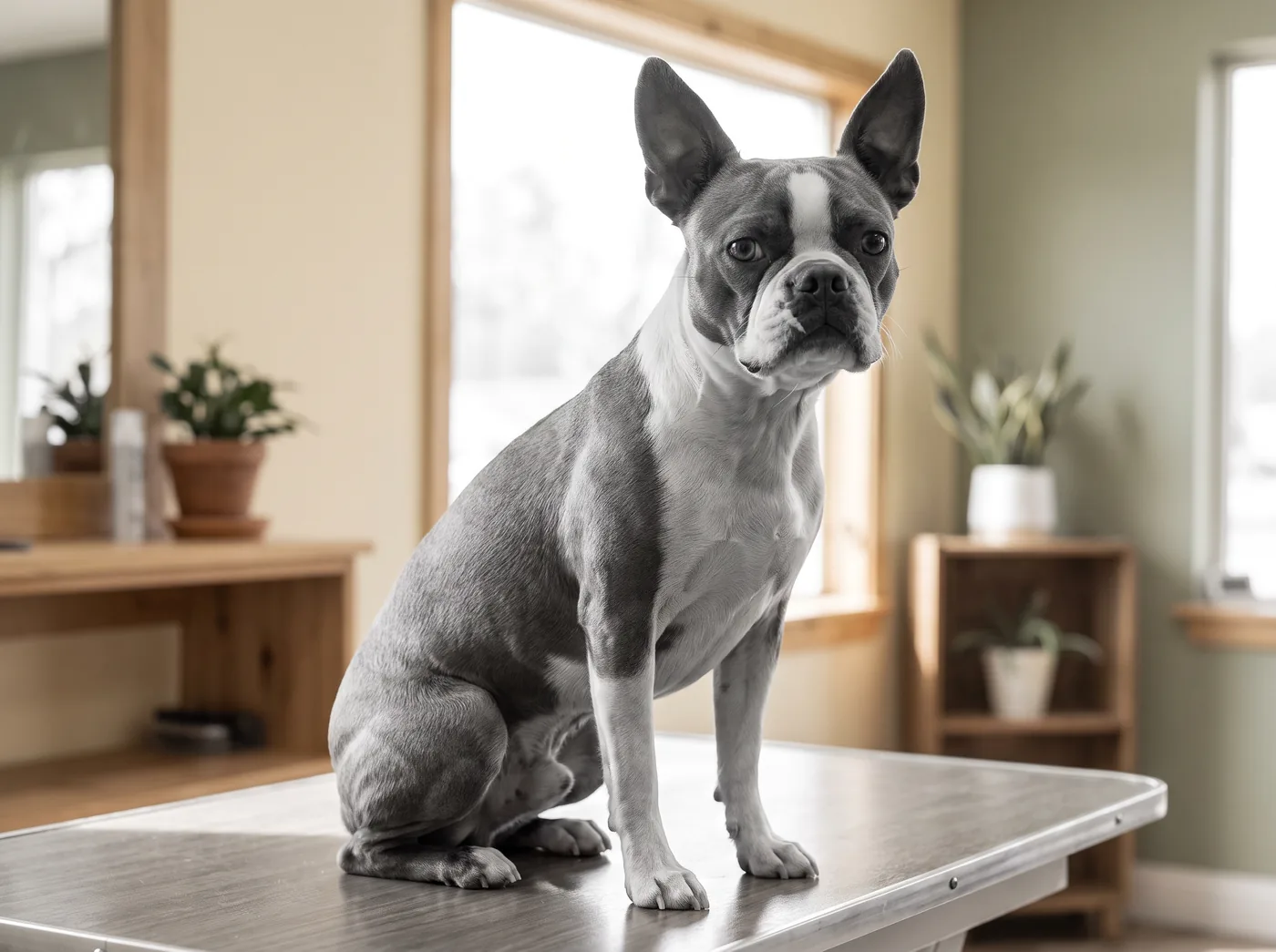
About the Boston Terrier
The Boston Terrier has one of the lowest maintenance coats there is: very short, fine, smooth and single, lying tight to the body with no undercoat and nothing to cut, comb or untangle. Ten minutes a week covers it completely, and a great many Bostons never see a professional groomer at all.
What the breed does carry is a compressed skull, and everything that follows from it. The Boston is brachycephalic, though less extremely so than a Pug or a French Bulldog, and it shares their difficulty with heat, their sensitivity around drying, and a small facial wrinkle that needs keeping clean.
It also has the most exposed eyes of the three. Large, round and set in shallow sockets facing slightly outward, they are injured far more easily than most breeds, and that is genuinely the thing most worth knowing before booking any appointment.
The coat, which is as easy as it gets
Short, fine, smooth and genuinely single. There is no undercoat, which puts the Boston with the Boxer and the Doberman rather than with the short-but-double breeds like the Pug.
That distinction is the reason a Boston sheds so much less than a Pug of similar size. There is no dense undercoat cycling and releasing, only a light steady drop of fine guard hairs. Owners who have had both are usually surprised by the difference.
A rubber grooming mitt once a week is the entire routine. It lifts the loose hair, spreads the skin oils and puts a shine on the coat, and most Bostons enjoy it.
A bath every six weeks or so, or when the dog needs one. Over bathing a fine single coat dries the skin, and this is a breed with a reasonable amount of allergic skin disease already.
There is no seasonal blow, no dematting, no haircut and no interval to keep. If the coat were the whole story this would be one of the least demanding dogs anywhere, which is exactly why the rest of this page is about the face.
The flat face, the wrinkle and the heat
A Boston has a shortened muzzle, which narrows the airway, and dogs cool themselves by moving air across wet surfaces when they pant. A dog that cannot move air efficiently cannot cool efficiently.
Bostons are moderately affected rather than severely, and many are noticeably more comfortable than a Pug or a Frenchie. That is a matter of degree rather than a difference in kind, and the precautions are the same.
At the salon: warm rather than hot water, a dryer on low or cool and never pointed at the face, short bursts with breaks, and absolutely no cage dryer. An enclosed box of warm moving air containing a dog that cannot cool itself is how flat faced dogs die at groomers, and any salon should be able to say plainly that they do not use one on brachycephalic breeds.
At home: avoid the middle of the day in summer, use a harness rather than a collar so nothing presses on the airway, and treat noisy laboured breathing, a widening tongue or any change in gum color as an emergency.
The facial wrinkle above the nose is smaller than a Pug's and often shallow enough to need little, but it still wants wiping and drying a few times a week. Some Bostons have a deeper fold and those need it daily.
The eyes, which are the real vulnerability
This is the part of Boston Terrier care that deserves the most attention and gets the least.
The eyes are large, round and prominent, set in shallow sockets and angled slightly outward, and the shortened muzzle removes the protective ridge a longer nosed dog has. The result is an eye that sits exposed and is injured by things that would never trouble another breed: a bramble on a walk, a cat, a rough carpet, a toy, or a groomer's hand moving quickly near the face.
Corneal ulcers are common in the breed and they escalate fast. The signs are squinting, holding an eye closed, pawing or rubbing at the face, excessive watering, redness, or any cloudiness on the surface. Every one of those is a same day veterinary matter, not a wait and see.
Bostons are also prone to dry eye, where insufficient tear production leaves the surface unprotected and a thick discharge builds up, and to cataracts, including a juvenile form that appears in young dogs.
Practically, at grooming time: nothing is sprayed toward the face, shampoo is kept well away, the face is wiped with a damp cloth instead, and nobody works quickly around the head. Ask for that explicitly.
Wipe under each eye daily to keep discharge from building up, and look at both eyes properly while you do it. On this breed that is the most valuable thirty seconds of the routine.
Skin, ears, nails and the rest
Bostons have a reasonable amount of allergic skin disease, showing as itching, licking the paws, a rash in the armpits or groin, and recurrent ear trouble. Because the coat is so short it is all visible early, which is useful. A dog that is licking its feet raw or scratching persistently needs a veterinarian rather than a soothing shampoo.
The ears are large, upright and open, which is the good news: airflow is excellent and primary ear infections are uncommon. When a Boston does get recurring ear trouble it is usually a symptom of allergy rather than an ear problem in itself, which is worth knowing because treating the ear alone will not hold.
Nails every three to four weeks. A small dog on carpet wears nothing down.
The tail is short and on many Bostons it is a screw or corkscrew tail set into a small pocket of skin. That pocket is exactly like any other fold: warm, enclosed and prone to getting sore. Check it and clean it weekly, because it is easy to miss entirely.
Teeth matter here as in any small breed with a shortened jaw, since crowding and misalignment are common and dental disease follows.
And flatulence, which is a genuine feature of the breed and comes largely from swallowing air while eating with a short muzzle. A slow feeder bowl helps more than any diet change.
What to tell your groomer
Say the dog is flat faced and ask what they do differently. The answer should include low or no heat, no cage dryer and someone watching the dog.
Say the eyes are prominent and easily damaged, and ask that nothing is sprayed near the face and that the head is handled slowly. This is the single most important instruction for this breed.
Ask for the nails, which is the main practical value of the appointment.
Ask them to check the tail pocket, since plenty of owners do not know it is there.
Mention any skin or allergy history, and any breathing difficulty or heat trouble.
And book early in the day in summer.
Keeping the coat between grooms
Look at the eyes properly
Thirty seconds, wiping under each. Squinting, pawing, redness or cloudiness is a same day vet visit on this breed.
Daily
Mitt the coat
A rubber grooming mitt once a week is genuinely the whole coat routine on a fine single coat.
Weekly
No heat, no cage dryer
A flat faced dog cannot cool itself by panting. Cool air, short bursts, and never enclosed in a warm box.
Any bath
Check the tail pocket
A screw tail sits in a small fold of skin that behaves like any other fold. Easy to miss entirely.
Weekly
Common Questions About the Boston Terrier
Do Boston Terriers shed?
Lightly, and much less than a Pug of similar size. The Boston coat is fine, short and genuinely single with no undercoat, so there is no dense layer cycling and releasing and no seasonal blow out, just a steady light drop of fine hairs. A rubber mitt once a week takes out most of it. Owners who have had both breeds are usually struck by the difference, and it comes down to the undercoat rather than to coat length.
Is a Boston Terrier the same as a French Bulldog to look after?
Similar in principle, easier in practice. Both are flat faced, so both need the same care around heat, drying and no cage dryer. But a Boston is less extremely brachycephalic and generally breathes more comfortably, has a lighter single coat where a Frenchie has a denser one, and has far shallower facial folds. What a Boston has more of is eye exposure: the eyes are larger, rounder and more prominent, and corneal injuries are notably common.
Why does my Boston Terrier eye keep watering?
Take it seriously rather than wiping it. Boston eyes are large, prominent and shallowly set with little protection from the shortened muzzle, so corneal ulcers are common and escalate quickly. Watering with squinting, pawing at the face, redness or any cloudiness is a same day veterinary matter. Persistent watering with a thick discharge can also be dry eye, where the dog does not produce enough tears to protect the surface, which needs diagnosis and lifelong treatment.
Similar breeds
Same coat, same schedule, or the breeds this one is crossed from.


Pug
A small dog that sheds like a much larger one, and a face fold that is the actual appointment
PugFind a groomer who knows this coat
Search 37,863 groomers by town, or keep reading the breed guide.
Find a Local Groomer View All Breeds