Briard Grooming
A long goat textured coat, and two dewclaws on each back leg that must be trimmed
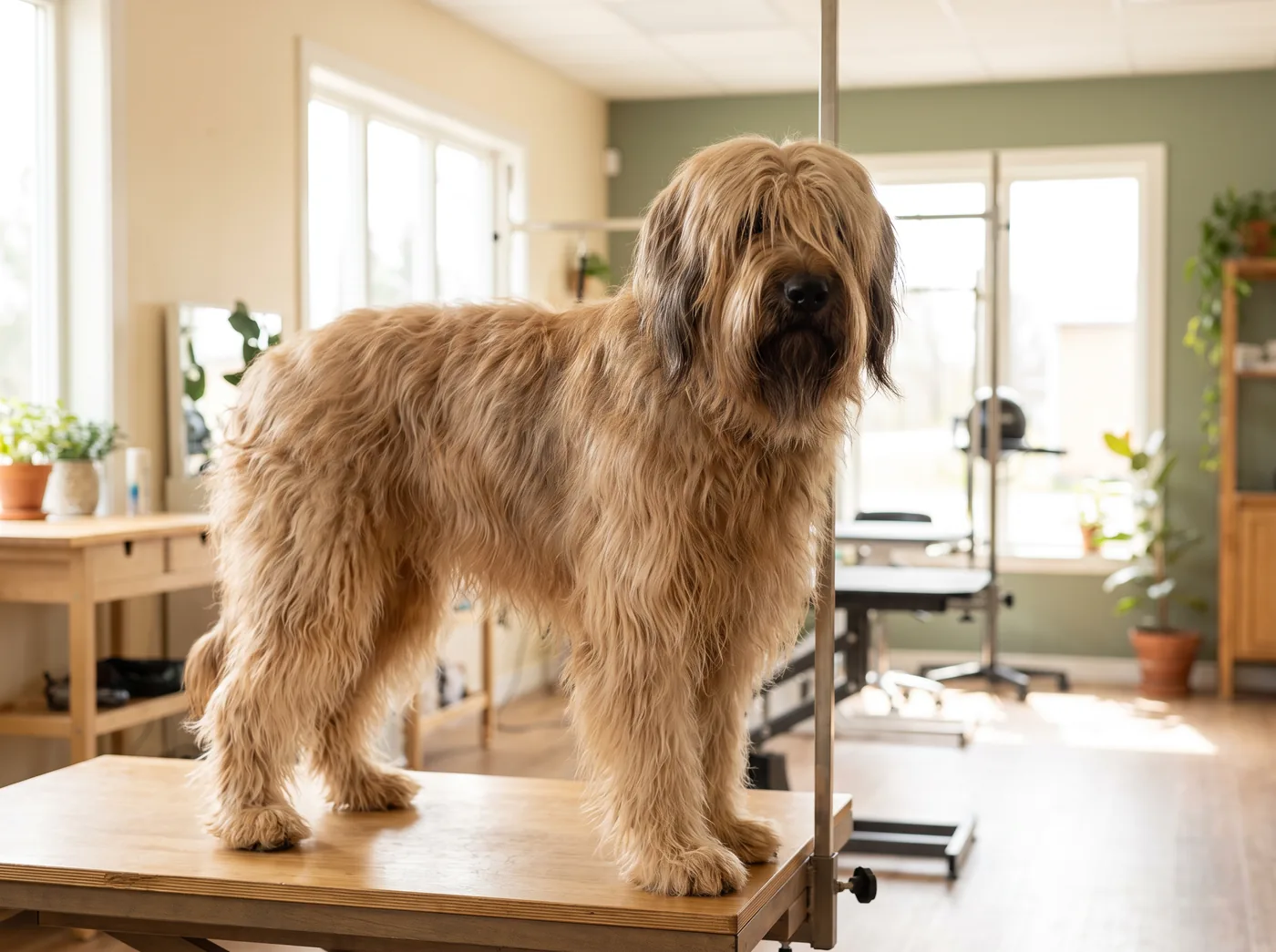
About the Briard
A Briard carries a long, coarse, dry coat that the standard describes as goat like, and that is a precise description rather than a poetic one. It is not soft, it is not silky, and it does not behave like the Old English Sheepdog coat it superficially resembles.
Underneath the coarse outer layer there is a fine dense undercoat, and the combination is what makes this breed mat as badly as anything alive. The outer coat is dry enough to grip, so shed hair is held rather than dropped, and it felts against the skin while the surface still looks brushed.
The other thing to know is on the back legs. Every Briard has two dewclaws on each hind leg, required by the standard, and they are a grooming job in themselves.
This coat can be clipped, but the texture or the color may change and it will not always come back the same. Talk it through with your groomer before the first one.
The double dewclaws, which nobody warns you about
Briards carry two dewclaws on each hind leg, low down near the foot. They are not a defect and they are not removed: the breed standard requires them, and a Briard without them cannot be shown.
Practically they are a maintenance item, because they never touch the ground and therefore never wear down.
A dewclaw that is not trimmed keeps growing in a curve, and eventually the tip curls back into the skin of the leg. That is painful, it becomes infected, and it happens quietly under a long coat where nobody is looking. It is one of the commonest avoidable injuries in the breed.
So check all four hind dewclaws every time you do the nails, which should be every three to four weeks, and part the coat to find them rather than assuming you would have noticed.
The second dewclaw on each leg is often loosely attached and moves, which makes it easy to catch on undergrowth, bedding or a crate door. A torn dewclaw bleeds a lot and needs a veterinarian.
Say this to a groomer at the first appointment. Plenty have never met a breed with double hind dewclaws and will trim four nails per foot and stop.
Keep the hair around them trimmed short so they can be seen and so debris does not pack in around them.
A goat coat, and why it mats so deep
The outer coat is long, coarse, dry and slightly wavy, with a natural resistance to water and dirt. Underneath is a fine dense undercoat. Both keep growing, which is what separates a Briard from a Husky or a German Shepherd.
That combination produces matting that is unusually severe. The coarse dry outer hair grips shed undercoat instead of releasing it, and the mat forms at the skin and grows outward, so the coat looks fine from above until a comb goes in.
Line brushing is the only method that works. Part the coat in a horizontal line, brush the hair below the parting downward with a slicker or a long pinned brush, then move the parting up an inch and repeat, working from the feet upward and from the rear forward. It is slow, and the alternative is a shave down.
Then prove it with a comb. If a metal comb will not pass from skin to tip in a section, that section is not brushed however good it looks.
Every two or three days for a coat kept long, and expect an hour when you do it properly.
The places that fail first: behind and under the ears, the beard, the armpits, the britches on the back legs, around the tail and under any collar or harness.
Long or shorter, and being realistic about it
A Briard in full show coat is a serious commitment: several hours of line brushing a week, a professional groom every eight to ten weeks, and no room to let it slide.
A shorter working trim, taking the coat down to a couple of inches all over while leaving the head furnishings, is entirely legitimate and is what most companion Briards wear. It reduces the brushing to something manageable and does not harm the dog.
Clipping does change the coat. Because there is an undercoat, a clipped Briard can come back softer and denser, and a soft coat mats more readily than the harsh one it replaced. That is a real cost and it is still usually better than a pelted dog.
The head is the part to think about. The standard has long hair falling forward over the eyes, and the breed genuinely sees through it. Owners often ask for it trimmed back and there is no welfare reason not to, but say what you want clearly, because a groomer who knows the breed will leave it and a groomer who does not will cut it off.
The beard and mustache collect food and water at every meal and need combing daily and washing often, exactly as on any bearded breed.
Whatever length you choose, keep the feet, the sanitary area and around the dewclaws short.
Bathing, drying and the size problem
A wet Briard is a large heavy dog carrying a great deal of water in a coat that resists giving it back.
Comb the whole dog out before the bath, without exception. Water tightens a mat the way it tightens a knot, so anything felted that goes into a bath comes out worse and can no longer be brushed out humanely. A groomer who bathes first and dematts second is working in the wrong order.
Bathe every eight weeks or so, and dry with a high velocity dryer while brushing. A dense double coat left damp at the skin grows yeast and hot spots, and on a dog this size the chest, armpits and britches are what stay wet.
Expect a full groom to take two and a half hours or more, and expect it to be priced accordingly. This is one of the more expensive breeds to keep properly.
Briards are a slow maturing, sometimes reserved breed that was bred to work independently, so early and frequent handling matters. A dog that is comfortable being brushed, having its feet held and its dewclaws checked from puppyhood is a completely different proposition at eighty pounds.
The coat also changes around a year old, and that transition is when many Briards mat badly for the first time.
What to tell your groomer
Say there are two dewclaws on each back leg and ask for all of them trimmed, because plenty of groomers have never seen a breed with them.
Ask for the hair around the dewclaws kept short so they stay visible.
Say whether you want the coat long or in a shorter working trim, and give a length.
Say clearly whether the fall over the eyes is to be left or trimmed back, because both are defensible and the default varies by groomer.
Ask for line brushing and a comb check rather than a surface brush, and expect two and a half hours or more.
Say the dog must be combed out before the bath, never bathed and dematted after.
Keeping the coat between grooms
Check all four hind dewclaws
Two per back leg. They never wear down and they grow into the leg if left.
Every three to four weeks
Line brush, do not sweep
Part, brush below the parting, move up an inch. The only method that reaches skin.
Every two to three days
Comb the beard daily
It sits in food and water at every meal, like every bearded breed.
Daily
Comb out fully before any bath
Water tightens a mat. Bathing a felted coat makes it impossible to save.
Every eight weeks
Common Questions About the Briard
Why does my Briard have two dewclaws on each back leg?
Because the breed standard requires them. It is a defining feature rather than a defect, and Briards are not shown without them. They matter for grooming because hind dewclaws never touch the ground and so never wear down: left untrimmed they curl round until the tip grows into the skin of the leg, which is painful, gets infected, and happens hidden under a long coat. Check all four every time you do the nails, every three to four weeks, and keep the hair around them short so you can see them.
How often does a Briard need brushing?
Every two or three days if the coat is kept long, and properly rather than quickly, which means line brushing: part the coat, brush the hair below the parting, move the parting up an inch and repeat. Expect an hour. The Briard coat is coarse and dry over a fine undercoat, so it grips shed hair instead of dropping it and mats at the skin while the surface still looks brushed. Prove it with a metal comb, since a comb that will not reach skin means that section is not done.
Should I trim the hair over a Briard's eyes?
It is your call and both answers are defensible. The standard calls for long hair falling forward over the eyes and the breed sees through it perfectly well, so there is no welfare reason to cut it. Plenty of companion owners trim it back anyway and the dogs are fine. What matters is saying which you want, clearly, at the appointment: a groomer who knows the breed will leave it untouched by default and one who does not will trim it off without asking.
Similar breeds
Same coat, same schedule, or the breeds this one is crossed from.

Old English Sheepdog
The one herding coat most owners genuinely do keep clipped, and why that is defensible
Old English Sheepdog
Bouvier des Flandres
A harsh tousled double coat that is stripped or scissored, and a beard that soaks
Bouvier des Flandres
Great Pyrenees
A white weatherproof coat built to live outdoors, on a dog that must not be clipped
Great PyreneesFind a groomer who knows this coat
Search 37,863 groomers by town, or keep reading the breed guide.
Find a Local Groomer View All Breeds