Bullmastiff Grooming
A mastiff built to move, with all of the face and rather less of the weight
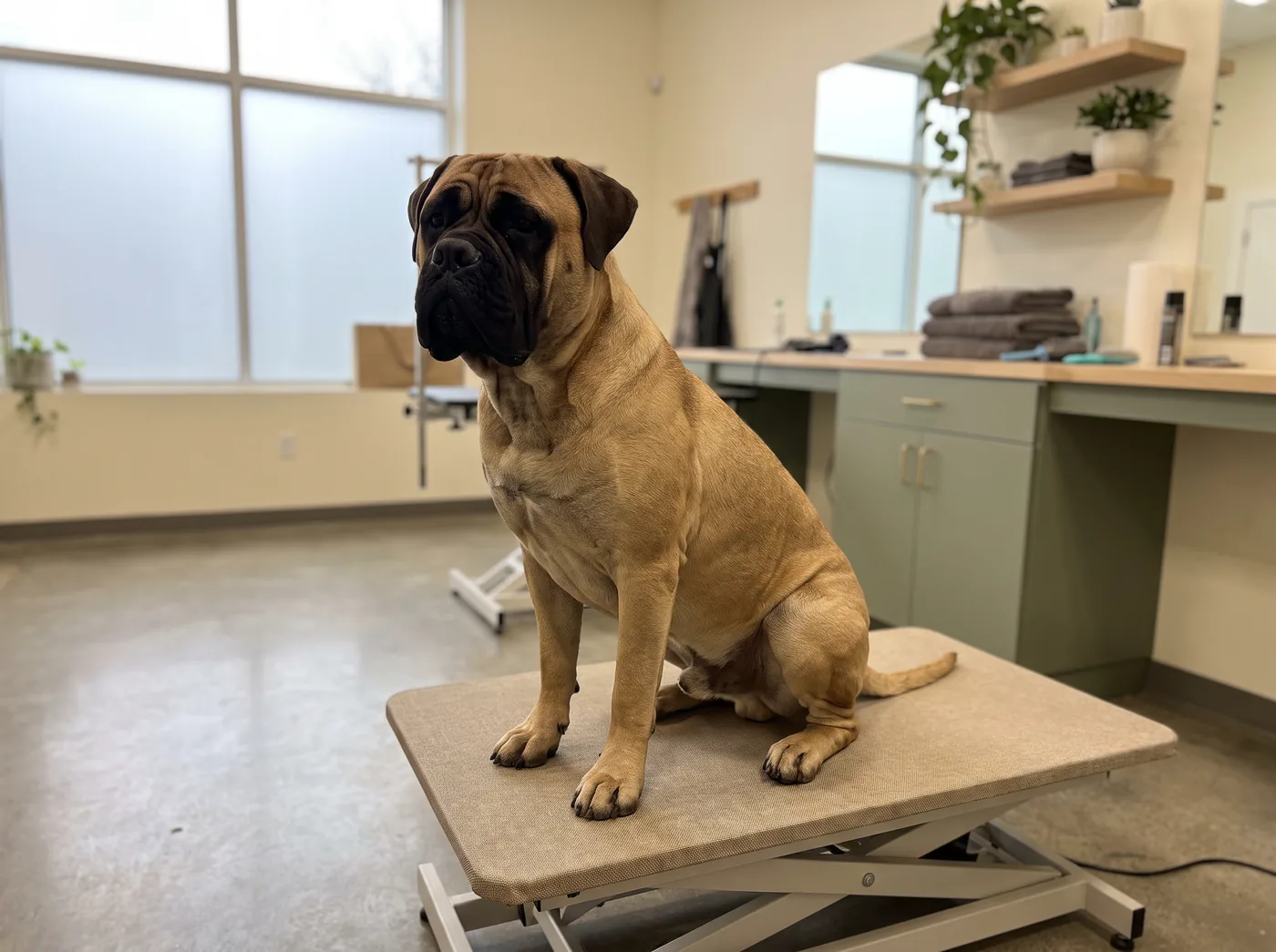
About the Bullmastiff
The Bullmastiff was created in Victorian England by crossing the Mastiff with the bulldog of the day, to produce a gamekeeper's dog fast enough to catch a poacher and powerful enough to hold him without biting. It is a mastiff built to move.
What that means practically is a dog that is lighter and considerably more athletic than a Mastiff, at a hundred to a hundred and thirty pounds rather than two hundred, but which kept the mastiff head: a broad skull, a shortened muzzle, heavy hanging flews and folds across the brow.
The coat is short, dense and takes ten minutes a week. Everything on this page is about the face, the drool and the heat, because a shortened muzzle on a very large heavily muscled dog is a worse combination for cooling than either problem alone.
Heat, which is the real risk
A Bullmastiff has a shortened muzzle, so it cannot move air across the wet surfaces of its airway as efficiently as a long nosed dog. It is nowhere near as compromised as an English Bulldog, but it is meaningfully affected, and it carries that limitation on a hundred and twenty pound body producing a great deal of heat.
That combination is worse than either factor alone. A large dog has less surface area relative to its mass to shed heat through, and a shortened muzzle takes away the main cooling mechanism.
So this is a breed that overheats, and it does so faster than its size suggests.
At the salon: warm rather than hot water, a dryer on cool or low and never at the face, short bursts with breaks, someone watching the dog rather than a timer, and no cage dryer. An enclosed box of warm moving air around a dog that cools poorly is how brachycephalic dogs die at grooming salons, and the extra body mass here makes it worse rather than better.
Book the first appointment of the day in summer.
At home: walks at the ends of the day, a hard rule about cars and conservatories, and cool floors available.
Increasing effort, a widening or bluish tongue, a change in gum color or any distress means stopping immediately.
Bullmastiffs are also prone to bloat as a deep chested breed, so no vigorous handling around a large meal.
The flews, the folds and the drool
The heavy hanging upper lips produce a great deal of saliva, and how much a given dog drools depends almost entirely on how loose those flews are.
The problem is not the furniture. It is that saliva keeps the skin under the jaw, along the lower lip and inside every facial fold permanently damp, and damp skin in an enclosed fold reddens, smells, grows yeast, and eventually becomes raw and painful.
Wipe the flews, under the jaw and into each fold with a damp cloth daily, and then dry them. The drying is the half that gets skipped and the half that decides the outcome.
Work through the whole list rather than just the obvious one: the fold across the brow above the eyes, the wrinkles beside them, the lip folds at the corners of the mouth, and the loose skin under the jaw and at the throat.
Anything red, sore, weeping or persistently smelly needs veterinary treatment before a cleaning routine will hold.
The eyes sit within those folds and can be affected by them: entropion, where a lid rolls inward and lashes rub the cornea, occurs in the breed and needs surgical correction. Squinting, watering or a dog holding an eye closed is a veterinary matter.
And a sudden increase in drooling is a veterinary sign rather than a grooming one. In a deep chested giant it can mean bloat, so restlessness, a distended abdomen or unproductive retching needs immediate attention.
The coat, the skin and the size
The coat routine is a rubber curry or grooming mitt once a week, in circles then along the lie. It sheds moderately and steadily with a heavier drop in spring, and the surface area of the dog means the total volume is more than the length suggests. A deshedding bath in spring is where a salon adds value on a coat with nothing to cut.
A bath every couple of months, and over bathing dries the skin.
On size: a Bullmastiff is smaller than a Mastiff but it is still a giant breed and still needs a floor level table or a walk in bath, and it still cannot be lifted. Ask before booking. Two people is normal.
Pressure calluses appear on the elbows and hocks as on any heavy dog, and thick orthopedic bedding in every room the dog uses does more than any cream. A cracked callus is painful and infects; a soft fluid filled swelling over an elbow is a hygroma and needs a vet.
Nails are thick and grow fast, and they are the job most often left because doing them on a dog this strong is awkward. Every three to four weeks, and start the handling in puppyhood, because a Bullmastiff that will not have its feet touched is a permanent problem.
Ears are small drop ears and want a weekly lift and smell.
A guardian breed, and a short life
The Bullmastiff was bred to confront and hold a person, and it retains the temperament that requires: confident, independent, protective of its own property and people, and reserved with strangers. It is typically quieter and less reactive than a Cane Corso, and it is still a hundred and twenty pound guardian.
The practical consequences are the same as for any large guardian. Be honest with a salon about how the dog is with strangers and with other dogs. Handle the feet, ears and mouth daily from eight weeks. Book short pointless visits early so the building is familiar. And accept that force is not an option: a Bullmastiff that has decided it is finished simply stops, and there is no persuading it physically.
The other thing worth stating plainly is the life span. Bullmastiffs commonly live only seven to nine years, which is short even by giant breed standards, and cancer rates in the breed are high.
That changes the calculus on two things an owner controls. Keep the dog lean, because weight loads joints and a heart already working hard on a short timeline. And take lumps seriously: on a coat this short they are easy to find during a weekly curry, and a groomer running hands over the dog will find them too.
Grow puppies slowly. Fast growth on a giant frame damages joints permanently.
What to tell your groomer
Say the dog is partly flat faced and ask directly whether they use a cage dryer on brachycephalic breeds. The answer must be no, and the size makes it more important rather than less.
Give the actual weight and ask whether they have a floor level table or walk in bath.
Ask for every fold cleaned and dried: brow, eyes, lips, jaw and throat.
Ask for a deshedding bath in spring rather than a plain wash.
Point out any calluses or lumps, and say honestly how the dog is with strangers and other dogs.
Book early in the day in summer, and mention when the dog last ate.
Keeping the coat between grooms
Wipe and dry the flews and folds
Brow, eyes, lips, jaw and throat. Saliva keeps that skin damp, and the drying is the half that matters.
Daily
No heat and never a cage dryer
A shortened muzzle on a hundred and twenty pound body cools badly. The size makes this more important, not less.
Any bath
Feel for lumps while you curry
A short coat makes them easy to find, and this breed has a short life and high cancer rates.
Weekly
Clip the nails
Thick, fast growing and awkward on a dog this strong. Start the handling in puppyhood or it never happens.
Every three to four weeks
Common Questions About the Bullmastiff
How is a Bullmastiff different from a Mastiff?
It was created by crossing the Mastiff with the bulldog of the day to make a gamekeeper's dog fast enough to catch a poacher, so it is lighter and considerably more athletic: a hundred to a hundred and thirty pounds against two hundred or more. It kept the mastiff head, so the folds, flews and drool are much the same. Grooming is nearly identical, but a Bullmastiff is more manageable to bathe and handle simply because there is less of it.
Do Bullmastiffs overheat easily?
Yes, and faster than the size suggests, because two things stack. The shortened muzzle limits how efficiently the dog can cool itself by panting, and a large heavily muscled body produces a lot of heat with proportionally less surface area to lose it through. It is far less severe than an English Bulldog but genuinely significant. No cage dryer, cool or low heat only, short bursts, early appointments in summer, and walks at the ends of the day.
Do Bullmastiffs shed?
Moderately and steadily with a heavier drop in spring, and more in total than the short coat suggests because there is a great deal of dog producing it. A rubber curry once a week handles most of it, and a deshedding bath in spring is where a salon adds real value on a coat with nothing to cut. There is no matting and no reason to clip one.
Similar breeds
Same coat, same schedule, or the breeds this one is crossed from.

English Mastiff
The heaviest dog a salon will ever handle, where the logistics and the drool are the whole job
English Mastiff
Cane Corso
A ten minute coat on a hundred pound dog, where the handling is the entire appointment
Cane CorsoFind a groomer who knows this coat
Search 37,863 groomers by town, or keep reading the breed guide.
Find a Local Groomer View All Breeds