Chihuahua Grooming
Two coats in one breed, and a dog small enough that the handling matters more than either
About the Chihuahua
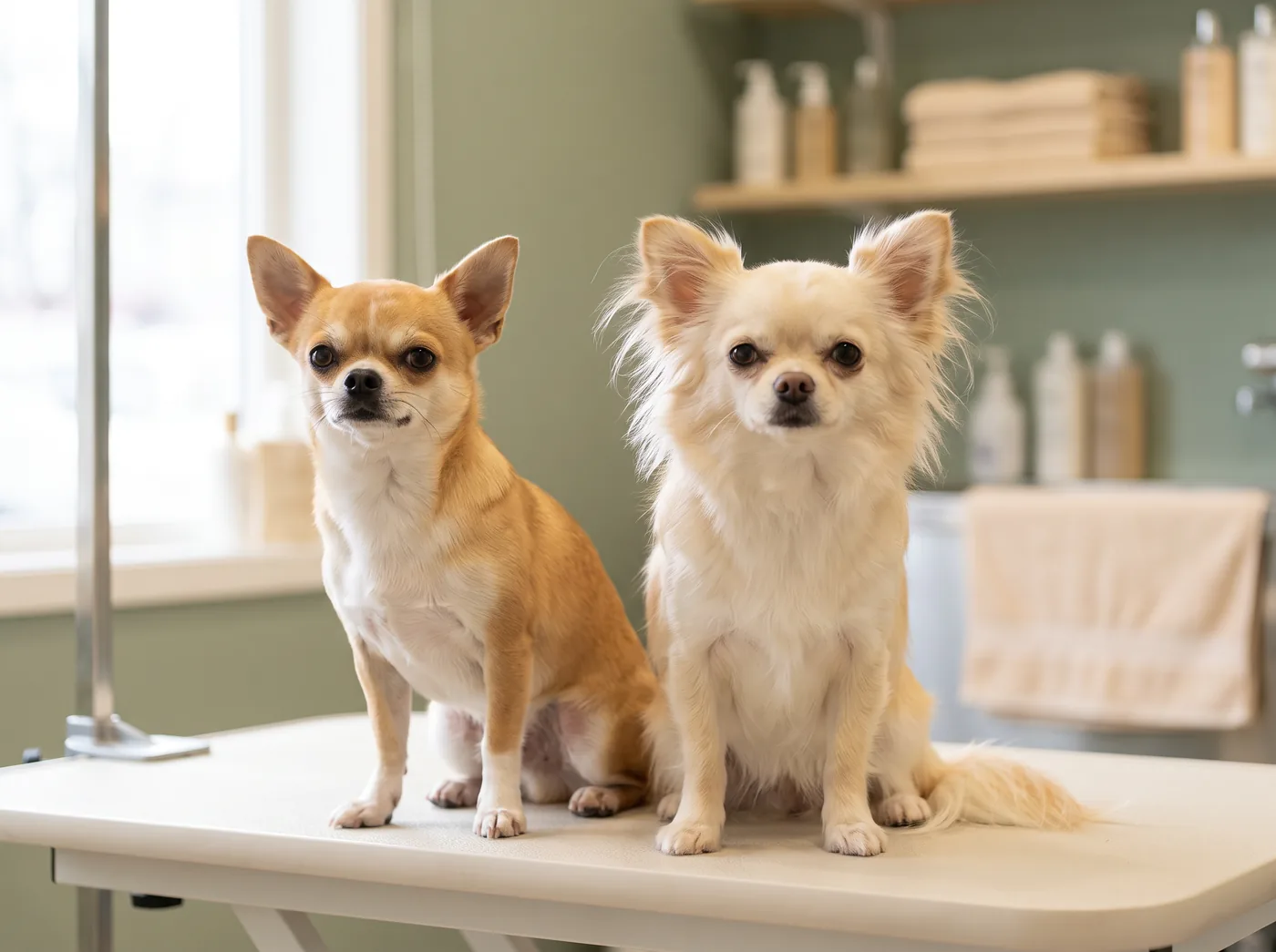
The Chihuahua comes in two coats that can appear in the same litter, and the split is a genuine one rather than a marketing distinction. The smooth coat is very short, close lying and glossy. The long coat is soft and slightly wavy, with feathering on the ears, the backs of the legs, the tail and a small ruff at the neck.
Neither is hard work. Both shed moderately, neither mats badly, and neither needs a haircut. A Chihuahua of either coat can be kept well at home by an owner who does ten minutes a week, and a good many never see a professional salon at all.
What does need attention has almost nothing to do with the coat. This is a three to six pound dog with a full sized set of teeth crowded into a very small jaw, no meaningful insulation, and bones that a fall from a grooming table will break. The rest of this page is about those.
This coat can be clipped, but the texture or the color may change and it will not always come back the same. Talk it through with your groomer before the first one.
Two coats, and which one is actually easier
Both varieties are the same breed and the same standard, differing only in coat, and both can be born in one litter. The long coat is recessive, so two smooth parents that both carry it can produce long coated puppies.
The smooth coat is short, hard and close lying, often with a small ruff at the neck. It needs a rubber mitt once a week and nothing else. It sheds a little more noticeably than people expect, because the hairs are short and stiff and show up on dark clothing.
The long coat is soft, flat or slightly wavy, with feathering on the ears, the backs of the legs and the tail, and a fuller ruff. It needs a comb through once or twice a week, concentrating on the feathering and behind the ears, which are the only two places it will ever mat. It sheds a little less visibly because the longer hairs tend to stay in the coat until combed out.
Counterintuitively, most owners find the long coat easier to live with. The shedding is less obvious, the feathering takes five minutes, and there is nothing to cut. Neither variety should be clipped short as a routine matter, though a long coat can reasonably have the sanitary area, the paw pads and any straggly feathering tidied.
The rest of the routine is identical for both, and it is where the real work is.
The teeth, which are the real health issue in this breed
If you do one thing on this page, do this one. Dental disease is the most common and most under treated health problem in toy breeds, and the Chihuahua is among the worst affected.
The reason is mechanical. Selective breeding shrank the jaw far faster than it reduced the number of teeth, so a Chihuahua carries essentially the same dentition as a Labrador in a fraction of the space. The teeth crowd, overlap and rotate, food and plaque pack into gaps a brush struggles to reach, and tartar builds fast. Retained baby teeth are common and make the crowding worse.
Left alone, the sequence is tartar, then gum inflammation, then bone loss, then loose and lost teeth, in a dog that will live fourteen years and could spend half of them with a sore mouth. Advanced dental disease in a small dog can also fracture the jaw, because there is so little bone left holding the teeth.
Daily brushing with a dog toothpaste is the only thing with real evidence behind it. Start young, keep it brief, and make it routine rather than a fight. Dental chews and additives help a little and replace nothing.
Expect professional cleanings under anesthesia to be part of this dog's life, and budget for them. A groomer cannot do this: hand scaling a conscious dog removes visible tartar and leaves the disease under the gum line, which is where it matters.
Handling a five pound dog safely
Size changes the appointment more than coat does, and this is the smallest breed there is.
A grooming table is roughly a meter off the ground, which for a Chihuahua is a fall that breaks legs. A dog this size is never left on a table unattended, not for a second, and a groomer who steps away from one is telling you something. Many small dogs are worked on a lap or a low surface for exactly this reason.
The legs themselves are fine boned and break easily, and luxating patella is common in the breed, so a leg should never be pulled straight or held in an awkward extension while nails are done. A dog that yelps when a leg is moved needs a veterinarian rather than more restraint.
Many Chihuahuas are also wary of strangers and handle badly on a table, which is worth being honest about rather than embarrassed by. It is partly the breed and largely the fact that small dogs get picked up and moved around without consent all day, so they learn that hands mean loss of control. The fix is the same as for any breed: brief, frequent, unremarkable handling of the feet, face and ears at home, starting young.
And the molera, the soft spot on the skull that many Chihuahuas keep into adulthood. It is normal in the breed and not a defect, but it means the top of the head is not fully protected by bone and should not be pressed or knocked.
Cold, nails and the small things
A Chihuahua gets cold, and for once the sweaters are not a joke. A tiny body has a large surface area relative to its volume, there is almost no fat, and neither coat variety offers much insulation. Shivering, refusing to go out and hunching are real signals. A fitted coat in cold or wet weather is sensible, and so is a warm bed, preferably one the dog can burrow into, since most Chihuahuas will dig into a blanket given the chance.
Nails need doing every three to four weeks and they are the job owners most often leave too long. A dog this light wears nothing down at all, even on pavement. Long nails push the toes sideways and change the dog's posture, which matters on a breed already prone to knee trouble. Take a very small amount frequently rather than a lot occasionally: the quick grows out with the nail, so on a badly overgrown nail you cannot shorten it in one go without cutting into it.
Ears are upright and open on both varieties, which is the good news, and they mostly need nothing beyond a weekly look. Long coated dogs grow feathering around the ear that can trap debris.
Eyes are large and reasonably prominent and can water. A daily wipe under each eye prevents staining on cream and white dogs; any squinting or sudden discharge is a veterinary matter.
Anal glands come up more in small breeds than large ones. Scooting or excessive licking is the sign; a groomer or a veterinarian can deal with it, and nobody should be expressing them routinely without a reason.
What to tell your groomer
Say which coat the dog has, because a smooth is a mitt and a long is a comb, and say if you want the long coat feathering tidied or left.
Say the dog must not be left on a raised table unattended. Any decent groomer already works this way with toy breeds and will not take offense at hearing it.
Mention any knee trouble or a history of limping, so the legs are handled gently and never extended for convenience.
Ask them to look at the teeth and tell you honestly what they see, then take that to a veterinarian. Groomers see a lot of mouths and are often the first to notice.
Say honestly how the dog is with strangers. A wary Chihuahua handled patiently is fine; a wary Chihuahua rushed is a bite, and it is the small dogs that get labeled difficult when the real problem was the pace.
Keeping the coat between grooms
Brush the teeth
The single most important item on this page. A full set of teeth in a tiny jaw crowds, and dental disease is the breed's biggest health problem.
Daily
Clip the nails, little and often
A dog this light wears nothing down. Long nails push the toes sideways on a breed already prone to knee trouble.
Every three to four weeks
Mitt the smooth, comb the long
A rubber mitt for a smooth coat. For a long coat, a comb through the ear, leg and tail feathering, which is the only place it mats.
Weekly
Keep the dog warm
Almost no fat and not much coat on a tiny frame. The sweaters are practical rather than decorative.
Cold weather
Common Questions About the Chihuahua
Is a smooth or long coated Chihuahua easier to groom?
They are close, and most owners find the long coat marginally easier to live with. The smooth needs a rubber mitt once a week and nothing else, but the short stiff hairs show up on clothing and furniture. The long coat needs a comb once or twice a week through the ear, leg and tail feathering, which is the only place it mats, and the shedding is far less visible. Neither needs a haircut and neither should be clipped short as routine.
Does a Chihuahua need professional grooming?
Not for the coat. Both varieties can be kept in good order at home with a weekly brush, a bath every six weeks or so and nails every three to four weeks. Plenty of Chihuahuas never see a salon. Where a groomer earns their money is nails, which owners of tiny dogs frequently leave far too long, and a bath done properly with a full dry. Book one if you want those done well, not because the coat demands it.
Why does my Chihuahua shiver?
Usually because it is genuinely cold. A three to six pound dog has a large surface area for its volume, almost no body fat and not much coat, so it loses heat fast and both varieties feel it. A fitted coat outdoors in cold or wet weather and a warm bed to burrow into usually solves it. Shivering can also be excitement, stress or, less often, low blood sugar in very small or young dogs, so shaking that comes with weakness or wobbliness is a veterinary matter rather than a warmth one.
Similar breeds
Same coat, same schedule, or the breeds this one is crossed from.

Pomeranian
A northern double coat on a five pound dog, and the breed shave downs ruin most often
Pomeranian
Dachshund
One breed with three completely different coats, and three different appointments
DachshundFind a groomer who knows this coat
Search 37,863 groomers by town, or keep reading the breed guide.
Find a Local Groomer View All Breeds