Norwegian Forest Cat Grooming
A weatherproof double coat on a cat, with a spring blow that startles owners
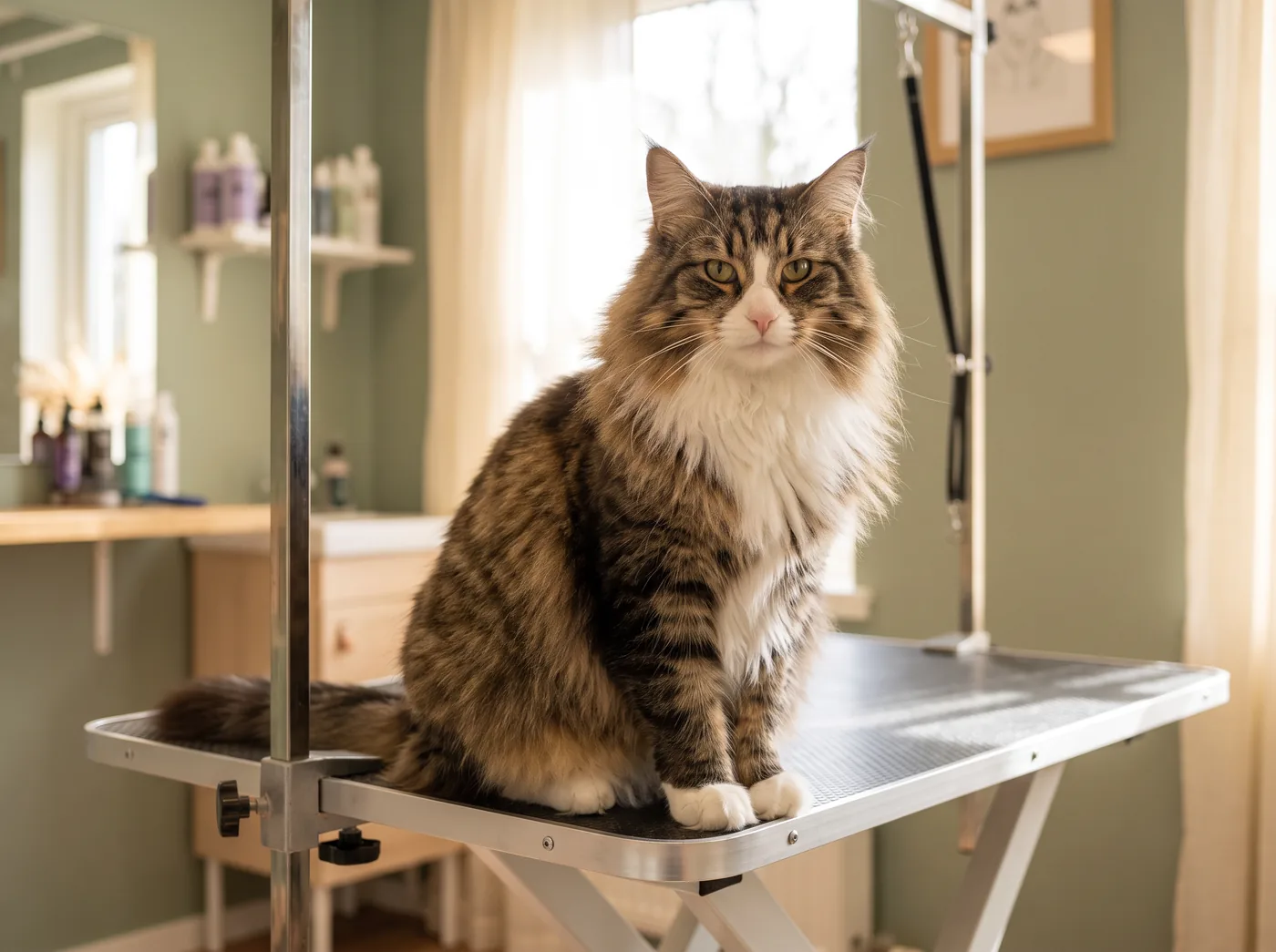
About the Norwegian Forest Cat
The Norwegian Forest Cat carries a genuine weatherproof double coat: a dense woolly undercoat under a long, coarse, water shedding top coat, with a heavy ruff at the chest, tufted ears, feathered britches and an extremely full tail. It is a working farm cat coat from a cold, wet climate and every part of it is doing a job.
That makes it a Maine Coon problem rather than a Persian one, and confusing the two is the most common mistake with the longhaired cats. A Persian coat is fine and silky with little undercoat and it felts. This coat is coarser on top, dense underneath, more water resistant, and it sheds vastly more.
The spring shed is the event that defines owning one, and it genuinely surprises people the first time.
This coat can be clipped, but the texture or the color may change and it will not always come back the same. Talk it through with your groomer before the first one.
What a full groom involves
Closer to a deshedding appointment than anything else, which is the same shape a double coated dog gets.
A comb and rake through dry first, working the ruff, the britches, behind the ears and the belly, which is where this coat actually needs attention. The back and sides are usually fine.
Then a bath, using a shampoo that lifts the undercoat and a conditioner to help it release. This coat is water resistant by design, so getting it genuinely wet to the skin takes longer than on an ordinary cat and is part of why the appointment is not trivial.
Then the dry, on a low setting, which drives the loosened undercoat out while it dries. The coat must come out genuinely dry: it is dense, and damp undercoat left against the skin mats and can cause skin trouble on a cat.
Then combing again to remove what has been freed, then nails, ears, the sanitary area trimmed and the paw tufts cleared, which on this breed grow generously.
Around ninety minutes.
The spring shed, which is a genuine event
Norwegian Forest Cats shed their dense winter undercoat in spring, and on a cat this size with a coat this thick it is not a gentle process. The undercoat releases in clumps over a few weeks and the cat can look uneven and tufted while it happens, particularly around the ruff and the britches.
Owners frequently think something is wrong. Nothing is: it is the same coat blow a Husky goes through and it is the coat working correctly.
What matters is that all of that released undercoat has to go somewhere. If it is not combed out, it stays in the coat, and retained undercoat is exactly what mats. A cat that is left through a spring shed can go from a fine coat to felted britches in a few weeks, which is faster than the same cat would mat at any other time of year.
So comb more often through spring rather than less, and book a deshedding appointment at the start of it rather than after. The dryer does something no amount of home combing matches.
The cat will also swallow a great deal of that hair while self grooming, so hairballs increase at the same time, and combing is the direct fix.
Where it mats, and the rules that apply to every cat
The ruff, the britches, the armpits, the belly and behind the ears. All of them are out of sight when the cat is standing and all of them are places a cat struggles to reach, which is the same list every long coated cat has.
On this breed the britches and the tail are the usual first offenders, because both are long, dense and constantly moving, and the tail sweeps everything.
Check by running a comb through those places weekly rather than by looking at the cat.
Two absolute rules, and they apply to every cat. Never cut a mat out with scissors: cat skin is thin and mobile and lifts into a fold underneath a mat, directly where the blade goes, and the resulting injuries are common, long and serious. And never bathe a matted coat, because water tightens a mat like a wet knot and a coat that could have been combed out sometimes cannot be afterward.
Anything that reduces flexibility accelerates all of it: weight, age, arthritis or a spell of illness. A cat that stops managing its own britches is telling you something.
What moves the price
Size, unusually for a cat. These are big animals and a twenty pound Wegie is a substantial thing to bathe, dry and hold.
Coat condition second: a maintained coat is a comb and a deshed, a felted one takes far longer and may need clipping in places.
Whether it is the spring shed, third, and it is a real difference.
Then the constraint that applies to all cat grooming: fewer salons take cats at all, and scarcity shows in the price.
Temperament is usually in your favor. Norwegian Forest Cats have a reputation for being calm and tolerant, and many are, though a large cat that objects is still a large cat that objects.
What to tell your groomer
Ask for a deshed rather than a haircut. This coat is not clipped as a matter of routine and a groomer reaching for clippers on a healthy Wegie is not the right groomer.
Say the weight, because at the top of the range it changes the booking.
Say if it is spring, and book at the start of the shed rather than after it.
If the cat is genuinely matted and a clip is proposed, that is a reasonable and different conversation. A cat coat does not carry the regrowth risk a dog's double coat does, so a clip to resolve matting is recoverable. It is a fix rather than a routine.
Ask whether they work without sedation and whether the cat can be kept away from dogs, which matters more for cats than most owners expect.
Keeping the coat between grooms
Rake the ruff and britches
A wide toothed comb or undercoat rake through the ruff, armpits, britches and behind the ears. The back looks after itself.
Every two or three days
Comb more in spring, not less
The winter undercoat releases over a few weeks, and anything not combed out stays in the coat and mats.
Through the spring shed
Never scissors on a mat
Cat skin lifts into a fold underneath and sits exactly where the blade goes. Clippers flat to the skin, or a groomer.
Always
Clear the paw tufts
This breed grows generous tufts between the toes that pick up litter and cost grip on a smooth floor.
Every few weeks
Common Questions About the Norwegian Forest Cat
Is a Norwegian Forest Cat the same as a Maine Coon to groom?
Very nearly. Both carry a true double coat with a dense undercoat, both shed heavily, both mat in the ruff, britches and armpits, and both are deshedded rather than clipped. The Wegie coat is slightly more water resistant and its spring shed is often more dramatic. What neither of them is is a Persian: that coat is fine and silky with little undercoat and needs a completely different approach.
My cat is shedding enormously in spring and looks patchy. Is that normal?
Yes. Norwegian Forest Cats drop their dense winter undercoat over a few weeks in spring, and while it happens the coat can look uneven and tufted, particularly at the ruff and britches. It is the coat working correctly. Comb more often through it rather than less, and book a deshedding appointment at the start, because retained undercoat is what turns a shed into a matting problem.
Can a Norwegian Forest Cat be shaved?
Not as a routine. The double coat insulates in both directions and shaving removes the protection without removing much heat. That said, unlike a dog's double coat a cat coat does not carry a serious regrowth risk, so a clip to resolve severe matting is a legitimate fix rather than permanent damage. For a healthy coat, deshedding takes out far more warmth and keeps the coat doing its job.
Similar breeds
Same coat, same schedule, or the breeds this one is crossed from.

Maine Coon
A working double coat on a very large cat, and the same rules a Golden Retriever gets
Maine Coon
Siberian Husky
The coat that shave downs ruin, and the one that needs almost nothing else
Siberian HuskyFind a groomer who knows this coat
Search 37,863 groomers by town, or keep reading the breed guide.
Find a Local Groomer View All Breeds