Saint Bernard Grooming
Two coat lengths on one enormous dog, and a great deal of drool either way
About the Saint Bernard
The Saint Bernard comes in two coat varieties that appear in the same litters, and the difference is length rather than texture. The rough coat is long, dense and heavily feathered on the legs, tail and neck. The smooth coat is short and lies flat.
Both are genuine double coats with a thick undercoat, so both shed heavily, both blow coat twice a year, and neither should ever be shaved. The rough variety adds matting to that list; the smooth one largely does not mat at all.
What neither variety escapes is the two things this breed is actually known for. It is enormous, which turns every part of the appointment into a logistics problem, and it drools prodigiously, which is a daily skin care job under the jaw rather than a joke about furniture.
The Saint Bernard has a double coat that regulates its own temperature. Shaving it does not keep the animal cooler, removes the protection against sun and insects, and the top coat often grows back patchy or never returns correctly. A thorough deshed takes out the undercoat and does the job the owner was actually asking for.
Rough and smooth, and which you have
Both varieties are the same breed and both occur in one litter. The original monastery dogs were smooth coated, and the rough coat was introduced later when the breed was outcrossed to Newfoundlands after a series of harsh winters.
The smooth coat, sometimes called shorthaired, is dense and lies flat, with a little feathering on the thighs and tail. It sheds heavily and blows coat twice a year, but there is nothing long enough to tangle, so matting is essentially a non issue. A weekly rake and curry keeps it in order.
The rough coat, or longhaired, carries the same dense undercoat under a much longer outer coat, with a heavy ruff at the neck and full feathering on the legs and tail. It needs line brushing every two or three days and it mats in all the usual places.
Counterintuitively, the smooth coat is often reported as shedding more noticeably, because the short stiff hairs come out freely and embed in fabric, while longer hairs tend to stay caught in the coat until brushed out. The total shed is comparable.
Neither variety was bred for warm climates, and both are genuinely uncomfortable in heat. That is a housing and timing question rather than a grooming one, and the answer is never to cut the coat off.
The drool, which is a daily skin job
The Saint Bernard has deep loose flews, the upper lips hanging well below the jaw, and a great deal of loose skin around the muzzle and throat. Drool is a structural consequence rather than a habit, and this breed produces more of it than almost any other.
The grooming issue is not the furniture. It is that saliva keeps the skin under the jaw, along the lower lip and in the throat folds permanently damp, and damp skin in a fold does what damp skin in a fold always does: it reddens, it smells, it grows yeast, and eventually it becomes raw and painful.
Wipe the flews, under the jaw and into any fold daily with a damp cloth, then dry them. On a rough coated dog, the chest feathering underneath gets soaked as well and needs drying and combing, because saliva soaked feathering mats and stains quickly.
Trimming the feathering short under the chin and on the upper chest is a standard and sensible request on a rough coat.
Two things to watch for. Persistent redness, a sour smell or a raw surface in a fold needs veterinary treatment before any cleaning routine will hold. And a sudden increase in drooling is a veterinary sign, not a grooming one: it can mean nausea, dental pain, something lodged in the mouth, or bloat, which in a deep chested giant breed is a life threatening emergency.
Shedding, matting and the twice yearly blow
Both varieties shed heavily year round and then release the entire undercoat twice a year over two to four weeks. On a dog this size the quantity is remarkable.
An undercoat rake is the primary tool for both coats, followed by a slicker on a rough coat and a rubber curry on a smooth one. During a blow this is daily and belongs outdoors.
A bath and a high velocity dry at the start of each blow is by far the most effective thing available, and on a dog this large it is genuinely a salon job. Warm water loosens the dead undercoat and the dryer drives it out, and one appointment beats several weeks of brushing.
On a rough coat the matting places are the standard ones: behind and under the ears, the ruff at the throat, the armpits, the trousers on the back legs, the tail and around the sanitary area. The chest is an extra one on this breed because of the drool.
Line brush a rough coat rather than brushing over the top of it, and check your work with a comb. Dead undercoat left in place is what mats, and a felted layer against the skin of a giant breed holds moisture and causes hot spots that are hard to spot until they are large.
The feet want the hair between the pads kept flush on a rough coat, which also helps grip on smooth floors.
Size, and why the appointment is a logistics problem
Everything on the Great Dane page about equipment applies here, with a heavier coat on top.
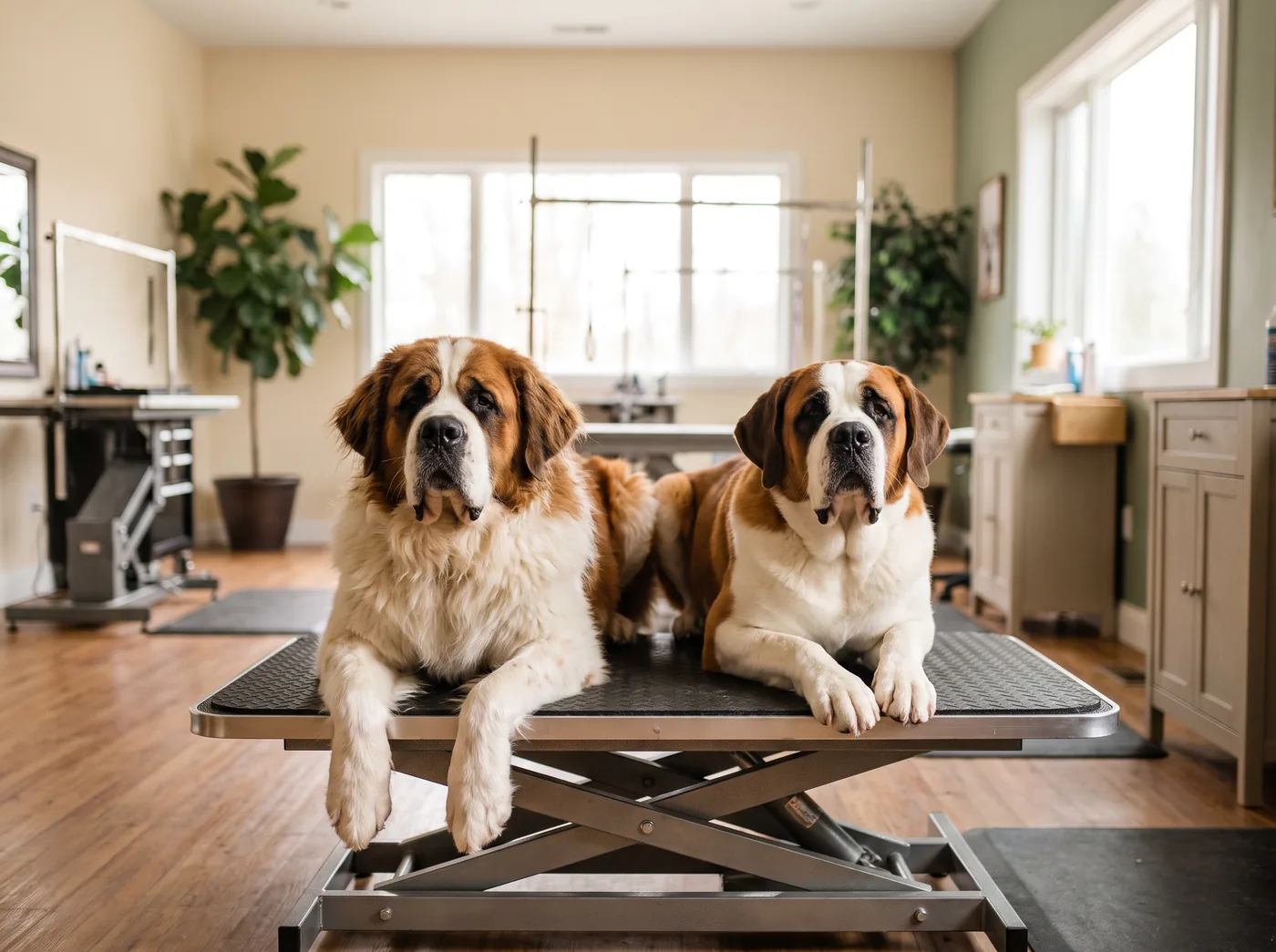
You need a salon with a floor level hydraulic table the dog walks onto and ideally a walk in bath, and you should ask before booking rather than on arrival. A standard table is the wrong height and rated well below the weight, and nobody should be lifting a Saint Bernard.
Two people is normal. Expect a size surcharge and expect it to be fair, and expect three hours or more, because the drying alone on a rough coat with that undercoat takes a long time.
Nails are thick and grow fast, and this is a breed with a short life span and a lot of orthopedic trouble, so overlong nails loading the joints matter more than cosmetics. Every three to four weeks, and start the handling in puppyhood, because a Saint Bernard that will not have its feet touched is a permanent problem rather than a passing one.
Elbow and hock calluses are common, as on any giant breed, and thick orthopedic bedding in every room the dog lies down in does more than any cream.
Ears are drop and want a weekly lift and smell.
And the same bloat caution as any deep chested giant: no vigorous handling around a large meal, including a long appointment.
What to tell your groomer
Say which coat variety the dog has when you book, because a rough and a smooth are meaningfully different appointments.
Ask whether they have a floor level table or walk in bath and a high velocity dryer, and whether they have handled a giant breed before.
Ask for a deshedding treatment rather than a plain bath and brush, and book at the start of each coat blow.
On a rough coat, ask for the feathering under the chin and on the upper chest trimmed short, and the feet cleared.
Say honestly when the dog was last brushed to the skin, and point out any calluses or sore folds.
Mention when the dog last ate, and ask for nothing to be cut beyond feet, hocks and sanitary area.
Keeping the coat between grooms
Wipe and dry the flews and throat
Saliva keeps the skin in the folds permanently damp. This is daily skin care, not housekeeping.
Daily
Rake the undercoat
Both varieties. Line brush a rough coat and prove it with a comb; a rubber curry finishes a smooth one.
Every two or three days
Book a deshed at each coat blow
On a dog this size a bath and high velocity dry is a salon job and beats several weeks of brushing.
Spring and autumn
Clip the nails
Thick and fast growing on a giant breed with a lot of orthopedic trouble. Overlong nails load the joints.
Every three to four weeks
Common Questions About the Saint Bernard
What is the difference between a rough and a smooth coated Saint Bernard?
Length, not texture, and both appear in the same litters. Both are genuine double coats with a dense undercoat, so both shed heavily, both blow coat twice a year and neither should ever be shaved. The rough coat is long with a heavy ruff and full feathering and needs line brushing every two or three days because it mats. The smooth coat lies flat, essentially does not mat, and needs a weekly rake and curry. Many owners find the smooth sheds more noticeably, because the short stiff hairs embed in fabric.
Can I shave my Saint Bernard in summer?
No. Both varieties are double coated, so shaving removes the outer coat that blocks sun and holds an insulating layer of air while leaving the undercoat that traps heat, making the dog hotter and exposing pale skin to sunburn. The regrowth is often permanently woolly and patchy. Saint Bernards genuinely do struggle in heat, but the answer is air conditioning, shade, cool floors, water and walking at the ends of the day, plus a thoroughly deshedded coat so air can reach the skin.
How do I manage Saint Bernard drool?
Treat it as skin care rather than housekeeping. Wipe the flews, under the jaw and into the throat folds daily with a damp cloth and then dry them, because saliva keeps the skin permanently damp and damp skin in a fold reddens, smells and grows yeast. On a rough coat the chest feathering gets soaked too and needs drying and combing, and having it trimmed short under the chin helps a lot. A sudden increase in drooling is a veterinary matter, not a grooming one.
Similar breeds
Same coat, same schedule, or the breeds this one is crossed from.

Newfoundland
A half day appointment, two groomers, and a coat that holds a bathtub of water
Newfoundland
Bernese Mountain Dog
A giant double coat with feathering, on a dog with a famously short life
Bernese Mountain DogFind a groomer who knows this coat
Search 37,863 groomers by town, or keep reading the breed guide.
Find a Local Groomer View All Breeds