Savannah Grooming
A coat that needs almost nothing, on a cat that changes everything else about the appointment
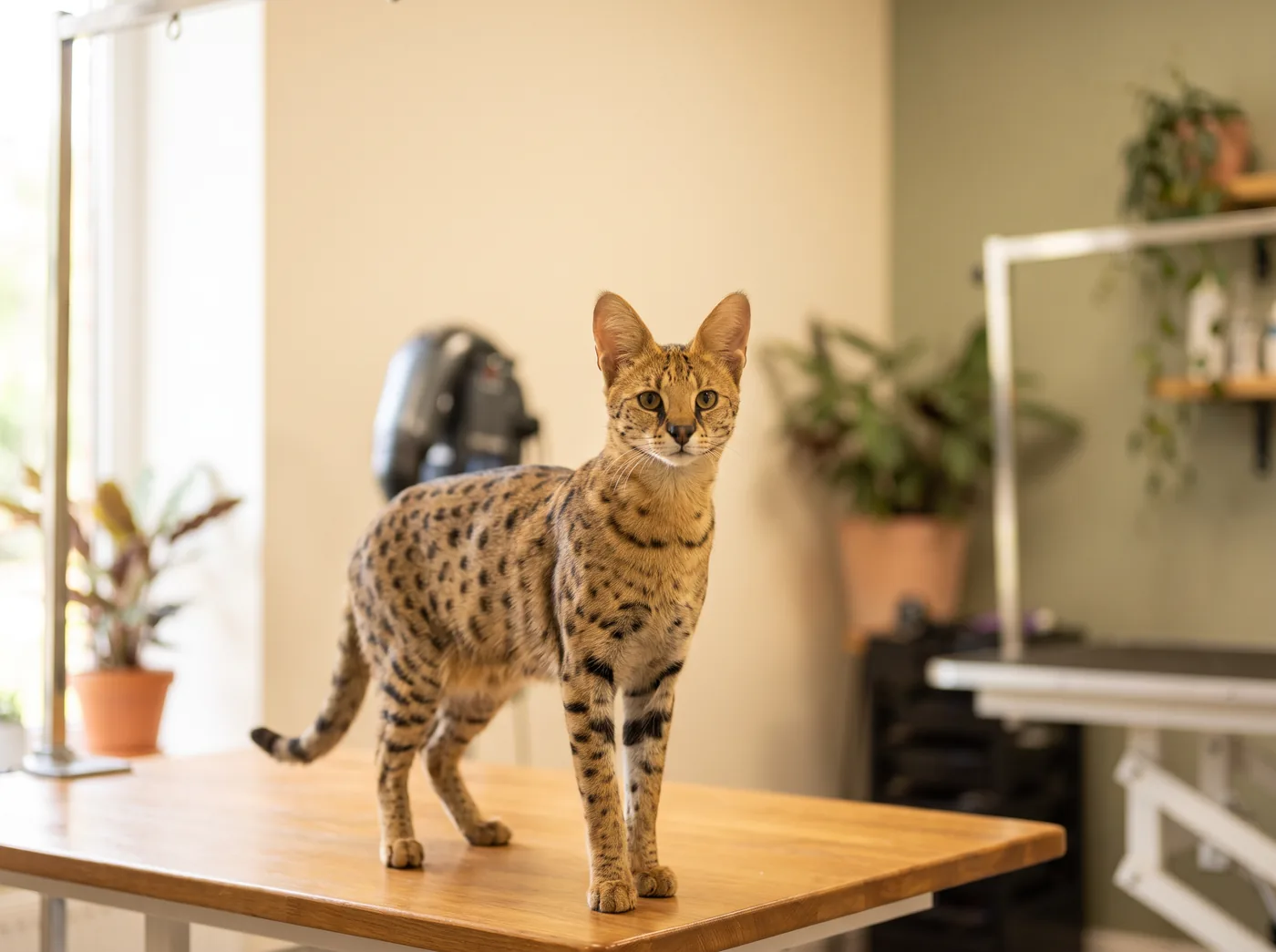
About the Savannah
The Savannah is a domestic cat crossed with the serval, a long legged African wild cat, and it is the largest and most striking of the hybrid breeds. It is very tall, very leggy, has enormous upright ears, and carries a short dense coat with bold solid spotting on a warm ground color.
The coat is the easy part and takes five minutes a week. It is short, close lying and does not mat, and there is nothing on this page about combing technique because there is nothing to say.
Everything else is different from a normal cat appointment, and that is what this page covers. How far the cat is from the wild ancestor changes its size, temperament and legal status dramatically, a groomer may reasonably decline to take one, and in some places owning the earlier generations is restricted or banned outright. Those are the things worth knowing before you need them.
This coat can be clipped, but the texture or the color may change and it will not always come back the same. Talk it through with your groomer before the first one.
What the F numbers mean, and why they matter
Savannahs are described by a filial number, and it is the single most important fact about any individual cat. It says how many generations separate it from the serval.
An F1 has a serval parent and is roughly half wild. These are very large, commonly 20 to 25 pounds and tall enough to reach a kitchen counter without effort, and they retain a great deal of wild behavior.
An F2 has a serval grandparent, an F3 a great grandparent, and so on. With each generation the size drops, the temperament settles, and the cat becomes progressively more like a domestic cat with an unusual look.
By F4 and F5 you have a cat that is legally and practically domestic in most respects, large and athletic but manageable, and this is what most pet Savannahs are.
For grooming the number tells you what appointment you are dealing with. An F5 is a normal cat that happens to be tall. An F1 is a 25 pound animal with wild ancestry, considerable strength, and no particular interest in being restrained by a stranger, and many salons will decline it outright, which is a reasonable professional judgment rather than prejudice.
Male Savannahs in the first few generations are usually sterile, which is why the breed is propagated through the females and why early generation cats are rare and expensive.
Know your cat's number and say it when you book.
The coat, which asks for nothing
Short, dense and close lying, with a slightly coarser feel in the earlier generations and a softer one further out. It sheds a moderate amount and it does not mat.
A rubber grooming glove or a soft brush once a week, run along the lie, removes what is loose and spreads the skin oils. That is the entire routine and it is genuinely all of it.
Bathing is almost never necessary, though Savannahs are unusual among cats in frequently enjoying water, which occasionally makes it easier than expected. A cat that plays in the bath does not need bathing for cleanliness.
Nails every three to four weeks, and this matters here more than on most cats. A Savannah is powerfully built, jumps to heights other cats cannot, and claws that catch at speed can tear.
Ears are the breed's most distinctive feature and among the largest relative to head size of any cat. They are open and well ventilated, which is good, and they collect visible wax, which needs a weekly look and a wipe of the outer ear only.
Teeth as with any cat.
Do not clip this coat. There is no reason to, and cat skin is thin.
Handling, and why a salon may say no
Savannahs are active, intelligent, physically confident and busy in a way that is different from most cats. They climb everything, open doors, and do not sit still. Many are affectionate and dog like with their own people, following them around and playing fetch, while being entirely uninterested in strangers.
They are also strong, fast and large, and in the earlier generations genuinely capable of hurting someone who has cornered them, without any aggressive intent on the cat's part.
That is why a groomer may decline, and it is worth taking the refusal at face value. A salon that has not handled the breed and says so is being professional. Pressing them into it is how a cat gets frightened and a person gets injured.
What works is the same as for any strong willed animal, applied earlier and more consistently. Handle the feet, ears and mouth daily from kittenhood as an entirely unremarkable event. Do nails a few claws at a time rather than fighting for all eighteen. Never restrain a Savannah that has decided the session is over: with this breed you will lose, and you will teach it that handling ends in a struggle.
Most Savannah care is done at home, which the coat makes entirely realistic.
If you do need a professional, look for a cat only groomer or one experienced with hybrids, and say the generation when you book rather than on arrival.
The legal point, which catches people out
This is not grooming advice, but it is the thing most likely to cause a genuine problem and it comes up when you need a professional.
Because Savannahs are descended from a wild species, ownership is regulated differently from ordinary cats and the rules vary enormously by state and by city. Some jurisdictions ban the breed entirely. Many permit later generations, commonly F4 or F5 and beyond, while restricting or prohibiting F1 to F3. Some require a permit for any hybrid. Local ordinances can be stricter than state law, so a city rule can catch a cat that the state allows.
The practical consequences show up at the worst moments. Some veterinary practices will not treat early generation hybrids, some insurers will not cover them, boarding facilities frequently refuse them, and a groomer who takes one may be operating outside the terms of their insurance without realizing it.
It also matters when moving. A cat that is legal where you live may not be legal where you are going, and that is a distressing thing to discover after the move.
Check your own state and city rules for the specific generation you have, and confirm before booking any professional service rather than assuming. This page cannot tell you the answer, because it changes by jurisdiction and it changes over time.
None of this applies to the Bengal in most places, which is far enough from its wild ancestor to be treated as fully domestic almost everywhere.
What to tell your groomer
Say the breed and the generation when you book, not when you arrive. An F5 and an F1 are completely different propositions and the salon needs to decide before you are standing in reception.
Accept a refusal gracefully. A groomer who has not handled a hybrid and says so is making a sound professional judgment.
Ask whether they take cats at all, whether cats are kept away from dogs, and whether they have a quiet room.
Say the coat needs a glove rather than a comb or a slicker, and that nothing needs cutting.
Ask for the nails, a few at a time, and for the ears checked.
And say honestly how the cat is about being handled and restrained, including anything that has gone wrong before.
Keeping the coat between grooms
Glove the coat along the lie
Five minutes. The coat is short, dense and does not mat, so there is genuinely nothing else to do to it.
Weekly
Clip the nails, a few at a time
A powerful cat that jumps higher than most. Never fight for all eighteen: you will lose and teach it to refuse.
Every three to four weeks
Handle from kittenhood
Feet, ears and mouth daily as a non-event. With this breed the window for teaching that closes early.
Daily, from the start
Know your generation
It decides size, handling, whether a salon will take the cat, and in some places whether ownership is legal at all.
Before booking
Common Questions About the Savannah
What do F1, F2 and F5 mean in Savannah cats?
They count generations from the serval, the African wild cat the breed comes from. An F1 has a serval parent and is roughly half wild, commonly 20 to 25 pounds and very tall. An F2 has a serval grandparent, an F3 a great grandparent, and so on. With each generation the cat gets smaller and more domestic in temperament. Most pet Savannahs are F4 or F5, which behave essentially as large athletic domestic cats. The number determines size, handling, and in many places the legality of owning one.
Do Savannah cats need grooming?
Almost none. The coat is short, dense and close lying, it does not mat, and a rubber grooming glove once a week is genuinely the whole routine. Bathing is rarely needed, although Savannahs often enjoy water. What does matter is nails every three to four weeks, because this is a powerful cat that jumps higher than most and a caught claw can tear, plus a weekly check of the very large ears, which collect visible wax.
Why would a groomer refuse to take my Savannah?
Usually the generation. Early generation Savannahs are large, powerful and closer to their wild ancestry, and a cat that feels cornered can injure someone without any aggressive intent. A salon that has not handled hybrids is making a sound professional judgment by declining. There can also be a legal dimension: ownership of earlier generations is restricted or banned in some states and cities, and a groomer may be outside their insurance terms taking one. Say the generation when you book.
Similar breeds
Same coat, same schedule, or the breeds this one is crossed from.


Abyssinian
A ticked coat that needs almost nothing, on a cat that would not sit still for it anyway
AbyssinianFind a groomer who knows this coat
Search 37,863 groomers by town, or keep reading the breed guide.
Find a Local Groomer View All Breeds