Grooming an Anxious or Reactive Dog
What frightens them, what good handling looks like, and the work that makes it better
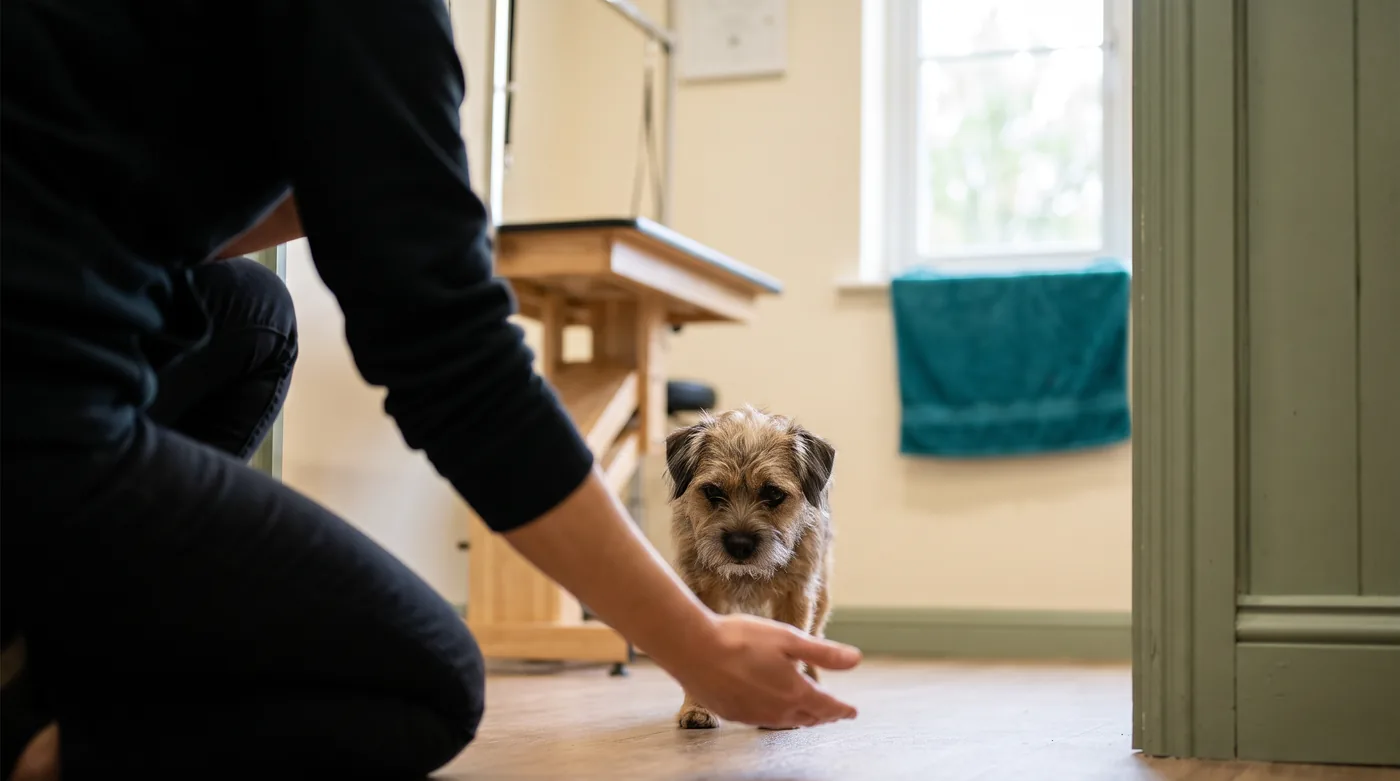
Some dogs walk into a salon and go to sleep on the table. Others shake in the car park. The difference is rarely temperament on its own, and it is almost never something an owner did wrong.
Grooming asks a dog to stand still on a raised surface while a stranger holds its feet, points a loud machine at it and runs a vibrating blade over its skin. Plenty of dogs find at least one part of that hard. The useful question is which part, because the answer changes what you do about it.
Why Are Dogs Frightened of Being Groomed?
Fear is usually attached to something specific and not to the whole experience. The common causes are worth knowing because most of them can be worked on separately.
- A bad first experience. One appointment that hurt, or one that went on far too long, will do it.
- Being restrained. Some dogs mind the holding far more than the grooming.
- Noise. Dryers, clippers and other dogs barking in a hard-surfaced room.
- Feet. Dogs that were never handled around the paws as puppies often object strongly as adults.
- The table. A raised surface a dog cannot get down from is genuinely unnerving until it learns the surface is safe.
- Pain. Covered below, and it is the first thing to rule out.
A dog that is fine being brushed at home and impossible at a salon is often reacting to the environment and the other dogs, not to the grooming itself. That points at a very different solution from a dog that hates being touched anywhere.
Is It Fear, or Is It Pain?
Check this first, before doing any training. Behavior that looks like anxiety is often a dog telling you that something hurts.
A dog with arthritis finds standing on three legs while the fourth is held genuinely painful, and older dogs get sore standing on a hard table long before they look uncomfortable. An ear infection turns ear cleaning into something worth biting over. Sore skin, a hot spot, an anal gland problem or a lump in the coat all produce the same reaction.
Matted coat belongs in this list too. Every stroke of a brush through a felted coat pulls on skin. A dog that fights being brushed may simply have learned that brushing hurts, which it does, and no amount of desensitization fixes that while the coat stays matted.
If the objection is new, or attached to one part of the body, a vet appointment is the right first step and behavior work is the second.
The Dryer Is Usually the Problem, Not the Clippers
Owners assume the clippers are the frightening part. Ask a groomer and most will tell you it is the dryer.
A high velocity dryer is loud, it pushes air hard enough to move the coat and the skin, and it blows air into the face if the dog turns into it. A dog that is calm through the bath and the haircut can come apart entirely at that stage.
There are real options here and they are worth asking about. A dryer can be run on a lower setting, held further away, or aimed away from the head with the face done by hand afterward. Some dogs manage far better with a towel dry and a stand dryer, which takes longer and often costs a little more. A groomer who knows the dryer is the issue can plan around it, but only if somebody tells them.
Why Nail Trims Are the Hardest Part
Nail trims produce more refusals than anything else, and the reason is usually one event. A quicked nail hurts sharply and bleeds a lot, and dogs are very good at remembering exactly which activity caused it.
The way back is slow and mostly at home. Handle the feet with no clippers in sight at all, several times a day, for a week. Then hold a foot and touch a clipper to a nail without cutting. Then take the very tip off one nail and stop for the day. One nail is a complete session and there is no rush to do more.
A grinder is worth trying, because it removes nail gradually and it is much harder to take too much. Some dogs mind the buzz and the warmth and prefer clippers. Trying both tells you which.
Grooming at home covers how to find the quick on a dark nail, which is the part most owners give up on.
How Do You Get a Dog Used to Being Handled?
The work is short, boring and repetitive, and it does more than anything else on this page.
Handle the areas that get touched during a groom: paws and between the toes, ears inside and out, muzzle and around the eyes, tail, and the back end. Touch, treat, let go. The dog should get the reward for allowing it and the session should end while it is still comfortable.
- Keep sessions short. Three sessions of one minute spread through the day beat one ten minute session that ends badly.
- Stop before the dog wants to. Ending on a good moment is the whole point.
- Go at the pace of the dog in front of you. If a paw is fine but toes are not, work on paws for a week.
- Do it when nothing is planned. Handling only in the hour before an appointment teaches a dog what handling predicts.
If you have a puppy, this is the single most valuable thing you can do with the first few months. A puppy's first groom covers the timing and why the window closes.
Introducing the Tools Before They Are Used
Most dogs meet a clipper for the first time when a stranger switches it on next to their head. That is a lot to ask.
Leave brushes, combs and clippers out on the floor where the dog can investigate them. Feed near them. Then switch a clipper on across the room and feed while it runs, moving it closer over several days only if the dog stays relaxed. Do the same with a hairdryer on a cool setting for the noise, kept well away and never pointed at the dog.
You do not have to groom with any of it. The aim is only that the sight and the sound stop being new.
What Is Cooperative Care?
Cooperative care is the approach most modern groomers and vet clinics are moving toward, and it is worth knowing the phrase because it tells you something about a salon that uses it.
The idea is that the animal is given a way to say yes and a way to say no. A dog is taught to rest its chin in your hand while its ears are done, and lifting the chin means stop. Work pauses when the dog asks for a pause, and continues when the position is offered again.
It sounds slow and at first it is. What it changes is the dog's belief about being handled: struggling stops being the only thing that ends the procedure. Dogs trained this way get easier over time, where dogs that are simply held tighter each visit get worse.
Visiting the Salon Without Being Groomed
Ask whether you can bring the dog in for a few minutes with nothing happening. Most salons will say yes if you come at a quiet time and ask in advance.
Walk in, let the staff drop a treat, stand near the noise, walk out again. Repeat it a few times over a couple of weeks. The point is that the building stops being the place where the difficult thing always happens.
A short walk near the salon beforehand helps as well, on the day and in general. A dog that has burned some energy off arrives calmer than one that came straight out of the house.
What Good Handling Looks Like in a Salon
When you visit, watch how the dogs already there are being handled.
- Somebody within arm's reach of every dog on a table
- Staff working at the dog's level and approaching from the side, not looming over the head
- Steady, quiet voices, and no shouting at animals
- A dog that is struggling being given a break rather than held harder
- Non-slip matting on tables and in the bath
- Nervous dogs kept away from the busiest part of the room
Sustained distress that nobody responds to is the thing to walk away from. Barking is normal in every salon that has ever existed.
What to Ask a Salon About a Nervous Dog
- Have you worked with anxious dogs before, and what do you do differently? You want specifics, not reassurance.
- Can you book us the first or last slot? A quieter room with fewer dogs helps enormously.
- What happens if he will not let you finish? The answer you want is that they stop and you come back another day.
- Do you groom one dog at a time? Some small salons and most mobile groomers do, and for a reactive dog that can matter more than anything else.
- Will you call me if it is not going well? Yes is the only good answer.
How to choose a groomer covers the rest of what to look at on a first visit.
Should You Stay and Watch?
Usually not, and this surprises people who assume their presence helps.
Most dogs are harder to work with while their owner is in the room. They watch you instead of the groomer, they try to get to you, and every reassuring noise you make gets read as confirmation that something is wrong. Groomers see the same dog settle within minutes of the owner leaving often enough that most salons ask you to go.
There are exceptions, and a first visit for a very frightened dog is sometimes one of them. Ask rather than assume, and take the answer seriously.
A Muzzle Is Not a Failure
Owners get upset at the suggestion, and it is worth reframing. A groomer working near a dog that might bite has to work slowly and defensively with sharp tools, which is more dangerous for the dog than the muzzle is.
A basket muzzle lets a dog pant, drink and take treats, which a fabric one does not. Introduce it at home over a couple of weeks by feeding through it, so it becomes something ordinary that predicts food.
A dog that arrives already comfortable in a muzzle usually has a calmer and shorter appointment than one that has it put on for the first time in a strange room.
When One Appointment Is Too Much
Some dogs cannot do the whole thing in one go, and forcing it teaches them that grooming is something to be survived.
- Split it up. A bath and dry one week, nails and face the next. Two short appointments cost more than one long one and are often the difference between possible and impossible.
- Take a simpler cut. A shorter, plainer haircut takes far less time on the table. Style is a fair thing to trade for a dog that copes.
- Try a mobile groomer. One dog, no waiting, no other animals, and it never leaves your street. For a reactive dog this is frequently the answer, and it typically costs $20 to $40 more than a salon.
- Do more at home. Every job you handle yourself is a job the salon does not need to.
What Helps on the Day
Gear That Helps a Nervous Dog
Nothing here is a substitute for the handling work, but each one makes it easier
We earn a commission on these links at no cost to you. How this works


What About Sedation?
For a small number of dogs, handling work and a patient groomer are not enough, and a coat still has to be dealt with. That is a conversation with your vet and nobody else.
Some vet clinics offer grooming under sedation for exactly these cases, which is safer than a salon attempting it because the dog is monitored by people qualified to do that. Many salons will not take a dog that has been sedated elsewhere, so tell them in advance.
Never give a dog anything from your own medicine cabinet, or anything left over from another animal. Human sedatives and painkillers are dangerous to dogs, doses are weight and health dependent, and a groomer cannot tell a sedated dog from an unwell one.
Where medication is used, the sensible framing is as a bridge. It buys comfortable appointments while the handling work is going on underneath, with the aim of needing it less over time.
Why Cancelling Appointments Makes It Worse
Cancelling appointments. It feels kind and it is the most reliable way to guarantee a painful groom later.
A coat that misses its interval keeps growing and starts to felt. When the dog finally goes in, the only humane option is often to clip the whole coat off underneath the mats, which takes longer, hurts more and confirms everything the dog already believed. The matting guide covers why brushing a felted coat out is worse than shaving it.
Booking shorter, simpler, more frequent appointments beats postponing a big one. How often to book gives the interval each type of coat actually needs.
How Long Does It Take to See a Difference?
Months, not weeks, and progress is not a straight line. A dog that was better last time can have a bad day for reasons nobody can identify.
The measure worth watching is not whether the dog enjoys it. Most never will. What you are looking for is a dog that walks in without planting its feet, tolerates the parts it used to fight, and settles again quickly afterward.
Sticking with one groomer matters more here than anywhere else. Somebody who has handled your dog a dozen times knows which foot it objects to and what to do first, and that history is worth more than a shorter drive.
Find grooming salons near you by state, county and town, and the breed guides cover how much grooming your dog actually needs, which decides how often you have to ask it to cope.
Explore Our Breed Directory
Browse detailed guides for every breed mentioned in this article
View All Breeds