Afghan Hound Grooming
The highest maintenance coat in dogs, and the only one whose honest bath interval is weekly
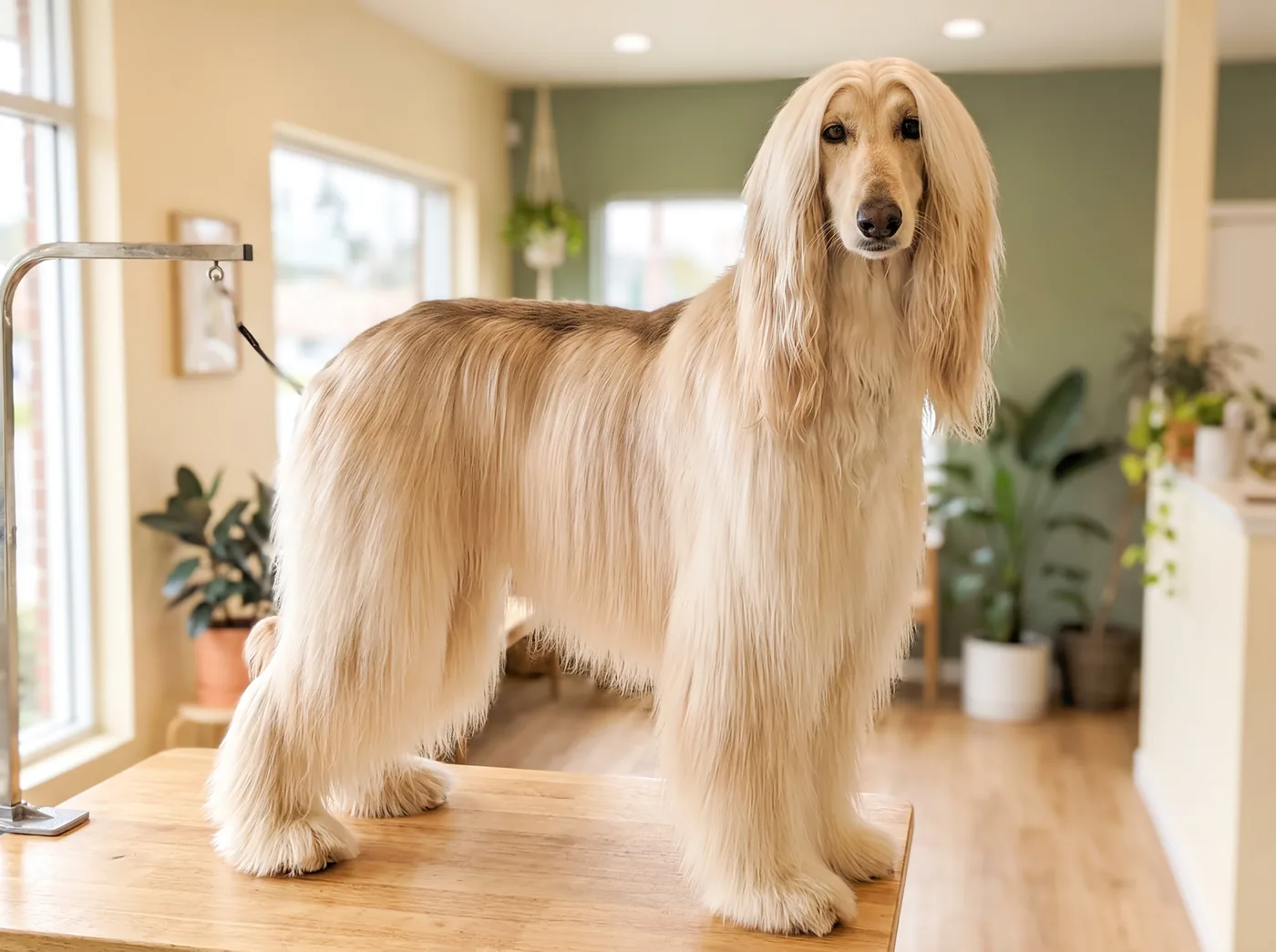
About the Afghan Hound
The Hound Group page says the group holds both the lowest maintenance coat in dogs and the highest. The Beagle is the low end. This is the high end, and the gap between the two is about as wide as grooming gets.
An Afghan Hound in full coat carries an extremely long, fine, silky, single coat that hangs straight almost to the ground, with a short close saddle of hair along the back and a topknot of long silky hair on the head. There is essentially no undercoat.
The hair is closer to human hair than to a typical dog coat, and it behaves like it. It grows continuously rather than shedding out, it is fine enough to tangle at the slightest provocation, and it breaks if it is brushed while dry. Keeping one properly is not a chore, it is a hobby, and it should be described as one before anybody takes on the breed.
This coat can be clipped, but the texture or the color may change and it will not always come back the same. Talk it through with your groomer before the first one.
Why this is the highest maintenance coat there is
Several things that make a coat difficult all appear at once here, and it is the combination rather than any one of them.
It is extremely long, so a tangle has room to grow into a mat before anything is visible.
It is very fine, and fine hair tangles far more readily than coarse hair. Afghan hair is finer than almost any other dog coat.
It does not shed out. A single continuously growing coat keeps every dead hair tangled among the living ones until something removes it, so all of it stays on the dog.
And it is fragile when dry. Brushing a dry Afghan coat snaps the hair, splits the ends and destroys the texture, and a coat brushed dry for a year looks visibly ruined.
Put those together and you get a coat that must be combed daily, cannot be combed dry, and punishes any gap immediately. Two neglected weeks on an Afghan is not a tidy up, it is a pelted dog.
The saddle is the exception and worth knowing about. The short close hair along the back is a breed characteristic in the mature dog rather than a bald patch or a grooming failure. Puppies do not have it and it develops with maturity, which alarms plenty of first time owners in both directions.
The weekly bath, and never brushing a dry coat
This is the technique that makes the difference, and it is genuinely counterintuitive to anyone used to other breeds.
An Afghan in full coat is bathed weekly, or at the very least fortnightly. That is not about cleanliness. It is because the coat cannot be worked dry without damage, so the bath is the mechanism that makes brushing possible at all.
The sequence is: bathe with a gentle shampoo, condition thoroughly, rinse, then blow dry while brushing the coat straight in sections. Almost all the brushing happens during the dry, on hair that is damp and conditioned and therefore able to slide rather than snap.
Between baths, the coat is misted with water or a light conditioning spray before any comb touches it. Never a dry comb, ever. It is the single most useful sentence on this page.
The tools are a pin brush and a wide toothed comb, worked in sections from the skin outward. A slicker used hard on this coat breaks hair.
A full session on a coated Afghan runs to four hours or more, which is why professional appointments are premium priced and why the salons that take them limit how many they book. Many serious owners do it themselves, because weekly at a salon is not realistic for most people.
Never bathe a matted coat. Water tightens a mat like a wet knot, so anything felted comes out first, worked apart with fingers and a comb from the outside in.
Where it mats, and what a walk costs
The places are the ones any long coated breed has, but the consequences arrive faster.
Behind and under the ears, which on this breed carry long silky hair over a long drop ear and go first. The armpits. The inside of the back legs. The chest. Around the collar, which is why a rolled leather collar or none at all is standard on a coated Afghan and a flat nylon collar will wear a permanent mat into the neck. And the rear.
The ears themselves need lifting at mealtimes, because the hair goes into the bowl, and a snood is normal equipment for this breed rather than an affectation.
Then there is the fact that this is a sighthound. An Afghan is built to run flat out over rough country and genuinely wants to, and a coat that reaches the ground collects everything the country contains: burrs, seeds, twigs, mud and thorns. A single run through undergrowth can undo a week.
That tension is real and there is no clever answer to it. Owners of coated Afghans generally manage it by running the dog somewhere clean, using a snood and a coat, and accepting a longer session afterward.
Grass seeds deserve a specific warning on a breed with this much foot and ear hair: check the feet, between the toes and inside the ears after any walk in long grass in summer.
The pet clip, and being honest about it
A great many pet Afghans are kept clipped short, and the breed community has strong feelings about it. The honest position is that it is a legitimate choice with a real cost, and that pretending otherwise helps nobody.
What you gain is enormous. A clipped Afghan can be brushed in ten minutes, dries quickly, does not collect half a field, and can be run in the countryside like a normal dog. Most importantly it removes the failure mode where a full coat is maintained badly and the dog ends up pelted, which is a genuinely miserable outcome and by far the most common one.
What you give up is the breed's defining feature and, on many dogs, some coat quality permanently. Clipping a fine single coat does not damage it the way clipping a double coat does, and it generally does grow back, but the texture often changes and the regrowth on some individuals is slower or thinner. Returning to a full show coat after years of clipping is not realistic.
The middle option worth knowing about is a shorter maintained coat: a few inches rather than shaved, tidied every six weeks, which keeps something of the outline and cuts the daily work substantially.
The honest summary is the same as for the Old English Sheepdog. If you will do the daily work, keep the coat, and it is magnificent. If you will not, clip it early and keep it clipped. The worst outcome by a distance is a long coat maintained by good intentions.
What to tell your groomer
Ask first whether they have groomed the breed. This is not a coat to learn on, and a salon that has not is better off saying so.
Say clearly whether you want the coat kept or clipped, and if kept, book the interval they recommend rather than one that suits you.
Say explicitly that the coat is not to be brushed dry, and ask that all brushing happens damp and conditioned during the dry.
Say honestly when the dog was last combed to the skin and where you have found mats, particularly behind the ears.
Ask for the feet cleared and the ears checked, and mention any grass seed history.
Expect three to four hours and a premium price, and book well ahead. Salons equipped for this have limited slots.
Keeping the coat between grooms
Never comb a dry coat
Mist with water or conditioner first, every time. Brushing this coat dry snaps and splits the hair permanently.
Every session
Bathe and dry weekly
Not for cleanliness. The bath is what makes brushing possible, and almost all the brushing happens during the dry.
Weekly
Comb behind the ears first
Long silky hair over a long drop ear. It is where an Afghan mats first and fastest, and a snood at mealtimes helps.
Daily
Lose the flat collar
A nylon collar wears a permanent mat into the neck of a coated Afghan. Rolled leather, or nothing at home.
Always
Common Questions About the Afghan Hound
How much grooming does an Afghan Hound really need?
In full coat, more than almost any other breed. Weekly bathing, because the coat cannot be brushed dry without breaking, plus daily combing on hair misted with water or conditioner, plus a full session of three to four hours to bathe, condition and blow dry while brushing the coat straight in sections. It is realistically a hobby rather than a chore. Two neglected weeks does not produce a scruffy dog, it produces a pelted one.
Can I clip an Afghan Hound short?
Yes, and a great many pet Afghans are kept clipped. It is a legitimate choice with a real cost. You gain a dog that can be brushed in ten minutes, run in the countryside and never pelted, which is the most common bad outcome by far. You give up the breed's defining feature, and while a fine single coat is not damaged the way a double coat is, the texture often changes and returning to a full show coat after years of clipping is not realistic. Decide early rather than drifting.
Why does my Afghan Hound have short hair along its back?
That is the saddle, and it is a normal breed characteristic in a mature Afghan rather than a bald patch or a grooming fault. The hair along the spine grows short and close while the rest of the coat stays long, and it develops with maturity, so puppies do not have it and it appears as the dog grows up. It worries first time owners in both directions: some think the coat is falling out, and others worry when a young dog has not developed one yet.
Similar breeds
Same coat, same schedule, or the breeds this one is crossed from.


Old English Sheepdog
The one herding coat most owners genuinely do keep clipped, and why that is defensible
Old English Sheepdog
Find a groomer who knows this coat
Search 37,863 groomers by town, or keep reading the breed guide.
Find a Local Groomer View All Breeds