American Curl Grooming
Backward curling ears with rigid cartilage, and none of the Scottish Fold's skeletal disease
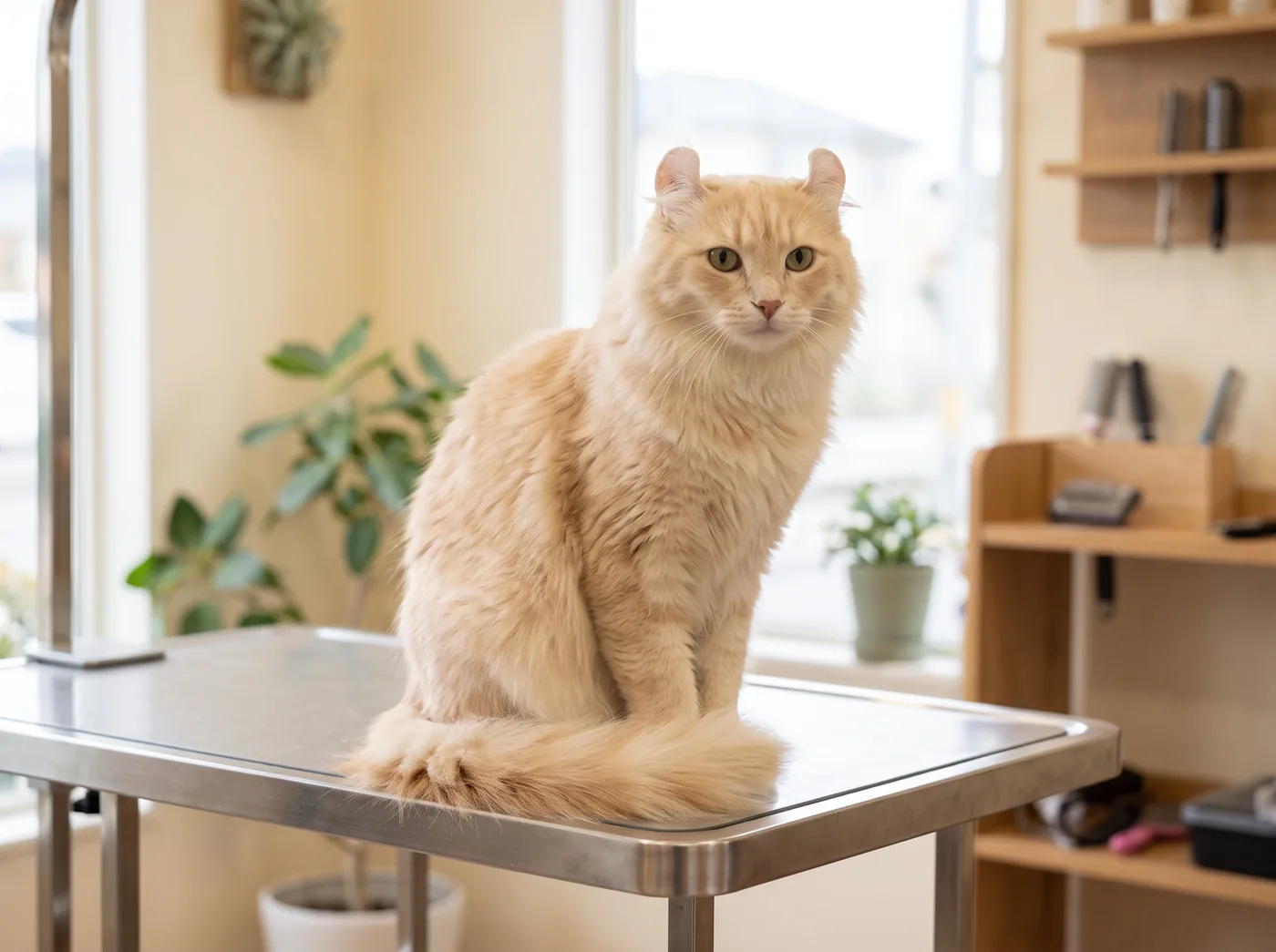
About the American Curl
The Scottish Fold page explains that the folded ear comes from a cartilage mutation which affects cartilage everywhere in the body, and that Folds carry a painful degenerative joint disease as a result. It is one of the most serious welfare warnings in cats.
An American Curl also has ears shaped by a cartilage mutation and it is a completely different situation. The Curl mutation is a separate dominant gene that changes the shape of the ear cartilage without the skeletal disease, and decades of the breed have not shown the joint problems Folds have.
That distinction matters, because owners who have read about Folds reasonably assume the worst. What the Curl does carry is a handling rule: the cartilage is firm, and a firm ear can be hurt.
The American Curl has a double coat that regulates its own temperature. Shaving it does not keep the animal cooler, removes the protection against sun and insects, and the top coat often grows back patchy or never returns correctly. A thorough deshed takes out the undercoat and does the job the owner was actually asking for.
The ears, and the one rule that matters
American Curl kittens are born with straight ears. Within the first few days they begin to curl backward, tighten over the next weeks, and then relax and set into their final shape by around four months. Breeders often cannot tell how much curl a kitten will keep until then.
The finished ear curves smoothly backward in an arc, and it is firm. There is solid cartilage in the base and the ear does not flop or fold the way an ordinary cat's does. It should feel like a firm ridge under the skin.
The rule follows directly: never force, straighten, unfurl or bend the ear. It does not have the give an ordinary ear does, the cartilage can be damaged, and it hurts.
That means ear cleaning is done differently. Clean only the visible outer part with a soft damp cloth or a cotton pad, wiping what you can see and reach without manipulating the ear. Do not pull the ear open to look inside, do not push anything down the canal, and do not hold the ear back to get at it.
Say this to a groomer, a boarding kennel and a veterinarian, because handling an ear firmly to examine it is an ordinary reflex and this is not an ordinary ear.
The curl also means the canal is more open to the air than a folded ear, so wax and debris are actually less of a problem than on a Fold. Check weekly and wipe what is visible.
Why this is not the Scottish Fold situation
It is worth being precise, because the two breeds get lumped together and the difference is real.
The Scottish Fold mutation affects cartilage throughout the body. That is why Folds develop osteochondrodysplasia, a degenerative joint disease affecting the tail, ankles and knees, and why every Fold is affected to some degree. Several countries have restricted or banned breeding them.
The American Curl mutation is a different dominant gene which alters the cartilage of the ear specifically. The breed has been studied since it appeared in California in 1981, and it has not shown an associated skeletal or joint disease. Curls are generally robust and long lived, and the gene can be carried in a single copy without health consequences.
So the honest summary is that the Curl is the ear mutation breed without the ear mutation problem.
That is not a license to be careless with the ears themselves, which is the previous section, and it does not mean a Curl has no health needs. It means the specific and serious welfare warning attached to the Fold does not transfer.
If you are choosing between the two on welfare grounds, that difference is the whole answer.
The coat, in both lengths
American Curls come in semi longhair and shorthair, and both occur in the breed. The semi longhair is the more familiar and is what most people picture.
The semi longhair coat is fine, silky and lies flat against the body, with very little undercoat, a plumed tail that is the showiest part of the cat, and modest feathering around the neck. Little undercoat means little matting, which makes this one of the easier semi longhair cats to keep.
Comb once or twice a week with a fine metal comb, paying attention to the britches, the armpits and behind the ears, and use the tail plume as the visible sign that the coat is being kept up.
The shorthair is a close flat coat needing a comb through once a week and nothing else.
Neither needs bathing routinely. Cats groom themselves and a healthy Curl stays clean, so a bath is for a specific reason rather than a schedule.
Shedding is moderate and rises seasonally. Combing is what controls both the hair around the house and the hairballs, and a cat that suddenly stops grooming itself or develops a greasy or matted coat is telling you it is unwell, in pain or overweight, and that is a veterinary conversation.
Handling, claws and the rest of the routine
Curls are known for being sociable, people oriented and playful well into adulthood, which makes handling easier than with many breeds. Use that: a cat that is combed from kittenhood as an ordinary part of the day never has to be restrained for it.
Keep sessions short and stop before the cat wants to. Two minutes daily beats a struggle every fortnight.
Claws need clipping every two to three weeks, taking the sharp tip only and staying well clear of the pink quick. Cats do not wear their claws down indoors, and an overgrown claw can curl into the pad.
Provide a scratching post, and understand that scratching is a normal need rather than a behavior problem. Declawing is an amputation of the last bone of each toe, it is illegal in many countries and unnecessary everywhere, and no groomer should offer it.
Teeth matter, as they do in every cat, and dental disease is one of the commonest causes of a cat stopping grooming itself.
Handle the ears as described above and mention the ear rule to anyone who will handle the cat.
What to tell your groomer or vet
Say first that the ears must never be forced, straightened or bent, because the cartilage is firm and handling it like an ordinary ear can hurt the cat.
Ask that ear cleaning is limited to the visible outer part with a soft damp cloth, with nothing pushed into the canal.
Say that a Curl does not carry the Scottish Fold's joint disease, since the two get confused and it changes what somebody looks for.
Ask for a comb through rather than deshedding tools, since there is little undercoat.
Ask for claws tipped, and say no to any offer of declawing.
Mention if the cat has stopped grooming itself, because that is a symptom rather than a coat problem.
Keeping the coat between grooms
Never force the ear
Firm cartilage, not a flexible ear. Wipe the visible outer part only, nothing inside.
Weekly
Comb through, britches and tail
Fine metal comb. Little undercoat, so this is quick and mats are rare.
Once or twice a week
Tip the claws
The sharp tip only, well clear of the quick. Indoor claws do not wear down.
Every two to three weeks
Watch for a cat that stops washing
A greasy or matted coat on a self grooming cat is a health signal, not laziness.
Ongoing
Common Questions About the American Curl
Do American Curls have the same health problems as Scottish Folds?
No, and this is the most useful thing to know about the breed. A Scottish Fold's folded ear comes from a mutation affecting cartilage throughout the body, which is why every Fold develops a degenerative joint disease and why several countries have restricted breeding them. An American Curl's ear comes from a different dominant gene that shapes the ear cartilage specifically, and the breed has been studied since 1981 without an associated skeletal disease. Curls are generally robust and long lived.
How do you clean an American Curl's ears?
Only the part you can see, with a soft damp cloth or cotton pad, and without manipulating the ear at all. The cartilage in a Curl's ear is firm rather than flexible, so it must never be forced straight, unfurled or bent back to get a better look, and it can be damaged by handling that would be fine on any other cat. Tell your vet, groomer and cattery the same thing, because holding an ear open to examine it is an ordinary reflex. The upside is that a curled ear is well ventilated, so wax builds up less than in a folded ear.
Do American Curls need a lot of grooming?
No. Even the semi longhair has a fine silky coat with very little undercoat, and undercoat is what mats, so a comb through once or twice a week keeps it, with a little extra attention to the britches, armpits and the plumed tail. The shorthair variety needs a weekly comb and nothing more. Neither needs routine bathing. Claws want tipping every two to three weeks. If a Curl stops grooming itself or the coat turns greasy or matted, that is a health sign rather than a grooming failure.
Similar breeds
Same coat, same schedule, or the breeds this one is crossed from.

Scottish Fold
A plush coat, folded ears that need checking, and a health question worth knowing
Scottish Fold
Turkish Angora
A long coat with no undercoat at all, and a deafness risk that changes how you approach the cat
Turkish Angora
Munchkin
A normal cat body on legs that cannot reach everywhere, which is the entire grooming story
MunchkinFind a groomer who knows this coat
Search 37,863 groomers by town, or keep reading the breed guide.
Find a Local Groomer View All Breeds