Munchkin Grooming
A normal cat body on legs that cannot reach everywhere, which is the entire grooming story
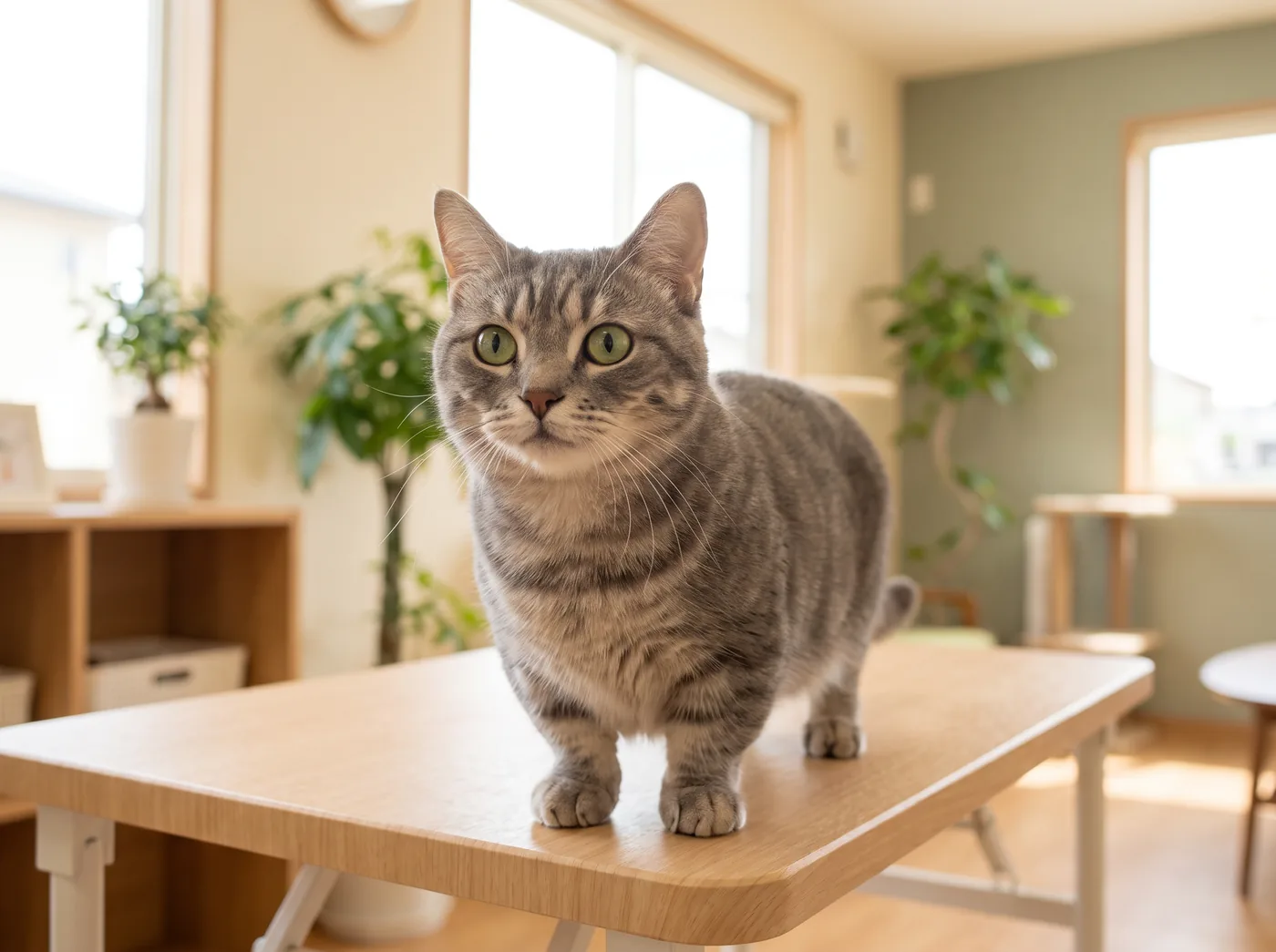
About the Munchkin
It comes back to the same thing every time: a cat keeps its own coat in order by twisting and reaching, so anything that limits how far it can reach shows up in the coat first. Weight, age, arthritis and a sore mouth all do it, and the coat is the early warning.
The Munchkin is that argument as an entire breed. It carries a normal sized cat body, head and tail on legs roughly a third the usual length, the result of a dominant mutation causing a form of dwarfism that shortens the long bones.
The coat itself is ordinary and comes in both short and long varieties, since Munchkins have been outcrossed to many breeds. There is nothing unusual about the hair. What is unusual is the cat's ability to look after it, and that is what this page is about. It also covers the controversy honestly, because there is one.
This coat can be clipped, but the texture or the color may change and it will not always come back the same. Talk it through with your groomer before the first one.
The reach problem, which is the whole point
A cat grooms itself with a set of movements that all depend on flexibility and limb length. It licks its flanks by twisting, reaches its back and shoulders over the top, cleans its face by wetting a front paw and wiping, and reaches its rear and the base of its tail by folding almost double.
Shorten the legs and several of those get harder. A Munchkin can generally manage its front end perfectly well, and struggles progressively with the middle of the back, the base of the tail and the rear.
The result is a coat that is immaculate at the front and neglected at the back, which is the same pattern an arthritic or overweight cat of any breed shows. The signs are dandruff along the spine and at the tail base, a greasy or clumped look over the lower back, and matting in exactly the places the cat cannot get to.
On a shorthaired Munchkin that means a weekly comb, with real attention to the lower back, tail base and rear rather than the parts the cat has already done.
On a longhaired one it means combing every two or three days and a professional groom on a schedule, because those areas will felt.
The other consequence is the litter box and the rear generally. A cat that cannot reach to clean itself after using one needs help, and keeping the sanitary area and the hair around it trimmed short is a sensible standing request rather than an occasional one.
The controversy, stated plainly
This page would be dishonest without it, and an owner deciding how to care for a cat is better served by the facts than by either enthusiasm or squeamishness.
The Munchkin is produced by a dominant mutation causing chondrodysplasia, a form of dwarfism affecting the growth of long bones. It arises spontaneously and has been documented in cats for decades, but it was only bred for deliberately from the 1990s.
It is recognized by TICA and by some other registries. It is not recognized by the Cat Fanciers' Association, nor by the UK's Governing Council of the Cat Fancy, and the GCCF has been explicit that it regards breeding for the trait as unacceptable on welfare grounds. Several European countries restrict or prohibit it.
The disagreement is about whether the mutation carries health costs. Advocates point out that many Munchkins live normal healthy lives and that the mutation does not affect the spine in the way it does in dwarf dog breeds. Critics point to reported associations with lordosis, an excessive inward curve of the spine, and pectus excavatum, a sunken chest, and argue that deliberately breeding for a skeletal mutation is the wrong principle regardless.
Two copies of the gene appear to be lethal before birth, so Munchkins are always bred to normal legged cats and litters contain both.
None of that changes how you care for a cat you already have. It is worth knowing if you are choosing one.
Weight, mobility and why they compound
Weight matters more in this breed than in almost any other cat, and the reason is straightforward: a heavy cat has less reach than a lean one, and a Munchkin starts with less reach to spare.
Every pound of extra weight reduces how far the cat can twist and how easily it can fold to reach its rear, so a slightly overweight Munchkin loses access to its own back end considerably faster than a slightly overweight ordinary cat would.
Munchkins are also less able to jump than other cats, though they climb and run perfectly well, so they naturally get less exercise from the vertical movement most cats do constantly. That makes weight gain easier and less obvious.
Feel the ribs monthly rather than judging by eye. You should be able to feel them easily under a thin layer.
Then the joints. Any cat that develops arthritis loses reach, and on a cat already limited by leg length that is a compounding problem rather than an additive one. Arthritis is badly under-diagnosed in cats because they do not limp obviously: they stop jumping, stop using high places, sleep more and stop grooming. On this breed, the coat over the back end is where you will see it first.
Practically: keep the cat lean, provide steps or ramps to favorite high places so it can keep moving, use a large litter box with a low entry, and take a coat change seriously rather than simply brushing more.
The two coats, and the practical routine
Because Munchkins have been outcrossed widely, the coat could be almost anything, but it falls into two groups.
The shorthair has a medium dense plush coat. A fine comb to the skin plus a rubber glove once a week covers it, and it mats only lightly, behind the ears, in the armpits and at the tail base.
The longhair is semi longhaired with a full plumed tail and a ruff. It needs combing every two or three days and it will felt at the tail base, the trousers and the rear if it is left, because those are precisely the areas the cat cannot reach.
On either coat, work from the back forward rather than the front. The front is the part the cat has already dealt with; the back is the part that needs you.
Keep the sanitary area, the trousers and the hair between the paw pads trimmed short. On a longhaired Munchkin this is not optional tidiness, it is what prevents waste being caught in coat the cat cannot clean.
Nails every three to four weeks. Munchkins climb enthusiastically and use scratching posts, but check them, since a cat that jumps less wears them down less.
The two absolute cat rules apply as always: never cut a mat out with scissors, because cat skin lifts into a fold beneath it, and never bathe a matted coat, because water tightens a mat like a wet knot.
What to tell your groomer
Say which coat length you have, because a shorthair and a longhair are different appointments.
Say the cat cannot reach its own back end properly, and ask them to concentrate there rather than working front to back out of habit.
Ask for the sanitary area, the trousers and the paw pads kept short as a standing request at every visit.
Ask them not to extend the legs awkwardly or lift the cat by the front, and mention any stiffness or reluctance to jump.
Mention any weight change, since on this breed weight translates directly into lost reach and a worse coat.
And ask whether they take cats, work without sedation and keep cats away from dogs, which is the question for any cat booking.
Keeping the coat between grooms
Comb from the back forward
The front is the part the cat has already done. The lower back, tail base and rear are the parts that need you.
Weekly, or every few days if longhaired
Keep the rear and pads trimmed
A standing request, not an occasional one. It prevents waste catching in coat the cat cannot clean.
Every few weeks
Feel the ribs monthly
Weight costs reach, and this breed has none to spare. A heavy Munchkin loses its own back end quickly.
Monthly
Give it steps to high places
They climb well but jump poorly, so vertical access keeps them moving and keeps the weight off.
Ongoing
Common Questions About the Munchkin
Can Munchkin cats groom themselves properly?
Only partly, and that is the main thing to know. Cats groom by twisting and reaching, and short legs limit how far a cat can fold and stretch. A Munchkin usually manages its front end perfectly and struggles progressively with the middle of the back, the tail base and the rear, so those areas get dandruffy, greasy and eventually matted. Comb from the back forward rather than the front, weekly on a shorthair and every two or three days on a longhair, and keep the rear trimmed short.
Are Munchkin cats healthy, and why do some registries not accept them?
The mutation causing the short legs is a form of dwarfism affecting long bone growth. TICA recognizes the breed; the Cat Fanciers' Association and the UK's GCCF do not, and the GCCF regards breeding for the trait as unacceptable on welfare grounds. Advocates note many Munchkins live normal healthy lives and that the spine is not affected as it is in dwarf dog breeds. Critics point to reported associations with lordosis and pectus excavatum. Two copies of the gene are lethal before birth, so they are always bred to normal legged cats.
Why does weight matter so much for a Munchkin?
Because weight costs reach, and a Munchkin has less reach to spare than any other cat. Every extra pound reduces how far it can twist and fold to clean its own back end, so a slightly overweight Munchkin loses access to its rear far faster than an ordinary cat would. They also jump less than other cats, so they get less incidental exercise and gain weight more easily. Feel the ribs monthly rather than judging by eye, and treat a declining coat over the back as a warning.
Similar breeds
Same coat, same schedule, or the breeds this one is crossed from.

Scottish Fold
A plush coat, folded ears that need checking, and a health question worth knowing
Scottish Fold
American Shorthair
The working cat that became a breed, and one of the least demanding coats there is
American ShorthairFind a groomer who knows this coat
Search 37,863 groomers by town, or keep reading the breed guide.
Find a Local Groomer View All Breeds