Belgian Tervuren Grooming
The long coated Belgian, and four times the appointment a Malinois needs
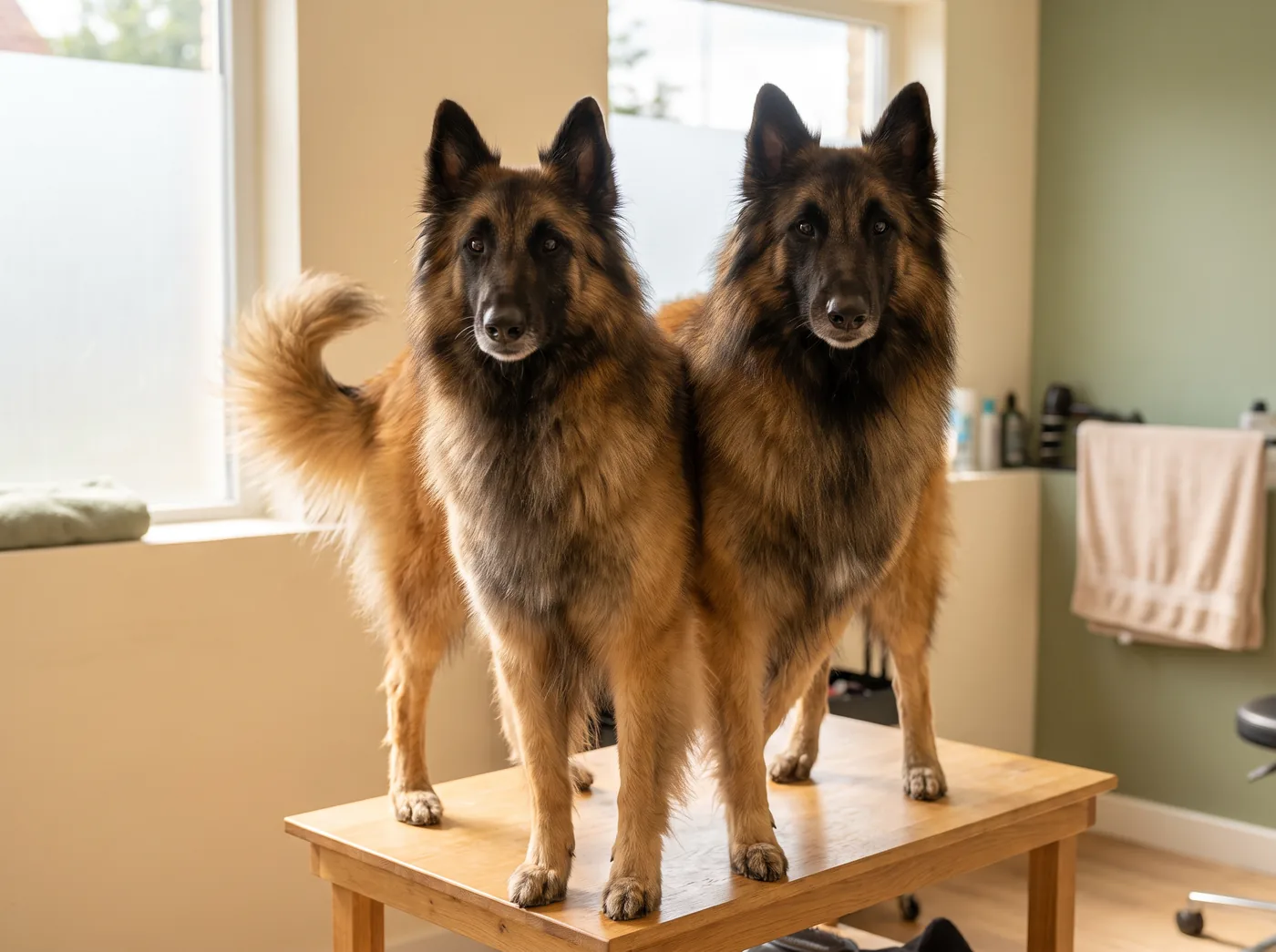
About the Belgian Tervuren
The Belgian Malinois page makes the point that the four Belgian shepherds are either one breed or four depending on the registry, that they span three completely different coat types, and that a salon expecting a Malinois and receiving a long coated one has booked a quarter of the time it needs. This is that dog.
The Tervuren carries the same fawn to mahogany coloring with a black overlay as the Malinois, on the same working frame, with a completely different coat: long, straight and abundant, with an enormous ruff around the neck known as the collarette, heavy feathering on the backs of the legs, and a full plumed tail.
Underneath it is a dense undercoat, so this is a genuine working double coat with all the demands of one. Line brushing every two or three days, a professional appointment every six to eight weeks, twice yearly coat blows, and it is never shaved.
The Belgian Tervuren has a double coat that regulates its own temperature. Shaving it does not keep the animal cooler, removes the protection against sun and insects, and the top coat often grows back patchy or never returns correctly. A thorough deshed takes out the undercoat and does the job the owner was actually asking for.
The collarette, and where the coat actually fails
The coat is not evenly distributed and that is the practical fact. It is heaviest by a wide margin at the collarette, the ruff around the neck and chest, which on males is genuinely dramatic. After that the trousers on the hind legs, the tail plume, the feathering on the backs of the front legs, and behind the ears. The back and flanks carry far less.
Those heavy areas are where a Tervuren mats and where a casual brush skims. A dog can look magnificent while carrying a felted layer under the collarette, which is the most common presentation at a salon.
Line brushing is the method: part the coat down to the skin and work outward in sections, so every hair passes through the brush from root to tip. A slicker for the body and an undercoat rake for the dense areas, then a metal comb as the test. If the comb will not pass freely from skin to tip, that section is not brushed however good it looks.
Every two or three days, and the collarette and behind the ears every single time.
The coat is harsher and less profuse than a Rough Collie, which helps, but it is on a considerably more athletic dog that spends more time outdoors in cover.
Neutered and spayed dogs frequently grow a softer, thicker, more cotton like coat that mats more readily, which is normal and means more brushing.
Shedding, the blow, and never shaving
Tervurens shed heavily year round and then release the whole undercoat twice a year over two to four weeks. Intact females often blow coat after a season as well.
An undercoat rake and a slicker, in sections, daily during a blow and outdoors. A bath and a high velocity dry at the start of each blow is by far the most effective intervention available and removes more than several weeks of brushing.
Dead undercoat left in place is what causes the matting: it packs down against the skin, binds with the growing coat, and becomes a felted layer that traps moisture and produces hot spots underneath.
And then shaving, which happens to long coated Belgians for the usual reason. Removing the outer coat takes away the layer that blocks sun and holds insulating air while leaving the undercoat that traps heat, so the dog gets hotter rather than cooler and its skin is exposed for the first time. The regrowth is frequently permanently woolly, uneven and mat prone, and on a working dog expected to be outdoors in all weather that is a functional loss.
The correct response to a hot Tervuren is a thoroughly deshedded coat plus shade, water and working the dog at the ends of the day.
Trimming is limited to the feet, the hocks and the sanitary area. Some owners also tidy the hair between the pads and around the ears, which is fine.
Drive and sensitivity, which shape the appointment
Tervurens share the Malinois' working heritage and much of its drive: high energy, enormous focus, strong herding instinct and a real need for a job. An under-exercised Terv is difficult everywhere, including a grooming table.
Where they generally differ is sensitivity. Tervurens are typically softer and more sensitive to handling and to atmosphere than a working line Malinois, and they respond badly to being rushed, cornered or handled roughly. They are also often noticeably reserved with strangers, which is in the standard rather than a fault.
What that means practically: a Tervuren usually cannot be pushed through a two and a half hour appointment it is not comfortable with. It can be taught to accept the whole thing if the work is done early, and short uneventful visits from puppyhood matter more here than on a low drive breed.
Handle the feet, ears and mouth daily from eight weeks, get the dog used to the sound of a high velocity dryer before it ever needs one, and find one groomer the dog knows rather than moving around.
Ask about the salon floor. Many working line Belgians are not comfortable with unfamiliar dogs, and a busy open floor is a poor environment for a sensitive, reactive, high drive dog.
And exercise properly beforehand. On this breed it is not a courtesy.
What a full groom involves, and the other Belgians
Two and a half hours is normal, and most of the back half is drying. Getting water and shampoo to the skin through a dense undercoat takes time, rinsing takes longer, and drying all the way down cannot be rushed. A Tervuren that goes home damp underneath is a hot spot risk.
The order is: line brush through dry, dealing with any felting first, then bathe, then a high velocity dry with brushing throughout, then feet, hocks, nails, ears and sanitary area. Nothing else is cut.
Ears are upright, triangular and open, which is the easy version. A weekly look is enough, though the long hair around the base wants combing.
Nails every three to four weeks.
For completeness, the family again, because booking depends on it: the Malinois is short coated, the Tervuren is this dog, the Groenendael is the same long coat in solid black and is groomed identically, and the Laekenois is the rare wire coated one that is stripped like a terrier jacket.
So a Groenendael owner can follow this page exactly. A Laekenois owner should not.
What to tell your groomer
Say Tervuren rather than Belgian Shepherd, because that name covers four dogs and three coat types.
Ask whether they have a high velocity dryer and have booked two and a half hours.
Ask for a deshedding treatment rather than a bath and brush, and book at the start of each coat blow.
Say when the collarette and behind the ears were last brushed to the skin, since that is where the matting is.
Say the dog is sensitive as well as high drive, and ask them to work slowly and to keep it away from a busy floor.
Ask for nothing cut beyond feet, hocks and sanitary area, and decline any offer to shave.
Keeping the coat between grooms
Line brush the collarette
The heaviest coat on the dog and where it felts first. Part to the skin and prove it with a comb.
Every two or three days
Deshed at each coat blow
Dead undercoat left in place is what mats. A bath and high velocity dry beats several weeks of brushing.
Spring and autumn
Never shave the coat
It removes the sun barrier and leaves the insulation, and the regrowth is often permanently woolly and mat prone.
Always
Work the dog first
High drive and genuinely sensitive. A Terv that has not worked will not settle for a two and a half hour appointment.
Every visit
Common Questions About the Belgian Tervuren
How is a Belgian Tervuren different from a Malinois?
Coat, almost entirely. Same coloring, same working frame, same heritage, and depending on the registry they are varieties of one breed or separate breeds. A Malinois is short coated and needs ten minutes a week. A Tervuren carries a long double coat with an enormous ruff called the collarette, heavy leg feathering and a plumed tail, needing line brushing every two or three days and a two and a half hour appointment every six to eight weeks. Temperamentally Tervurens are typically a little softer and more sensitive.
Do Belgian Tervurens shed a lot?
Heavily, year round, and then far more twice a year when the entire undercoat releases over two to four weeks. Intact females often blow coat after a season too. An undercoat rake and slicker in sections every two or three days, daily and outdoors during a blow, plus a bath and high velocity dry at the start of each one, which removes more than several weeks of brushing does.
Can I shave my Tervuren in summer?
No. Shaving removes the long outer coat that blocks sun and holds an insulating layer of air while leaving the dense undercoat that traps heat, so the dog gets hotter and its skin burns. The regrowth is frequently permanently woolly, uneven and far more prone to matting, which on a working dog expected to be outdoors is a functional loss rather than a cosmetic one. Deshed it thoroughly instead and use shade, water and working at the ends of the day.
Similar breeds
Same coat, same schedule, or the breeds this one is crossed from.

Belgian Malinois
A short coat that sheds like a long one, on a dog that needs a job far more than a salon
Belgian Malinois
Rough Collie
A Sheltie coat at twice the size, and one drug warning worth knowing before any sedation
Rough Collie
Australian Shepherd
A working double coat with feathering, and three places it always mats
Australian ShepherdFind a groomer who knows this coat
Search 37,863 groomers by town, or keep reading the breed guide.
Find a Local Groomer View All Breeds