Himalayan Grooming
A Persian coat and a flat face on the same cat, which is the hardest combination there is
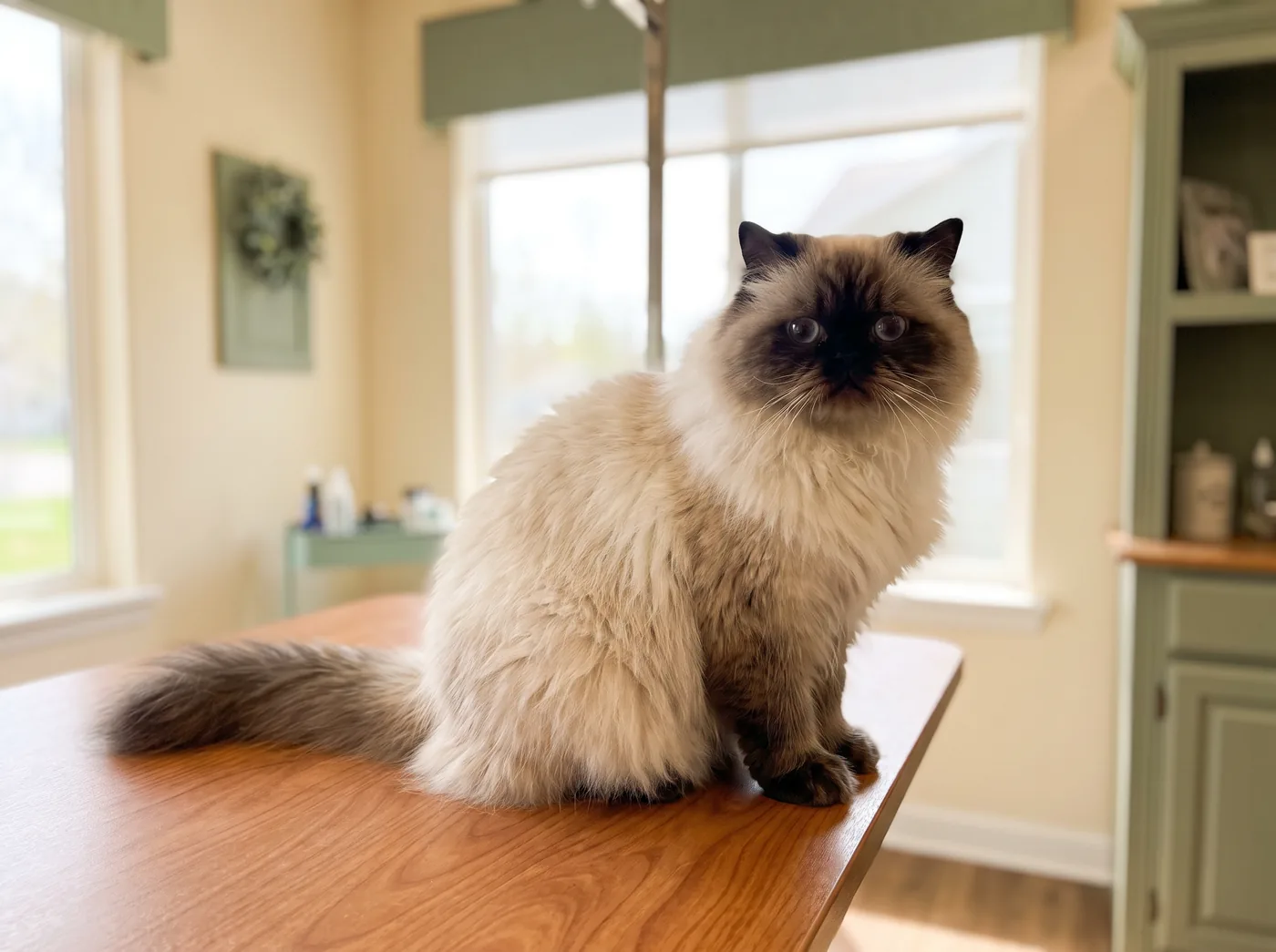
About the Himalayan
The Himalayan was created by crossing Persians with Siamese to put the pointed coloring of one onto the body type of the other. Depending on the registry it is either its own breed or a color division of the Persian, and for grooming purposes that argument does not matter at all.
What matters is that a Himalayan is, in every practical sense, a Persian. It carries the same enormous, fine, silky coat over a dense undercoat, and the same flat compressed face. Nothing about the Siamese ancestry made either of those easier.
That combination is the hardest in cats. The Exotic Shorthair page makes the same point from the easy side: it removes the coat work and keeps the face work. The Himalayan keeps both, in full, and both are daily.
This coat can be clipped, but the texture or the color may change and it will not always come back the same. Talk it through with your groomer before the first one.
The coat, which is a Persian coat
Long, fine, silky, and standing away from the body over a thick undercoat. It is about the highest matting risk of any coat, cat or dog, and the reason is the combination of length, fineness and undercoat density.
Fine hair tangles more readily than coarse hair. A dense undercoat gives it something to tangle with. And the sheer length means a mat has room to grow before anything is visible from outside.
The result is a coat that must be combed to the skin every single day. Not brushed over, combed through, in sections, with a metal comb, on a dry coat. A slicker over the top produces a cat that looks immaculate while a solid felted sheet forms underneath, and that is the single most common way a Himalayan ends up shaved.
The places to work are the six that matter on every long coated cat, and all six are out of sight when the cat is standing: the armpits, the inside of the back legs, the belly, the ruff under the chin, behind the ears and the base of the tail.
The belly and the armpits are the worst on this breed, because they are the hardest for the cat to reach and the easiest for an owner to skip on a cat that does not want to be turned over.
Ten minutes a day genuinely prevents almost all of it. Two missed weeks does not.
The face, which is a Persian face
The flat compressed skull distorts the tear duct, so the eyes water more or less permanently. The overflow runs down into the fold that crosses the muzzle, oxidizes, and stains the hair a reddish brown that will not wash out.
On a Himalayan that shows badly, because the classic colors are pale bodied with dark points and the staining lands squarely on the light part of the face.
The fold itself is the more important half. Warm, enclosed and constantly damp is what yeast and bacteria want, and left alone the sequence is a sour smell first, before anything is visible, then redness, then a raw sore surface.
The routine takes under a minute: wipe under each eye and right into the muzzle fold with a damp cloth or unscented wipe, then dry it. The drying is the half that gets skipped and the half that matters.
Keeping the hair around the eyes and on the muzzle trimmed short helps considerably, because it lets the area dry rather than holding moisture against the skin.
Escalate to a veterinarian for any sudden increase in watering, squinting, pawing at the face or discharge that changes color. Blocked ducts, inward turning lashes and corneal damage all present this way, and the prominent eye on a flat faced cat is injured easily.
The flat face also means heat and drying care: no hot air, dryer never pointed at the face, and short sessions, because a brachycephalic cat cools itself poorly.
The lion cut, and when it is the right answer
A lion cut clips the body coat short and leaves the head, the lower legs and the tip of the tail, and it is common on Persians and Himalayans. It gets treated as either a scandal or a default, and neither is right.
It is genuinely the correct answer in several situations. A coat that is already pelted, where combing it out would mean hours of dragging on skin. A cat that has become unable to groom itself through age, arthritis, obesity or illness. A cat that will not tolerate daily combing at all, where the honest choice is between a clipped cat and a matted one. And any cat where matting has already caused skin damage underneath.
It is not the right answer as a default for a healthy, well combed cat, and it is not a substitute for the daily routine on the parts that are left.
Two practical points. It is a professional job, because cat skin is extremely thin and mobile and lifts into folds under a blade, and a lion cut on a matted cat is genuinely delicate work. And the coat takes months to return, sometimes coming back with a different texture, so it is a decision with a long tail.
The face routine does not change at all. Everything in the section above still applies to a clipped cat, and it remains daily.
The points, the litter box and the two absolute rules
Himalayans are a pointed breed, which means the coloring is temperature dependent: pigment develops only below a certain temperature, so the cool extremities carry the dark color. Kittens are born almost white and develop points over weeks and months.
Practically, a patch shaved for a veterinary procedure often grows back noticeably darker, because the skin was cooler while it healed. It is normal and usually fades over later coat cycles. Cats living in colder homes tend to darken overall with age, and the same cat can look different between summer and winter.
The litter box is a genuine issue on this breed and rarely mentioned. A long coated cat with heavy trousers and a plumed tail carries litter and waste out of the box, and a Himalayan with a flat face and short legs is not a precise or athletic user of one. Keeping the sanitary area, the trousers and the hair between the paw pads trimmed short is standard and prevents most of it. A large open box with low sides helps.
Then the two rules that apply to every cat and never bend.
Never cut a mat out with scissors. Cat skin lifts into a fold beneath a mat and sits exactly where the blade goes. Serious injuries from owners with scissors are a routine emergency presentation.
Never bathe a matted coat. Water tightens a mat like a wet knot. Comb first, always.
What to tell your groomer
Say the cat is flat faced and ask them to keep the dryer off the face, use low or no heat and work in short bursts.
Ask them to clean and dry the muzzle fold as part of the appointment, and to trim the hair around the eyes and on the muzzle short.
Ask for the sanitary area, the trousers and the paw pads kept short, which solves most of the litter box problem.
Say honestly when the coat was last combed to the skin and where you have found mats, particularly on the belly and in the armpits.
Mention any change in weight or mobility, which is the best single predictor of what a long coated cat's coat is about to do.
And ask whether they take cats, work without sedation and keep cats away from dogs.
Keeping the coat between grooms
Comb to the skin, every day
Metal comb, in sections, on a dry coat. The belly and armpits are the worst and the easiest to skip.
Daily
Clean and DRY the muzzle fold
Under each eye and into the fold, then dry. Under a minute, and the drying is the half that matters.
Daily
Keep the rear and pads trimmed
A flat faced longhaired cat is not a precise user of a litter box. This solves most of that problem.
Every few weeks
Never scissors on a mat
Cat skin lifts into a fold underneath and sits where the blade goes. Clippers flat to the skin, or a groomer.
Always
Common Questions About the Himalayan
Is a Himalayan the same as a Persian?
For grooming purposes, yes, entirely. A Himalayan is a Persian carrying the pointed coloring of a Siamese, and depending on the registry it is either a separate breed or a color division of the Persian. The coat is the same long fine silky coat over a dense undercoat, and the face is the same flat compressed face. Both need daily attention. Nothing about the Siamese ancestry made either half easier, so read the Persian advice and follow all of it.
Should I get my Himalayan a lion cut?
It depends on the cat rather than the breed. It is the right answer for a coat that is already pelted, for a cat that can no longer groom itself through age, arthritis, weight or illness, and for a cat that genuinely will not tolerate daily combing, since a clipped cat beats a matted one. It is not a default for a healthy well combed cat. Have it done professionally, because cat skin is thin and lifts under a blade, expect months of regrowth, and note that the daily face routine does not change at all.
Why are my Himalayan points getting darker?
Because pointed cats color by temperature. Pigment only develops below a certain skin temperature, which is why the cool extremities carry the dark points, so anything that cools the skin darkens the hair that grows there. A patch shaved for surgery commonly grows back darker and usually fades over later coat cycles. Cats in colder homes darken overall with age, and the same cat can look different between summer and winter. All of it is normal and none of it needs treatment.
Similar breeds
Same coat, same schedule, or the breeds this one is crossed from.

Persian
The cat that genuinely needs a groomer, and the one owners realize it about too late
Persian
Exotic Shorthair
A Persian face on a short coat, which removes half the work and none of the face
Exotic ShorthairFind a groomer who knows this coat
Search 37,863 groomers by town, or keep reading the breed guide.
Find a Local Groomer View All Breeds