Irish Water Spaniel Grooming
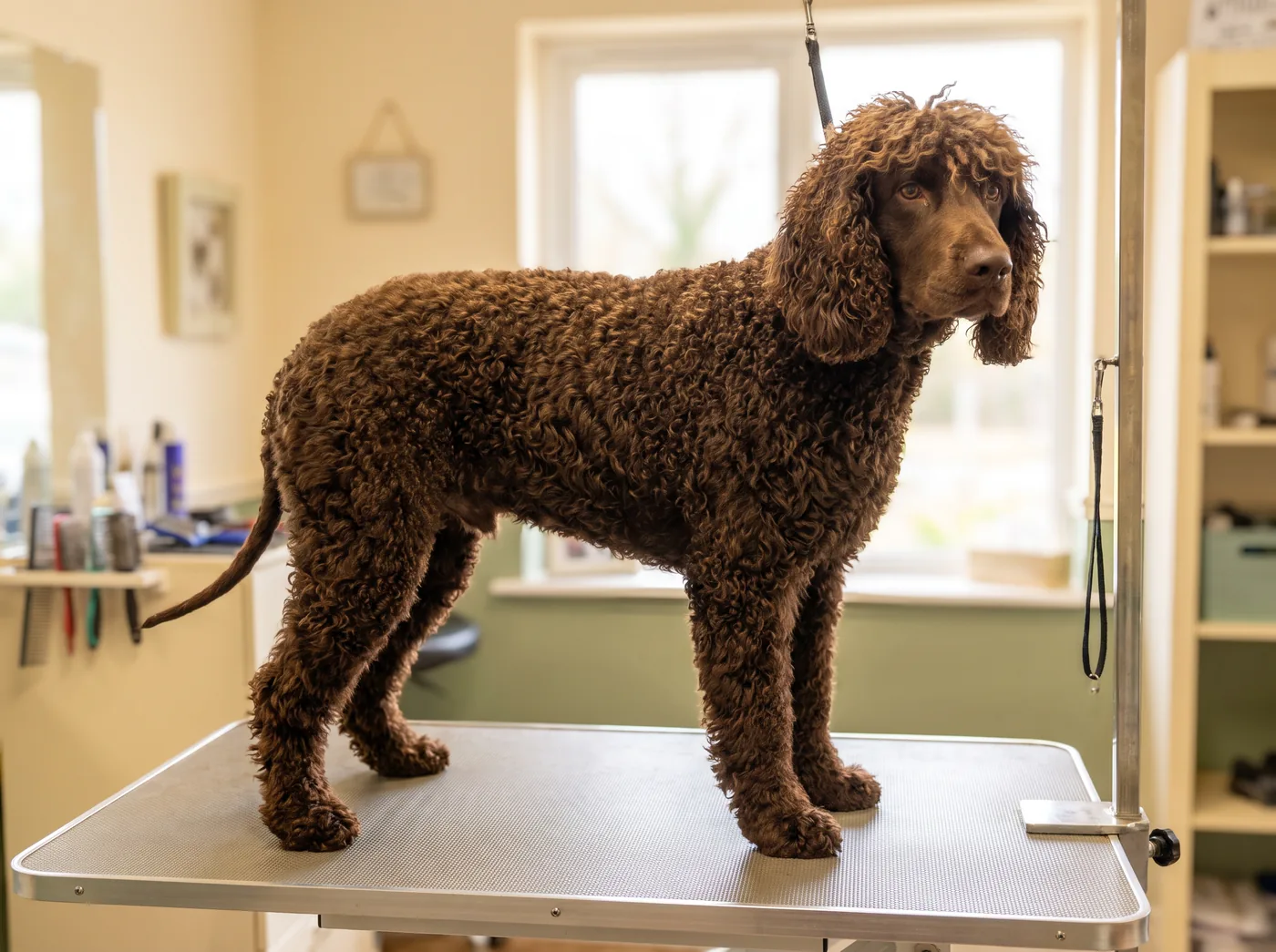
Crisp ringlets over the whole dog except the tail, which is bare by design
About the Irish Water Spaniel
The tallest of the spaniels and one of the most distinctive coats on the site: dense, crisp ringlets covering the body and legs, a topknot of long loose curls falling over the forehead, and a completely smooth face.
Then the tail, which is the fact nobody expects. An Irish Water Spaniel has a short curled coat at the base of the tail for two or three inches and then nothing: the rest is smooth, bare and tapering, which is why the breed has been called the whiptail or rat tail spaniel for two hundred years. It is normal, it is required by the standard, and it is not hair loss.
Groomers who have not met the breed have been known to apologize for it or worry about mange, and owners have been known to worry too, so it is worth saying plainly.
The rat tail, and the rest of the pattern
The coat is not uniform and the pattern is the breed, so it is worth knowing which bits are meant to be bare.
Ringlets, dense and crisp rather than soft, cover the body, the neck, the chest and the legs down to the feet.
The topknot is longer, looser curls growing forward from the skull and falling over the forehead, ending in a peak between the eyes. It is trimmed to shape rather than removed.
The face is smooth, short and hairless, with a clear line where the topknot ends. The muzzle is smooth all the way down, and the throat has a smooth V shape.
The tail is the famous part: thick and covered in curls for two or three inches at the base, then abruptly smooth and bare for the rest of its length.
The ears are long, low set and covered in long twisted curls.
Trimming the coat means maintaining that pattern rather than shortening everything, and it is skilled scissoring work. A groomer who does not know the breed will either leave the face and throat hairy or clip the whole dog to one length, and both are wrong.
Keeping ringlets, without brushing them out
The coat is single, with no undercoat, and it sheds very little. What it does instead is hold shed hair inside the curls, which is where the matting comes from.
The handling is a middle position between the Poodle and the Lagotto. You do have to get through the coat to the skin, and you do not want to brush the ringlets out into frizz.
Work with a wide toothed comb and your fingers rather than a slicker, in sections, separating rather than dragging. Every two or three days.
The places that mat: behind and under the ears, the armpits, the chest, the britches, and anywhere a collar or harness sits.
The ears are the worst, because long twisted curls hang over a drop ear on a dog that swims.
If the coat is worked into frizz it settles back into ringlets over a couple of weeks, particularly after a bath, so it is a cosmetic setback rather than a disaster.
Bathe every eight weeks or so, work shampoo through the curls rather than lathering the surface, and rinse until it runs clear, since residue trapped in a ringlet irritates the skin underneath.
Water, drying and the ears
The clue is in the name. These are serious water dogs, the coat is oily and water resistant, and an IWS will swim in anything.
A dense curled coat holds a lot of water and gives it up slowly, so drying is the real work after any swim. Squeeze, towel hard, and dry with cool or warm air working your fingers through rather than brushing. Get to the skin, especially at the chest, armpits and under the ears.
A curled coat put away damp sours and grows yeast at the skin, and the classic complaint about the breed smelling is almost always a drying problem rather than a dirt one.
Rinse with fresh water after salt or chlorinated water, which sits in the curls and irritates skin.
The ears need the most attention of anything on this dog. Long, low set, heavily curled and hanging over a canal on an animal that is constantly wet, which is the worst combination there is.
Dry them after every swim and bath, keep the hair around the opening and on the underside of the flap trimmed short so air reaches the canal, and lift and smell weekly. Any smell, discharge, head shaking or scratching means a veterinarian.
Finding a groomer, and the drug warning
Few groomers have handled an Irish Water Spaniel, and the trim is genuinely specialized. Ask directly whether they know the breed pattern, and if not, bring photographs of a correctly trimmed dog and be specific: smooth face and throat, topknot shaped not shortened, ringlets left as ringlets, tail bare below the curls at the base.
A pet trim shortening the body ringlets a little is perfectly reasonable. Clipping the whole dog to one length is not, and it also softens a coat that depends on being crisp.
One thing to say out loud at any veterinary appointment rather than a grooming one, because it is genuinely dangerous: Irish Water Spaniels are among the breeds reported to be sensitive to sulfa drugs and to some anesthetics and vaccines, with reactions well recognized in the breed community. It is worth raising with a vet before any sedation, including sedation for grooming.
Any breed sedated for grooming needs a veterinarian involved anyway, and this is a breed where that matters more than usual.
Nails every three to four weeks, pads cleared, and the feet checked after work in cover.
What to tell your groomer
Say the bare tail is correct and required by the standard, not hair loss, so nobody worries about it or tries to fix it.
Ask for the breed pattern kept: smooth face and throat, topknot shaped, ringlets left as ringlets, and bring photographs.
Say to comb and separate with fingers and a wide toothed comb rather than brushing the curls out with a slicker.
Ask for the ear openings and the underside of the flaps kept trimmed, and the ears dried thoroughly.
Say drying must reach the skin, and allow the time on a dense curled coat.
Mention the breed's reported drug sensitivities if sedation is ever discussed.
Keeping the coat between grooms
Separate, do not brush out
Wide toothed comb and fingers, in sections. A slicker turns ringlets to frizz.
Every two to three days
Dry and check the ears
Long curled ears over a canal on a dog that swims. The worst combination there is.
After every swim
Dry to the skin, fingers not brush
A damp curled coat at the roots is where the smell and the skin trouble start.
After water
Bring photos of the trim
Smooth face and throat, shaped topknot, ringlets kept, bare tail. Few groomers know it.
Every six to eight weeks
Common Questions About the Irish Water Spaniel
Why does my Irish Water Spaniel have a bald tail?
Because it is meant to. The breed has curls for two or three inches at the base of the tail and then a smooth, bare, tapering tail for the rest of its length, which is why it has been called the rat tail or whiptail spaniel for two centuries. The standard requires it. It is not hair loss, mange or a grooming failure, and it does not need treating. It is worth mentioning to a groomer or a new vet, since people unfamiliar with the breed do occasionally raise it as a concern.
How do you brush an Irish Water Spaniel without ruining the curl?
Use a wide toothed comb and your fingers rather than a slicker, working in sections and separating the ringlets rather than dragging through them. The aim is to reach the skin without brushing the curl out into frizz, which sits between the Poodle approach and the leave-it-alone approach used on a Lagotto. If it does frizz it settles back into ringlets over a couple of weeks, especially after a bath, so it is a cosmetic setback rather than lasting damage.
Why does my IWS smell after swimming?
Almost always because the coat is not dry at the skin. A dense curled water resistant coat holds a great deal of water and releases it slowly, and a damp coat sours and grows yeast at the roots. Squeeze the water out, towel hard, then dry with cool or warm air working your fingers through the curls rather than brushing, paying attention to the chest, armpits and under the ears. Bathing more often makes it worse rather than better.
Similar breeds
Same coat, same schedule, or the breeds this one is crossed from.

Portuguese Water Dog
A curly working coat with two traditional clips, and one of them has a real reason behind it
Portuguese Water Dog

Lagotto Romagnolo
A working curl that is kept short and left in ringlets, which is the opposite of a Poodle
Lagotto RomagnoloFind a groomer who knows this coat
Search 37,863 groomers by town, or keep reading the breed guide.
Find a Local Groomer View All Breeds