Poodle Grooming
The coat every doodle inherits, and the one the whole trade is built around
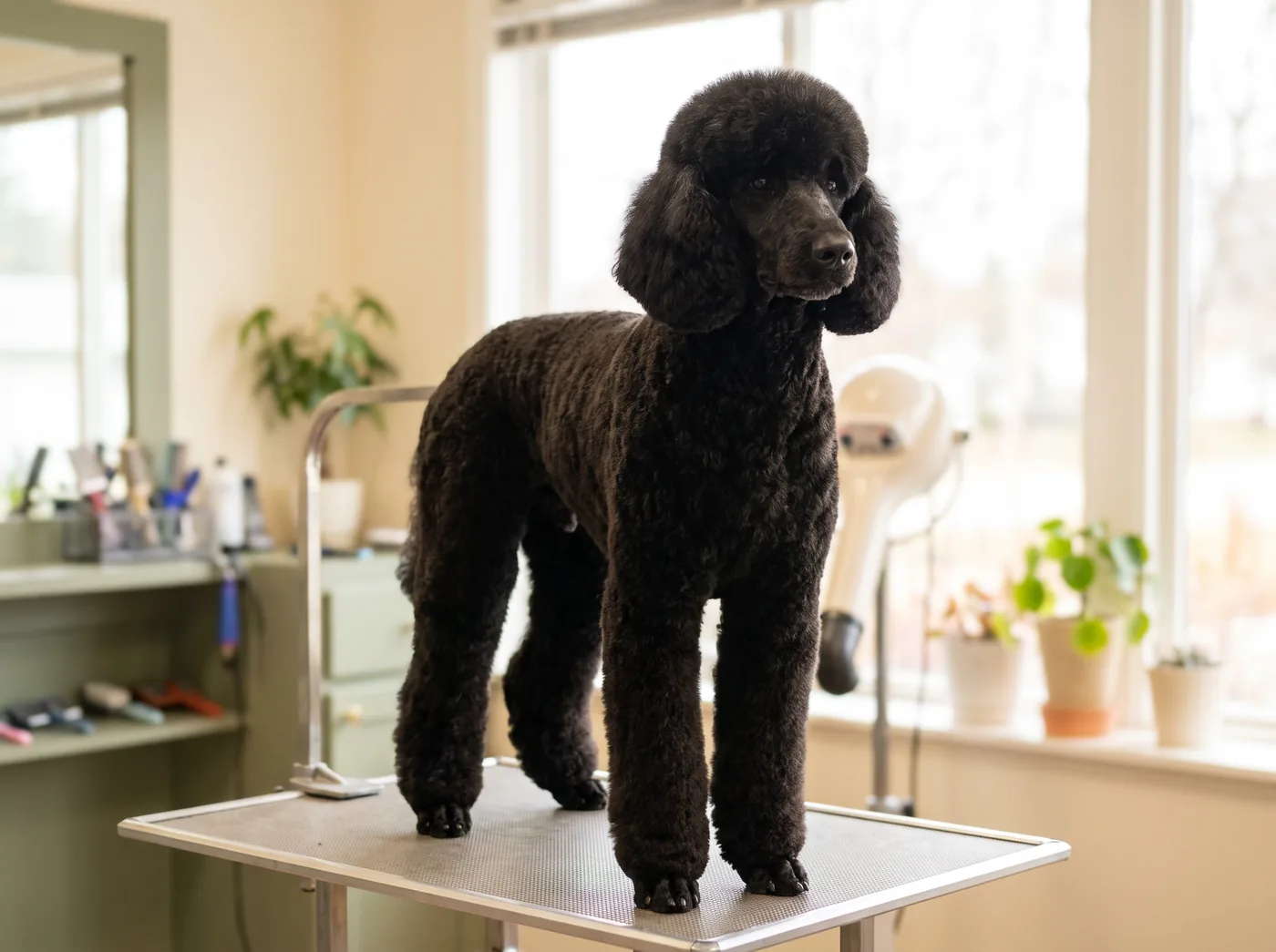
About the Poodle
The Poodle has the most worked with coat in grooming, and every doodle cross exists because of it. It is a single coat of dense, tightly curled hair that grows continuously and traps shed hair rather than dropping it. That combination is why Poodles shed almost nothing into a house, why they need cutting every few weeks, and why they can felt to the skin faster than any other breed.
This page is written around the Standard, but the coat is the same on the Miniature and the Toy and so is almost all of the advice. What changes with the varieties is the time, the price and the handling, not the technique.
The Poodle is also the breed where the haircut is a genuine craft. Almost every recognizable pet trim in a modern salon started here.
What a full groom involves
A full brush and comb through, dry, before anything else. On a Poodle this is not a formality: the coat can be solid against the skin while looking immaculate, and finding that out in the bath is finding out too late.
Then a rough pre clip to take off length, then a double bath and conditioner, then a full blow dry with a brush working the coat straight as it dries. Straightening the curl in the dry is what makes scissor work possible; a Poodle dried curly cannot be cut to a line.
Then the clipper work, which sets the length on the body and does the close areas: the face, the feet and the base of the tail are traditionally clipped short on this breed and it is what gives a Poodle its outline.
Then the scissor finish, which is where the time goes and where the skill is. Legs are scissored round into columns, the head is shaped, the ears and tail are finished. On a Standard in a full pet trim this is easily an hour and a half on its own.
Nails, ears and sanitary throughout. Three hours for a Standard is normal.
How often, and what happens if you stretch it
Four to six weeks, and the shorter end if the trim is long. This is a coat that never stops growing and never sheds out, so there is no version of it that reaches a stable length on its own.
Stretching it produces matting rather than scruffiness, and it produces it against the skin where you cannot see it. A Poodle at ten weeks looks bigger and softer and is frequently felted underneath, particularly in the armpits, behind the ears and along the collar line.
The consequence is a shorter clip than you asked for. That is not damage: a curly coat grows back true with the same texture and color, and the dog is comfortable within a day. But it is a decision made for you rather than by you, and it repeats until the interval changes.
If you want a Poodle in a long trim, the daily comb is the price of it. If you would rather not do the daily comb, ask for a shorter clip and book at six weeks. Both work. The combination that does not work is a long trim and a long gap.
The coat problems a Poodle actually gets
Felting is the whole problem and it is invisible from above. A slicker brush glides over the surface of a Poodle coat indefinitely while a solid layer builds underneath, so brushing daily and being matted are entirely compatible. The comb is the arbiter: part the coat to the skin and draw a metal comb outward. If it will not reach skin, the coat is matted whatever the brush is telling you.
Check behind both ears, both armpits, the trousers, the collar line and either side of the tail base. Those five places account for most of it.
Ears are the second problem. Poodles grow hair inside the ear canal, which most breeds do not, and it traps wax and moisture. Whether that hair should be plucked is genuinely debated in the trade now: routine plucking can irritate the canal, and current thinking in many practices is to thin or trim rather than pull unless there is a reason. Ask your groomer and your veterinarian what they prefer for your dog rather than assuming.
The third is the feet. Hair grows between the pads, mats there, and collects grit, and on a clipped foot it is easy to miss because the outside looks tidy.
What moves the price
The variety, first, because it sets the bath and dry time and how much surface there is to scissor. A Standard is a substantially bigger job than a Toy and is priced accordingly.
Then the trim. A short uniform clip with a simple outline is far quicker than a scissored trim with rounded legs and a shaped head, and it holds its shape longer. Traditional patterns take longer still. This is the breed where what you ask for genuinely changes the bill.
Then coat condition, which on a Poodle can change a booking from a haircut into a strip down.
Then color, occasionally and legitimately: white and light coated Poodles show staining on the face, feet and sanitary area, and getting them genuinely clean takes longer than it does on a black dog.
What to tell your groomer
Name a length rather than a style if you can, or bring a photograph. Poodle trim names are a real vocabulary and they are not universal: a lamb trim, a teddy bear, a sporting trim and a puppy clip mean somewhat different things in different salons.
Say what you want on the face. A clipped face is the traditional Poodle look and stays clean; a teddy bear face with the muzzle left full reads softer and needs daily wiping. It is the single decision that changes the dog most.
Say what you want on the feet and the tail, since both are traditionally clipped and plenty of owners prefer them left natural.
Tell them about the ears: whether the dog has had ear trouble, and what your veterinarian prefers regarding the hair in the canal.
And book the next one before you leave. A Poodle on a standing five week cycle is a predictable, pleasant appointment. The same dog at eleven weeks is a different conversation.
Keeping the coat between grooms
Comb, do not just brush
A slicker tidies the surface. A metal comb drawn from the skin outward is the only thing that tells you whether the coat is actually clear.
Daily
Check the five hot spots
Behind both ears, both armpits, the trousers, the collar line and either side of the tail base.
Weekly
Keep an eye on the ears
Poodles grow hair inside the canal, which traps wax and moisture. Look and smell weekly, and follow your veterinarian on whether to pluck or trim.
Weekly
Clear between the pads
Hair mats between the toes and collects grit even when the outside of the foot looks tidy.
Every couple of weeks
Common Questions About the Poodle
Do Poodles really not shed?
They shed, but the hair stays in the coat instead of falling out, so it does not end up on your furniture. That is the whole trade: almost nothing in the house, and a coat that has to be combed and cut on a schedule because the shed hair is still on the dog. Poodles are among the better breeds for allergy sufferers for the same reason, though no dog is truly hypoallergenic since the allergen is in dander and saliva rather than hair.
What is the difference between a puppy cut, a teddy bear and a lamb trim?
Less than you would hope, and the names are not standard across salons. Broadly, a puppy cut is one fairly short length all over with a rounded head; a teddy bear leaves the face full and rounded rather than clipped; a lamb trim leaves the legs longer than the body. Because the terms drift, the reliable approach is a photograph plus a length: say what you want on the body, the legs and the face separately and you will get it.
Is a Standard Poodle harder to groom than a Miniature or Toy?
The coat and the technique are identical. What changes is the scale: a Standard takes far longer to bathe, dry and scissor, needs a table and bath that will take a large dog, and asks the dog to stand for a long session. A Toy is quick to bathe and slow to finish, because the detail work around a very small face and feet does not scale down. The interval is four to six weeks for all three.
Similar breeds
Same coat, same schedule, or the breeds this one is crossed from.

Goldendoodle
The busiest coat in any grooming salon, and the one owners are warned about least
Goldendoodle
Find a groomer who knows this coat
Search 37,863 groomers by town, or keep reading the breed guide.
Find a Local Groomer View All Breeds