Puli Grooming
A corded coat that is separated by hand, never brushed, and takes a day to dry
About the Puli
Almost every grooming guide ends in some version of brush it more often. This one does not, and getting that wrong is expensive.
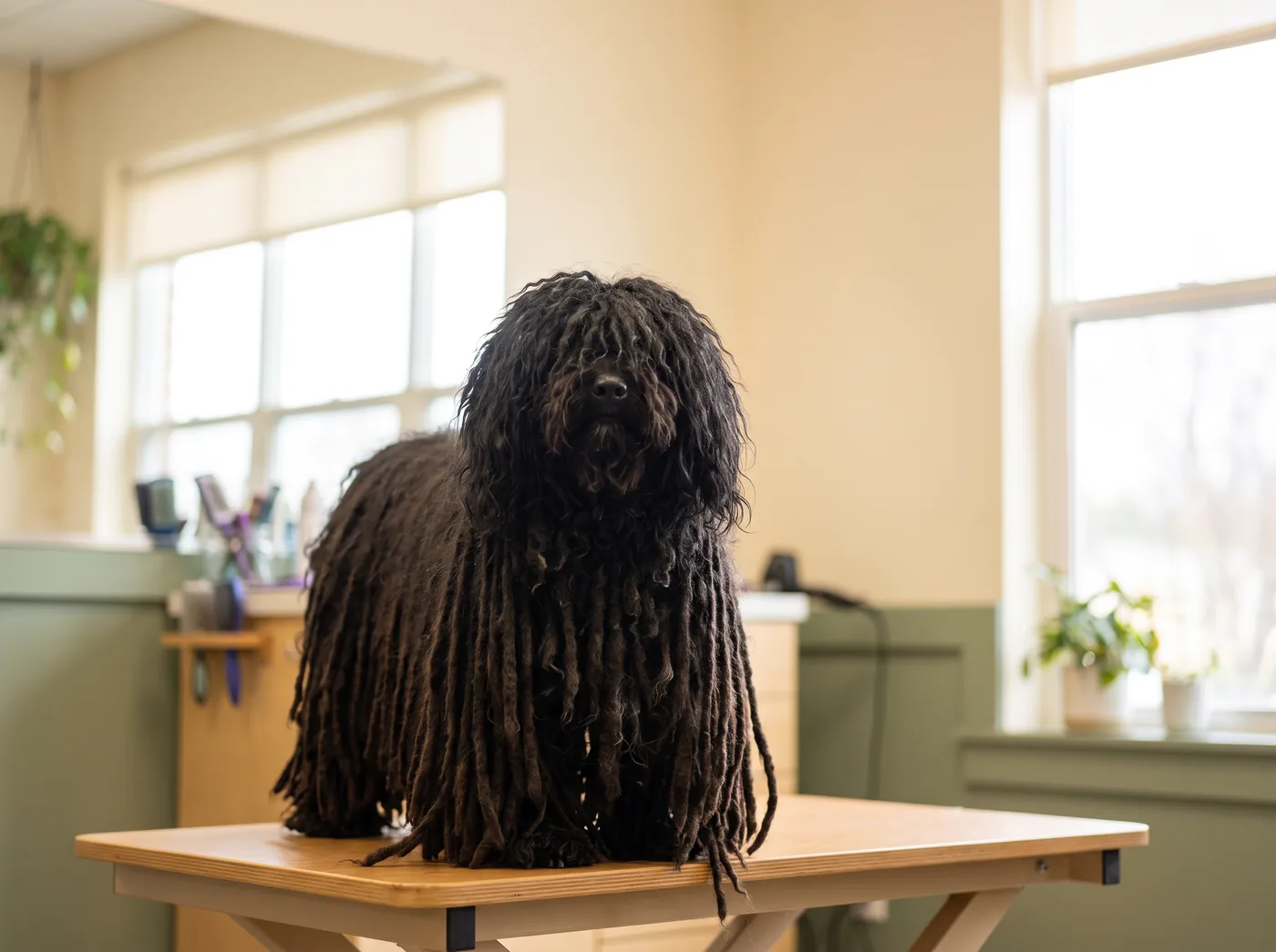
A Puli has a corded coat. The soft woolly undercoat and the harsher outer coat tangle together into narrow ropes that grow for the life of the dog, and those cords are the coat. They are not neglect and they are not mats in the sense a groomer usually means. Brushing a corded Puli out does not tidy it, it destroys it, and a full coat represents four or five years of growth.
The work is real but it is a different kind of work. You separate the cords with your fingers, you keep the skin underneath clean, and you accept that a bath is most of a day. In exchange the coat barely sheds and needs no cutting at all.
The Puli has a double coat that regulates its own temperature. Shaving it does not keep the animal cooler, removes the protection against sun and insects, and the top coat often grows back patchy or never returns correctly. A thorough deshed takes out the undercoat and does the job the owner was actually asking for.
How cords form, and what you actually do
A Puli puppy has a soft wavy coat that behaves like any other and can be brushed. The change comes somewhere between about six and twelve months, when the adult outer coat comes through into the woolly undercoat and the two begin to tangle. That tangling is the start of the cords, and it is the point at which the brush is put away for good.
What you do instead is separate. As clumps form, you take them in your fingers and pull them apart down to the skin, splitting a wide flat mat into narrower ropes. It is done dry, without tools, and it is a job you do sitting with the dog rather than on a table.
The size the cords settle at is decided in this first year by how finely you split them, and it is largely permanent. Thin cords look elegant, take longer to dry and take far more work; thick cords are quicker to manage and read as heavier. Somewhere around the width of a pencil is a common compromise.
Once established, cords need going through every few weeks, mainly at the roots where new growth felts together at the skin. Left alone the whole coat merges into a single mat against the body, and the only remedy for that is to shave it off and start again.
The cords keep growing and eventually reach the ground. Many owners trim the ends level so the dog can move and see, which is fine. The tips are the oldest and dirtiest part of the coat anyway.
Bathing, and why drying takes most of a day
This is the part owners are not warned about and it is the single biggest practical fact about the breed.
A corded coat holds an enormous amount of water. Each cord is a dense rope of wool that soaks through and then releases it very slowly, so a bathed Puli is heavy, and a coat that is put away damp will sour, smell and go moldy at the skin. Skin infection under a wet corded coat is the classic Puli problem.
Realistic timings: washing itself takes a while, because shampoo has to be worked into each cord and then rinsed out completely, and residue left inside a cord irritates skin you cannot see. Then squeeze water out of the cords by hand, towel hard, and dry with a stand dryer on cool or warm air for several hours. Depending on the coat and the weather, from wet to genuinely dry to the skin is anywhere from most of a day to twenty four hours.
Plan for that. Bathe in the morning, not the evening, and never bathe a Puli the day before it needs to be somewhere.
Because bathing is such an undertaking, most owners bathe rarely, around every eight to twelve weeks, and spot clean between. That is reasonable so long as the feet, the beard and the rear are kept clean, since those are what dirty first.
Check the skin under the cords while you separate them. You cannot see it, so you have to feel for heat, lumps and damp, and part the cords to look.
The alternative: the brushed coat, and the shave down
A corded coat is a choice and not an obligation, and it is worth saying plainly that there are three ways to keep a Puli.
Corded is the traditional coat and the one described above.
Brushed out is a genuine option if you commit before the cords set. A Puli coat that is brushed daily from puppyhood never cords and lives as a long, thick, wavy coat, roughly the workload of an Old English Sheepdog. What you cannot do is switch: once cords are established, brushing them out is not practical and often not possible.
Clipped short is the third, and there is no shame in it. A Puli in a short trim is a comfortable, easily maintained dog, and for a working owner or a family with limited time it is a far better outcome than a neglected corded coat with sores underneath. The coat can be grown back and re-corded later if you change your mind, though it takes years.
Choose deliberately in the first year rather than drifting. Most bad Puli coats are the result of an owner who wanted cords, did not know about the separating or the drying, and stopped keeping up.
Finding a groomer, and what goes wrong
Most groomers have never handled a corded coat and some will decline, which is the honest answer rather than a bad one. Call ahead and ask directly whether they have worked on a Puli, a Komondor or a corded Poodle.
The failure to guard against is a groomer who treats the cords as matting and brushes or dematts them out. It is a completely understandable mistake, because to anyone who has not seen a corded breed the coat looks exactly like severe neglect, and it is not reversible. Say it at the booking, say it again at drop off, and do not assume it is obvious.
The second thing to establish is drying. A salon that dries in a kennel dryer for an hour and sends the dog home damp is worse than no bath at all on this coat. Ask specifically how long they will dry for and whether the dog can stay for the day.
Nails, teeth, pads and the sanitary area still need the ordinary attention, and those are worth booking even with an owner who does the coat at home. The hair around the eyes and the rear needs keeping clear so the dog can see and stay clean.
Expect a Puli appointment to be priced high and to take several hours, because it genuinely does.
What to tell your groomer
Say, before anything else, that the coat is corded and must never be brushed, combed or dematted.
Say whether you want the cords kept, the coat clipped off, or the ends tidied only, and be specific.
Ask how long they will dry the dog for, and expect the honest answer to be several hours. Book a day appointment.
Ask them to check and report on the skin under the cords, since neither of you can see it without parting them.
Ask for the eyes kept clear, the rear kept clean and the pads and nails done.
If they have not worked on a corded coat before, say so out loud and decide together rather than hoping.
Keeping the coat between grooms
Separate the cords by hand
Fingers only, dry, splitting clumps to the skin. No brush ever touches this coat.
Every two to three weeks
Feel and look at the skin
You cannot see it through the cords. Part them and check for heat, damp and lumps.
Every two to three weeks
Bathe in the morning
Rinse every cord clear of shampoo. Residue inside a cord irritates skin you cannot see.
Every eight to twelve weeks
Dry for hours, to the skin
Squeeze, towel, then a stand dryer. A damp corded coat sours and goes moldy.
After every bath
Common Questions About the Puli
Do you brush a Puli?
No, and this is the one breed where brushing is the mistake. The coat is corded: the wool undercoat and the harsher outer coat tangle into ropes that grow for the dog's whole life, and those cords are the coat rather than matting. You separate them with your fingers instead, pulling clumps apart down to the skin every few weeks so the roots do not felt together. Brushing a corded Puli out destroys several years of growth and cannot be undone. If you want a brushed coat, you have to commit to it before the cords set at around six to twelve months.
How long does it take to dry a Puli?
Most of a day, and sometimes closer to twenty four hours to be genuinely dry at the skin. Each cord is a dense rope of wool that holds a great deal of water and gives it up slowly. This is the fact owners are least often warned about and it drives the whole routine: bathe in the morning, never the night before an event, and use a stand dryer on cool or warm air for several hours after squeezing and toweling. A corded coat put away damp sours and grows infection against skin you cannot see.
Can a Puli be clipped short instead?
Yes, and it is a perfectly reasonable choice. A Puli in a short trim is comfortable, easy to keep and far better off than a corded dog whose owner cannot keep up with the separating and drying. The coat grows back and can be corded again later, though that takes years. What does not work is changing your mind in the other direction: once cords are established you cannot brush them out into a long coat, so the decision to cord, brush or clip is best made deliberately in the first year.
Similar breeds
Same coat, same schedule, or the breeds this one is crossed from.

Old English Sheepdog
The one herding coat most owners genuinely do keep clipped, and why that is defensible
Old English Sheepdog
Lagotto Romagnolo
A working curl that is kept short and left in ringlets, which is the opposite of a Poodle
Lagotto Romagnolo
Find a groomer who knows this coat
Search 37,863 groomers by town, or keep reading the breed guide.
Find a Local Groomer View All Breeds