Thai Grooming
The rounder older Siamese type, and the sixth page about what is really one cat
About the Thai
Six breed names describe what is, biologically, one cat, and it is worth saying so directly.
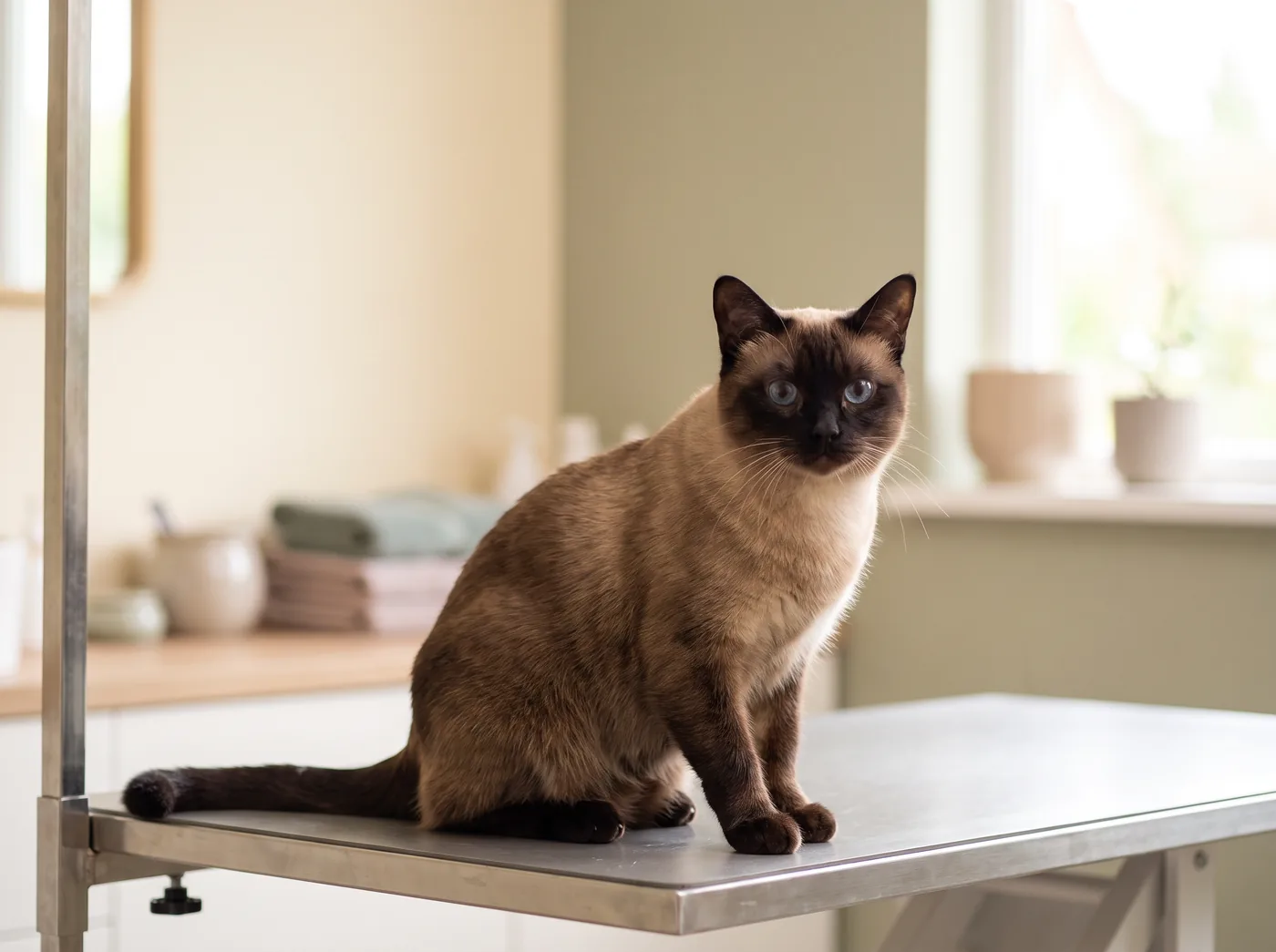
The Siamese as shown today is a long, fine boned cat with an extreme wedge shaped head and very large ears. That look was developed over the twentieth century. The cats originally imported from Siam were rounder headed and sturdier, and breeders who preferred the older type kept them going.
Those cats are now recognized as the Thai, or sold as traditional or old-style Siamese, or as Applehead Siamese, depending on who is selling.
For grooming it makes no difference at all: short fine close lying coat, no undercoat, five minutes a week.
What differs is build, and a sturdier cat with more body fat handles cold and clipper work slightly better than the modern wedge does.
The Thai has a double coat that regulates its own temperature. Shaving it does not keep the animal cooler, removes the protection against sun and insects, and the top coat often grows back patchy or never returns correctly. A thorough deshed takes out the undercoat and does the job the owner was actually asking for.
Six names, one cat
Worth setting out in one place, because an owner will be told six different things.
Siamese: pointed, short coated, modern extreme wedge type, four point colors in most registries.
Thai: pointed, short coated, older rounder type. Also sold as traditional Siamese, old-style Siamese or Applehead.
Colorpoint Shorthair: pointed, short coated, modern type, in the colors the Siamese standard excludes. Called Siamese outside the United States.
Balinese: the same cat with a long coat.
Oriental Shorthair: the same cat without the pointed pattern.
Oriental Longhair: the same cat, long coated and not pointed.
All six have a fine single coat with no undercoat and all six take a comb once a week. That is the point. The registry distinctions are real and they change nothing about the animal in front of a groomer.
It is the clearest example on the site of the breed name telling you very little and the coat telling you everything.
Five minutes a week
The coat is short, fine, close lying and glossy with essentially no undercoat.
Comb once a week with a fine metal comb, or go over the cat with a rubber grooming mitt. That is the entire coat routine, and it doubles as the weekly check over the body.
Shedding is low, matting does not happen, and there is no reason to bathe or clip a healthy cat.
Do not use a slicker or a deshedding blade. There is no undercoat to remove and those tools pull live hair from a single coat.
A dull, greasy or scurfy coat on a cat this glossy is a signal rather than a grooming failure, and it usually means the cat has stopped grooming itself: dental pain, arthritis, obesity or illness.
Because the coat is so easy, keep the weekly habit for the check rather than the coat.
A sturdier build, and what that changes
The one practical difference from the modern Siamese is body type, and it is worth knowing because the oriental cautions are slightly softer here.
A Thai is moderate rather than extreme: a rounded head, moderate ears, a compact muscular body with more substance and more body fat than a modern wedge.
That means it chills a little less readily than a Siamese or an Oriental, and there is marginally more between a clipper blade and the skin.
The cautions still apply, just less sharply. If a bath is genuinely needed, keep the room and water warm, work quickly and dry thoroughly before the cat wanders off damp.
Teeth still matter more than the coat. The Siamese lineage brings a tendency toward gum disease, and dental pain is a main reason a cat stops grooming itself.
Weight is worth watching in the other direction: a sturdier build hides gain better than a lean one, so feel for ribs rather than judging by outline.
The point coloring, and the shaved patch
Point coloring comes from a temperature sensitive gene: pigment develops in the cooler parts of the body, so the face, ears, feet and tail darken while the warm core stays pale.
Kittens are born white and the points develop over weeks and months, deepening for a year or more.
A cat living somewhere cold darkens overall with time, and an older pointed cat is usually darker than it was at two.
The consequence worth telling a vet in advance: a patch shaved for surgery or a blood sample regrows noticeably darker, because the skin there was cooler while it was bare. It fades back over subsequent coat cycles.
It is the same fact that appears on the Balinese, Snowshoe and Colorpoint Shorthair pages, and it catches owners out every time.
Claws want tipping every two to three weeks, ears wiped weekly on the visible part, and the cat handled from kittenhood, which is easy on a breed this sociable and vocal.
What to tell your groomer or vet
Say it is a Siamese type cat whatever name it was sold under, so Siamese advice applies without adjustment.
Ask for a comb or rubber mitt only, and no slicker or deshedding blade.
Say the coat is not to be clipped and the cat does not need bathing.
Warn that a shaved patch will regrow darker for a while, so nobody records it as a problem.
Say the cat is sturdier than a modern Siamese but still chills, so warmth matters after anything wet.
Ask for claws tipped and the mouth looked at.
Keeping the coat between grooms
Comb or mitt, five minutes
No undercoat, so no slicker and no deshedding blade. It never mats.
Weekly
Keep it warm if it gets wet
Sturdier than a modern Siamese and still thin coated. Warm water, dry fully.
If bathed
Brush the teeth
The Siamese lineage brings gum disease, and it matters more than the coat.
Daily if you can
Warn about the shaved patch
It regrows darker for months. The same on every pointed cat here.
Before any procedure
Common Questions About the Thai
What is the difference between a Thai and a Siamese?
Body type, and nothing that affects grooming. The Siamese shown today is long and fine boned with an extreme wedge shaped head and very large ears, a look developed over the twentieth century. The cats originally imported from Siam were rounder headed and sturdier, and breeders who preferred that older type kept them going. Those are now recognized as the Thai, and also sold as traditional Siamese, old-style Siamese or Applehead. The coat is identical: five minutes a week.
Why are there so many Siamese type breeds?
Because registries split them on coat length, point color and body type, and different registries draw the lines differently. Siamese, Thai, Colorpoint Shorthair, Balinese, Oriental Shorthair and Oriental Longhair are all essentially one cat with those variables changed. Every one of them has a fine single coat with no undercoat and every one takes a comb once a week, so for grooming the distinctions are irrelevant. It is the clearest case there is of the coat mattering and the breed name not.
Is a Thai hardier than a modern Siamese?
Somewhat, and it shows up in small practical ways. A Thai is moderate rather than extreme in build, with more substance and more body fat, so it chills a little less readily and there is marginally more between a clipper blade and the skin. The cautions still apply, just less sharply: keep the room and water warm if a bath is genuinely needed, and dry thoroughly. Teeth still matter more than the coat, since the Siamese lineage brings a tendency to gum disease.
Similar breeds
Same coat, same schedule, or the breeds this one is crossed from.


Colorpoint Shorthair
A Siamese in sixteen colors the Siamese standard does not allow, and the same easy coat
Colorpoint Shorthair
Find a groomer who knows this coat
Search 37,863 groomers by town, or keep reading the breed guide.
Find a Local Groomer View All Breeds