Australian Cattle Dog Grooming
A short coat that sheds like a long one, on a dog that needs a job more than it needs a salon
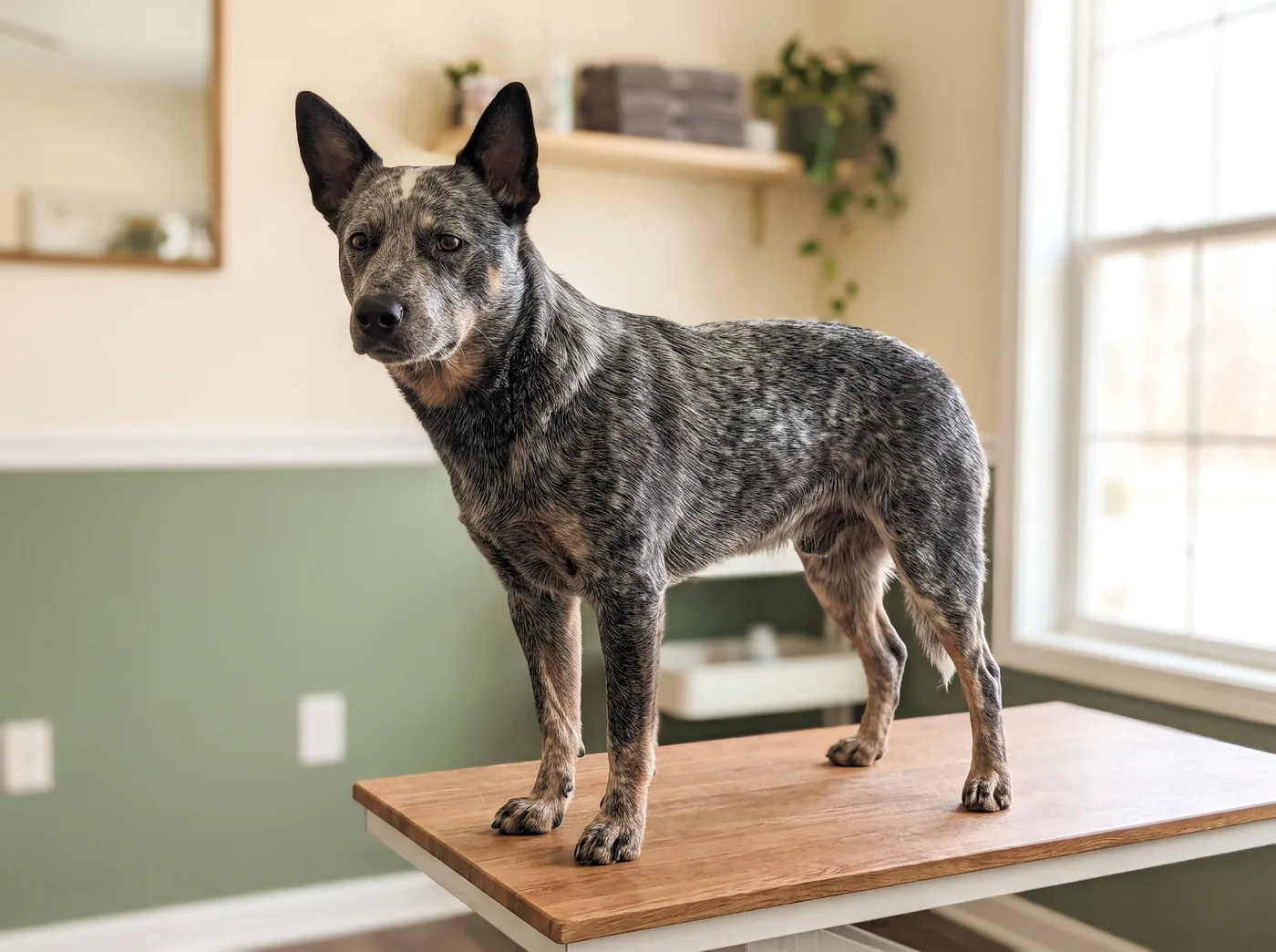
About the Australian Cattle Dog
The Australian Cattle Dog carries a short, straight, dense double coat built to work stock in Queensland heat and shrug off rain and thorn. It is about an inch long, it lies flat, and it looks like the least demanding coat a working dog could have.
It is not. This is a genuine double coat with a full undercoat underneath, and it sheds accordingly. Twice a year it releases that undercoat completely, and the volume that comes off a mid sized dog with a one inch coat surprises almost every first time owner.
The routine is still short and entirely doable at home. Ten minutes a week, more during a coat blow, a bath every couple of months and nothing that needs cutting. What this breed actually needs is not a groomer but a job, and the most common problem a professional sees on a Heeler is a dog with too much energy and no outlet for it standing on a table.
The Australian Cattle Dog has a double coat that regulates its own temperature. Shaving it does not keep the animal cooler, removes the protection against sun and insects, and the top coat often grows back patchy or never returns correctly. A thorough deshed takes out the undercoat and does the job the owner was actually asking for.
A short coat with everything a long one has
The mistake people make with this breed is reading the length and stopping there. A Cattle Dog coat is short, but it is structurally identical to a Husky coat: a harsh weather resistant outer layer over a dense soft undercoat that does the insulating.
Both layers are simply compressed into about an inch, which is what makes the breed practical to work in Australian summers while still handling cold nights.
Two things follow. The first is that shedding is driven by the undercoat, and this dog has a full one, so it sheds far more than the length suggests. The hairs are short, straight and stiff, so they stand up in carpet and weave into upholstery rather than sitting on the surface where they can be lifted off.
The second is that everything the site says about double coats applies here in full, including the rule about clipping. A short double coat is still a double coat, and the fact that a Heeler does not look like a Samoyed does not change what happens when you take a blade to it.
What the coat does not do is mat. There is nothing long enough to tangle, so dematting is essentially never an issue on this breed and a neglected Heeler coat produces a great deal of loose hair rather than a felted mess.
Blowing coat, and what to do about it
Twice a year, usually spring and autumn, the whole undercoat releases over two to four weeks. On this breed it comes out in tufts rather than the sheets a Samoyed produces, but the total volume is comparable and it goes everywhere.
An undercoat rake is the tool that matters, worked in the direction the coat lies, followed by a rubber curry to lift what the rake loosened. During a blow, daily and outdoors. Between blows, ten minutes once a week keeps it under control.
A bath with a proper high velocity dry is worth booking at the start of each blow. Warm water loosens the dead undercoat and the dryer drives it out, and one appointment removes more than a fortnight of brushing. It is the single most useful thing a salon does for this breed.
Two tools to avoid. Anything with a cutting edge sold for deshedding takes the outer coat with the undercoat and slowly damages the guard hairs. And a slicker used hard on a coat this short reaches skin rather than coat, which is uncomfortable and achieves nothing.
Neutered and spayed dogs often shed less predictably and can look permanently mid-blow rather than having two clean seasons. That is normal and does not change the routine.
Do not clip it, even though it is short
This comes up more with Heelers than with the obviously fluffy breeds, precisely because the coat looks trivial. A groomer is asked to take an inch down to a quarter for summer, it sounds harmless, and it is not.
The outer guard hairs block sun and hold a layer of still air against the dog, which insulates against heat as well as cold. The undercoat is the part that traps warmth. Clipping cuts through both and removes the sun barrier while leaving much of the insulation, so the dog is hotter, not cooler, and is now exposed to direct sun on skin that has never had any.
The regrowth is the other half. Guard hairs and undercoat return at different rates, the undercoat frequently wins, and the coat that comes back can be softer, duller, patchy and less weather resistant. On a working dog that is a functional loss rather than a cosmetic one.
The right answer to a hot Cattle Dog is the same as for any double coated breed. Deshed it properly so air can move through the coat, then use shade, water and timing. A well brushed Heeler copes with heat extremely well, which is what it was bred to do.
The one exception is a veterinary one: a surgical site or a genuine skin condition where a vet asks for an area to be clipped. That is a medical decision and it is fine.
The rest of the routine, and the thing that matters more
Ears are pricked and open, which is the easy version. Air moves through them, infections are uncommon, and a weekly look is enough. A Heeler that works in long grass wants checking for seeds.
Nails every three to four weeks. A dog that runs on grass and dirt wears down less than people assume, and this breed is athletic enough that foot health matters.
Teeth, which is standard and skipped as often here as anywhere.
Feet and legs after work: check between the toes for grass seeds and thorns, which is the routine hazard for any dog that pushes through cover.
And then the part that is not grooming but decides how every appointment goes. The Australian Cattle Dog was bred to move stubborn cattle by biting their heels and getting out of the way, and it is one of the most driven, most intelligent and least idle breeds there is. A Heeler that gets a real job, or a real substitute for one, is a straightforward dog to handle. A Heeler with nothing to do is not, and a groomer meeting the second version has a genuinely difficult hour.
They are also naturally reserved with strangers and physically confident, which is a combination worth flagging honestly rather than discovering on a table.
What to tell your groomer
Ask for a deshedding bath with a high velocity dry rather than a bath and brush. That is where the entire value is on this coat.
Book one at the start of each coat blow rather than in the middle of it.
Say no to any offer to clip the coat down for summer, and read the section above for why.
Say honestly how the dog is with strangers and with being restrained. Heelers are confident, reserved and quick, and a groomer who knows works differently from one who does not.
Mention any grass seed history, and ask them to check between the toes and in the ears.
And exercise the dog properly before the appointment. It is the most useful thing you can do for everyone involved.
Keeping the coat between grooms
Undercoat rake, then rubber curry
The rake loosens the dead undercoat and the curry lifts it out. Ten minutes weekly, daily and outdoors during a blow.
Weekly
Book a deshed at each coat blow
A bath and a high velocity dry removes more in one appointment than a fortnight of brushing does.
Spring and autumn
Never clip it for summer
A short double coat is still a double coat. Clipping removes the sun barrier and leaves the insulation behind.
Always
Exercise before the appointment
The most useful thing you can do. This breed was built to work all day and a bored Heeler is a difficult hour.
Every visit
Common Questions About the Australian Cattle Dog
Do Blue Heelers shed a lot?
Far more than the coat length suggests, yes. It is only about an inch long but it is a full double coat with a dense undercoat, and shedding is driven by the undercoat rather than by length. Year round there is a steady moderate drop, then twice a year the whole undercoat releases over two to four weeks. The hairs are short and stiff, so they stand up in carpet and weave into fabric. An undercoat rake weekly, daily during a blow, plus a deshedding bath at each seasonal change.
Can I shave my Australian Cattle Dog for summer?
No, and the short coat is exactly why people ask. It is still a double coat: the outer guard hairs block sun and hold an insulating layer of air, while the undercoat traps warmth. Clipping removes the sun barrier and leaves much of the insulation, so the dog gets hotter and is exposed to sunburn. The regrowth is often softer, patchier and less weather resistant, which on a working coat is a functional loss. Deshed it thoroughly instead and use shade, water and timing.
Why are Blue Heeler puppies born white?
Because the blue and red coloring comes from a roan pattern that is not expressed at birth. Australian Cattle Dog puppies are born almost pure white, inherited from the Dalmatian used in the breed's development, and the blue or red ticking comes through over the following weeks, usually settling by around six weeks and continuing to darken for months. Solid patches over an eye or ear are usually visible from the start. It is entirely normal and tells you nothing about the adult coat quality.
Similar breeds
Same coat, same schedule, or the breeds this one is crossed from.


Australian Shepherd
A working double coat with feathering, and three places it always mats
Australian ShepherdFind a groomer who knows this coat
Search 37,863 groomers by town, or keep reading the breed guide.
Find a Local Groomer View All Breeds