Bull Terrier Grooming
Ten minutes of coat over one of the most allergy prone skins in dogs
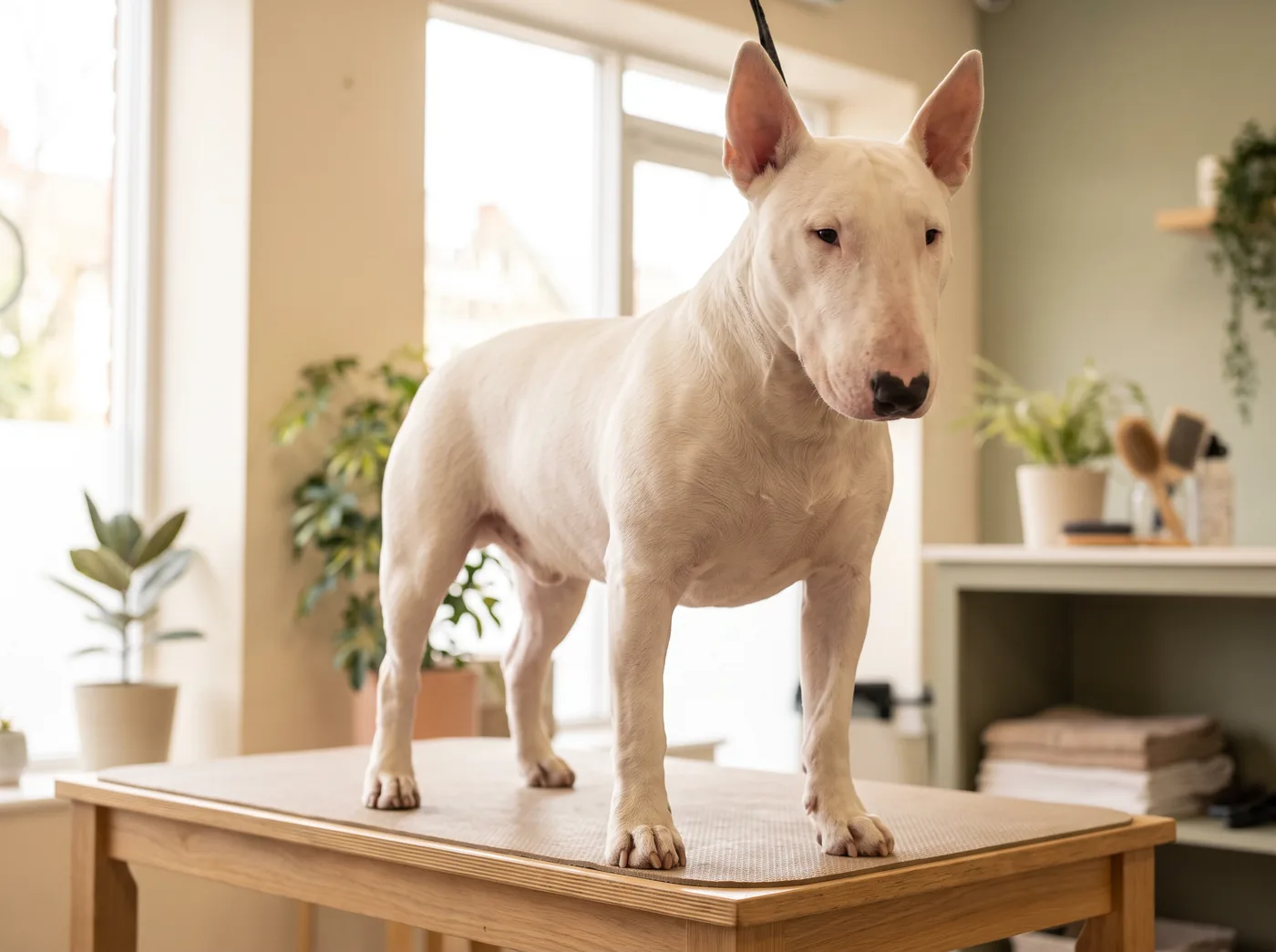
About the Bull Terrier
The Bull Terrier has a short, flat, harsh coat lying tight over a great deal of muscle. There is nothing to strip, nothing to cut, nothing that mats, and ten minutes a week covers it completely.
It is a terrier that sits with the Staffordshire Bull Terrier rather than with the wire jackets, and like the Staffy almost everything worth saying is about the skin underneath rather than the hair on top.
Bull Terriers have among the highest rates of allergic skin disease of any breed, white dogs carry a real risk of congenital deafness, and the breed has a well recognized tendency to compulsive behaviors that a groomer will meet on a table. All three change how an appointment goes, and none of them is guessable from looking at the dog.
The coat, and the skin underneath it
A rubber grooming mitt once a week, in circles then along the lie. That lifts the loose hair, spreads the skin oils and gives the coat its hard gloss. Shedding is moderate and steady, with a heavier drop twice a year, and the short stiff hairs work into fabric.
A bath every six weeks or so, and this is where the breed differs from most short coated dogs. Bull Terrier skin is frequently compromised, so bathing is often prescribed rather than optional: many of these dogs are on a medicated wash from a veterinarian, and that schedule overrides any general advice on this page.
The skin itself is the subject. Atopic dermatitis, an inherited reaction to ordinary environmental things like pollens, dust mites and grasses, is very common and usually shows as paw licking that stains the hair rust brown, face rubbing, and red inflamed skin in the armpits, groin and between the toes.
Demodectic mange is also common in young dogs, showing as patchy hair loss around the eyes and muzzle with little itching at first.
Because the coat is so short all of it is visible early, which is a genuine advantage. Persistent scratching or licking is a veterinary matter rather than a case for a soothing shampoo, because damaged skin grows bacteria and yeast, which itches more, which drives more licking.
White dogs also have pink skin underneath and burn, so shade in strong sun and a dog formulated sunscreen without zinc oxide on the muzzle, ear tips and belly.
Deafness in white dogs, which changes the handling
The same pattern as the Dalmatian, and for the same underlying reason: the genetics that produce a solid white coat also affect the development of the inner ear.
Congenital deafness is meaningfully common in white Bull Terriers, considerably less so in colored ones. It may affect one ear or both, and unilateral deafness in particular goes unnoticed for years, because a dog that hears on one side responds normally to almost everything except locating sound.
Responsible breeders test puppies, but plenty of pet Bull Terriers have never been tested.
It matters on a grooming table because a deaf dog startles when it is touched. There was no sound to warn it, so a hand arriving on its shoulder is a surprise, and that is exactly how a relaxed dog becomes a snapping one and then gets labeled difficult.
The handling is simple once it is known. Approach from the front and within sight. Let the dog see and smell a hand before it lands. Wake a sleeping dog by touching the shoulder rather than the head. Get attention with a vibration through the floor or a hand movement rather than a voice. And keep a hand in contact when working behind it.
Tell your groomer, and say so even if you are only unsure. A dog that ignores you from another room is worth a hearing test rather than a training class.
Spinning and tail chasing, which a groomer will meet
This belongs on a grooming page because it happens on tables and gets misread as a behavior problem or as the dog being difficult.
Bull Terriers have a well documented tendency to compulsive behaviors, most recognizably spinning and tail chasing. In its mild form it is a habit that appears when the dog is excited or frustrated. In its severe form it is a genuine neurological condition, it can occupy hours of a dog's day, and affected dogs may injure their own tails.
What it looks like: the dog begins turning tightly, becomes progressively harder to interrupt, and appears not to hear or see the person trying to stop it.
What it is not: disobedience, or a dog trying to get off the table.
On an appointment, the useful responses are to reduce stimulation, give the dog a break rather than restraining it harder, and let it settle. Pressure escalates it.
Tell a groomer if your dog does this, and say what usually stops it. A salon that knows will book more quietly and work in shorter stretches.
Severe cases are a veterinary matter and do respond to treatment, so a dog that spins for extended periods, cannot be interrupted, or is damaging its tail should be seen rather than managed at home.
The related practical point: this is a strong, determined, physically robust breed with a high pain tolerance, so a Bull Terrier that is uncomfortable often does not show it in the usual way.
Ears, nails, feet and the rest
Ears are upright, open and thin, which is the good news: airflow is excellent and primary ear infections are uncommon. When a Bull Terrier does get recurring ear trouble it is usually a symptom of the underlying allergy rather than an ear problem in itself, and treating the ear alone will not hold.
Nails every three to four weeks, thick and strong on a powerful dog, and worth starting in puppyhood because this is not an animal that can be overpowered later.
Feet want checking between the toes, since interdigital cysts and allergy driven inflammation both show there first, and a Bull Terrier that licks its feet raw is telling you something.
Teeth, which are large and crowded in a distinctively shaped head, so worth brushing daily.
The eyes are small, triangular and deep set, which restricts peripheral vision slightly. It is nothing like a Chow, but it is another reason to approach from the front rather than over the head, particularly on a dog that may also be deaf.
And keep the dog lean. Bull Terriers put weight on easily and carry it badly on a heavy frame with a lot of joint loading.
What to tell your groomer
Say whether the dog is deaf, deaf on one side, or untested, and ask them to approach from the front. This is the most useful thing you will tell them.
Say if the dog spins or chases its tail, and what usually settles it.
Name any skin history and any medicated shampoo you have been prescribed, since that schedule overrides the usual advice.
Ask them to look at the skin properly: armpits, groin, between the toes and around the muzzle.
Ask for the nails, which is the main practical value of the appointment.
And say the dog is strong and has a high pain tolerance, so discomfort may not show in the usual way.
Keeping the coat between grooms
Look at the skin, not the coat
Armpits, groin, between the toes and around the muzzle. Everything shows early on a coat this short.
Weekly
Approach from the front
Deafness is common in white dogs and often undiagnosed. A dog that did not hear you startles when touched.
Every time
Mitt the coat
A rubber grooming mitt once a week in circles then along the lie. That is the entire coat routine.
Weekly
Give space if the dog spins
Compulsive spinning is a recognized breed issue, not disobedience. Reduce stimulation and pause; pressure escalates it.
As needed
Common Questions About the Bull Terrier
Do Bull Terriers shed?
Moderately and steadily, with a heavier drop twice a year. The coat is short, flat and harsh, and the hairs are short and stiff enough to work into fabric and show on dark clothing. A rubber grooming mitt once a week handles most of it and gives the coat its hard gloss. There is nothing to cut, nothing that mats and no reason to clip one.
Why does my Bull Terrier have so many skin problems?
Because the breed has among the highest rates of allergic skin disease of any dog. Atopic dermatitis, an inherited reaction to pollens, dust mites and grasses, is the usual cause, and paw licking that stains the hair rust brown is its most recognizable sign. Demodectic mange is also common in young dogs. It needs veterinary diagnosis rather than a soothing shampoo, because damaged skin grows bacteria and yeast, which itches more and drives more licking. White dogs also burn on pink skin.
Are white Bull Terriers deaf?
A meaningful proportion are, and the risk is much higher in white dogs than colored ones, because the genetics producing a solid white coat also affect inner ear development. It may affect one ear or both, and one sided deafness often goes unnoticed for years. It matters for handling: a deaf dog startles when touched because nothing warned it, which is how a calm dog ends up snapping. Approach from the front, let the dog see your hand, and tell your groomer even if you are only unsure.
Similar breeds
Same coat, same schedule, or the breeds this one is crossed from.

Staffordshire Bull Terrier
A terrier with almost no coat, where the skin underneath is the entire subject
Staffordshire Bull Terrier
Dalmatian
The most relentless shedder for its coat length, and stiff white hairs that weave into everything
DalmatianFind a groomer who knows this coat
Search 37,863 groomers by town, or keep reading the breed guide.
Find a Local Groomer View All Breeds