Chow Chow Grooming
One of the densest undercoats in dogs, on a breed that will not tolerate being rushed
About the Chow Chow
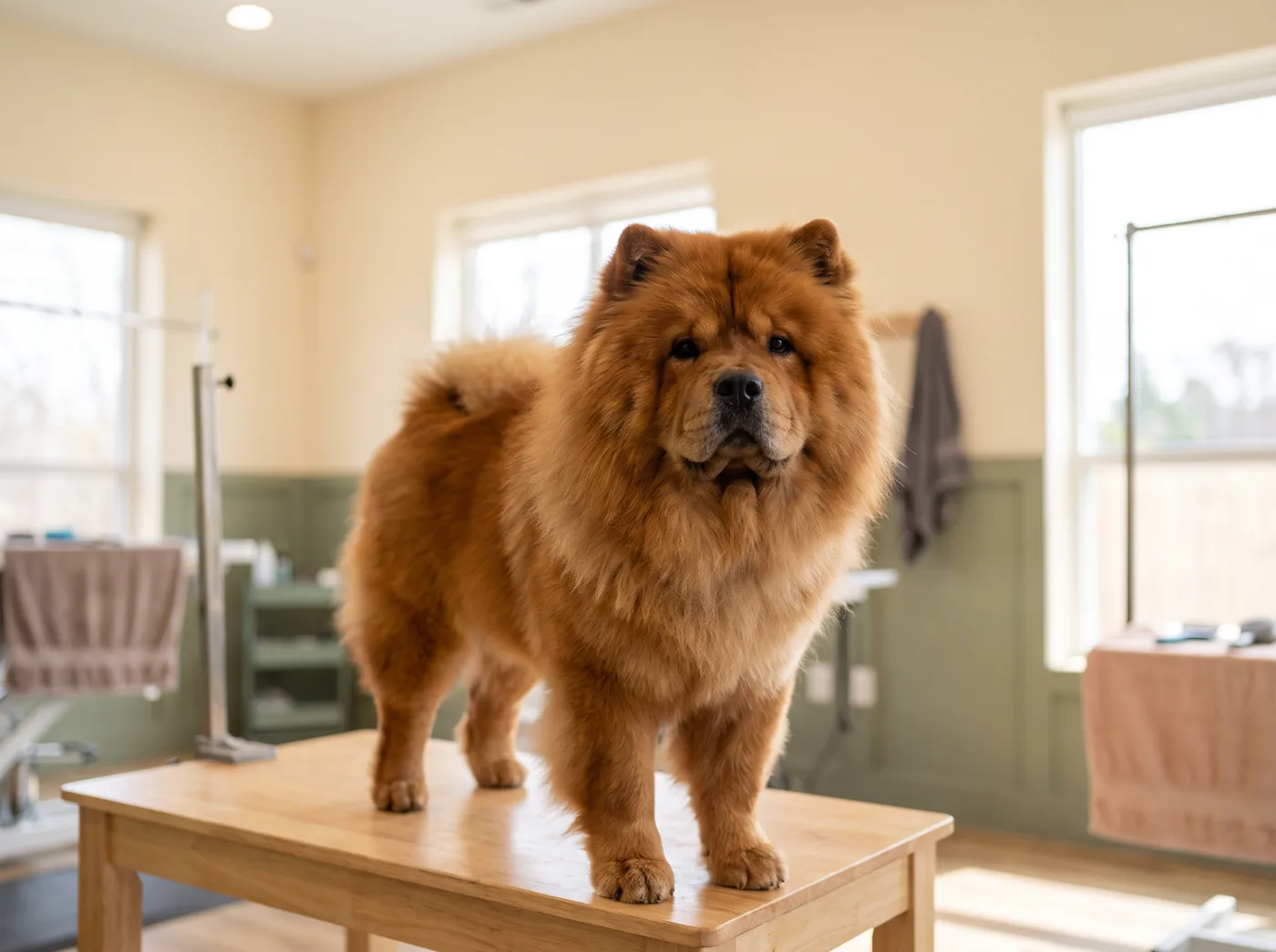
The Chow Chow carries one of the densest coats of any breed: a profuse standing outer coat over an undercoat so thick that reaching the skin is genuinely difficult, with an enormous mane framing the head that gives the breed its lion like outline.
Like the Saint Bernard, it comes in rough and smooth varieties. The rough is the one everybody pictures. The smooth has the same dense undercoat under a much shorter outer coat, so it sheds identically and mats far less.
Two things make this breed distinctive beyond the coat. It is one of the strongest never-shave cases on the site, for the same reasons as the Samoyed and with the same permanent consequences. And it has deep set eyes buried in a heavy ruff, which genuinely restricts what the dog can see, and that is a handling fact rather than a temperament excuse.
The Chow Chow has a double coat that regulates its own temperature. Shaving it does not keep the animal cooler, removes the protection against sun and insects, and the top coat often grows back patchy or never returns correctly. A thorough deshed takes out the undercoat and does the job the owner was actually asking for.
The coat, and why the ruff is the problem
The undercoat is the story. It is woolly, extremely dense, and packed tight enough against the skin that a slicker run over the top of a Chow barely reaches it. Over that sits a coarse standing outer coat that holds the whole thing away from the body.
It is not evenly distributed. The heaviest coat by far is the mane around the neck, shoulders and chest, then the trousers on the hind legs, the tail, and behind and under the ears. The back and flanks carry noticeably less.
Those heavy areas are exactly where a Chow mats, and they are exactly the areas a casual brush skims. A dog can look magnificent while carrying a solid felted layer through the mane, which is the single most common presentation at a salon.
The method is line brushing: part the coat down to the skin and work outward in sections so that every hair passes through the brush from root to tip. Use a slicker and an undercoat rake, and check with a metal comb. The comb is the test, and if it will not pass freely from skin to tip that section is not brushed.
Every two or three days, and the mane every time.
A smooth coated Chow needs the same raking for shedding but very little of the matting work, which makes it a considerably easier dog to live with and a fact worth knowing before choosing a puppy.
Blowing coat, and what a full groom involves
Twice a year the whole undercoat releases over two to four weeks, and on a coat this dense the quantity is extraordinary. It comes out in sheets and can be pulled away in handfuls.
An undercoat rake is the main tool, worked in sections in the direction the coat lies, followed by a slicker. Daily during a blow and outdoors.
A bath and a high velocity dry at the start of each blow is the most valuable appointment of the year for this breed. Warm water loosens the dead undercoat and the dryer drives it out, and it does in one session what weeks of brushing does not.
A full professional appointment runs three hours or more and it is largely drying. Getting water and shampoo through to the skin on a coat this dense takes time, rinsing takes longer, and drying all the way down is the step that cannot be rushed. A Chow that goes home damp at the skin is a Chow with hot spots in a week.
Beyond bathing, drying and brushing, nothing is cut except the feet, the hocks and the sanitary area.
Dead undercoat left in place is what mats, and a felted layer over the skin of a heavily coated dog traps moisture and causes hot spots that are invisible until they are large. Almost every badly matted Chow got there through a coat blow nobody kept up with.
Never shave a Chow Chow
The argument is the same as for the Samoyed and the consequences here are among the worst of any breed.
Shaving removes the coarse outer coat that blocks sun and holds an insulating layer of air, while leaving the dense woolly undercoat that traps heat. The dog is hotter, not cooler, and now has skin exposed to direct sun for the first time.
The regrowth is the part that does not recover. Undercoat returns faster than guard hairs and comes to dominate, and on a coat with an undercoat this dense the result is frequently a permanently woolly, dull, uneven coat that mats far more readily than the original. Chows are among the breeds most associated with coat that never properly returns after a clip.
They also genuinely struggle in heat, more than most breeds, being heavily coated with a shortened muzzle and a fairly restricted airway. That is real, and the answer is still not a clip: it is air conditioning, shade, cool floors, water and walking at the ends of the day, over a coat that has been thoroughly deshedded so air can move through it.
The single legitimate exception is a coat so badly pelted that brushing it out would mean hours of dragging on skin. Then clipping is the kind option and the lesson belongs to the months before.
The eyes, the temperament and how to approach one
Chow Chows have a reputation for being difficult with groomers, and part of it is temperament and part of it is anatomy that gets mistaken for temperament.
The anatomy first, because it is the part nobody mentions. A Chow has small, deep set, almond shaped eyes set into a heavy fold of skin and surrounded by a thick mane. That combination genuinely restricts peripheral vision. A Chow often cannot see a hand approaching from the side or behind, and a dog that is touched without warning reacts to being startled.
So the handling rule is simple and it prevents most incidents: approach from the front, in the dog's line of sight, let it see and smell your hand, and never reach over the head or come at a Chow from behind. Say this to any groomer who has not worked with the breed.
The temperament is real too. Chows are dignified, aloof, independent and famously undemonstrative, bonding closely with their own people and being indifferent to everyone else. They do not enjoy being handled by strangers and they will not be talked round the way a Labrador will. They are not aggressive by default; they are unwilling, and pushing an unwilling Chow is how people get bitten.
What works is early, patient, daily handling from puppyhood, short frequent salon visits from a young age, and a groomer who works slowly. What does not work is force.
The blue black tongue is a normal breed feature, present from a few weeks old, and tells you nothing about health. A tongue that changes color in an adult dog is a veterinary matter.
What to tell your groomer
Say the dog cannot see well to the sides, and ask them to approach from the front and never reach over the head. This is the most useful thing you will tell them.
Say honestly how the dog is with strangers and with handling, including anything that has gone wrong before.
Ask whether they have a high velocity dryer and enough time booked. Three hours is normal and a Chow dried badly gets hot spots.
Ask for a deshedding treatment rather than a plain bath and brush, and book one at the start of each coat blow.
Say when the mane was last brushed to the skin, since that is where the matting is.
Ask for nothing cut beyond the feet, hocks and sanitary area, and decline any offer to shave the dog for summer.
Keeping the coat between grooms
Approach from the front
Deep set eyes in a heavy ruff genuinely restrict side vision. Never reach over the head of a Chow.
Every time
Line brush the mane
Part to the skin and work outward. The mane is where the coat is heaviest and where a casual brush never reaches.
Every two or three days
Deshed at each coat blow
One of the densest undercoats in dogs. A bath and high velocity dry does what weeks of brushing cannot.
Spring and autumn
Dry all the way to the skin
A coat this dense holds water for hours, and damp undercoat against skin is where hot spots start.
Any bath
Common Questions About the Chow Chow
Should I shave my Chow Chow in summer?
No, and Chows are among the breeds most damaged by it. Shaving removes the outer coat that blocks sun and holds insulating air while leaving the extremely dense undercoat that traps heat, so the dog gets hotter and burns. The regrowth frequently never recovers: undercoat returns faster than guard hairs and dominates, leaving a permanently woolly, uneven, mat prone coat. Chows do genuinely struggle in heat, but the answer is a thoroughly deshedded coat plus air conditioning, shade and walking at the ends of the day.
Why does my Chow Chow react badly to being groomed?
Often because it did not see you coming. Chows have small, deep set eyes in a heavy fold of skin surrounded by a thick mane, which genuinely restricts peripheral vision, so a hand arriving from the side or over the head is a surprise rather than a threat the dog chose to ignore. Approach from the front, in its line of sight, and let it see and smell your hand. Beyond that, Chows are independent and aloof by nature, do not enjoy handling by strangers, and cannot be pushed through it.
Is a smooth coated Chow Chow easier to groom?
Considerably, and it is worth knowing before choosing a puppy. A smooth Chow has the same extremely dense undercoat, so it sheds exactly as much and needs the same raking and the same deshedding baths at each coat blow. What it does not have is the long outer coat and the enormous mane, which is where a rough coated Chow mats. That removes most of the line brushing and most of the risk of a felted dog, while keeping all of the shedding.


Find a groomer who knows this coat
Search 37,863 groomers by town, or keep reading the breed guide.
Find a Local Groomer View All Breeds