Cardigan Welsh Corgi Grooming
The older of the two corgis, with a tail, a heavier coat and the same fragile back
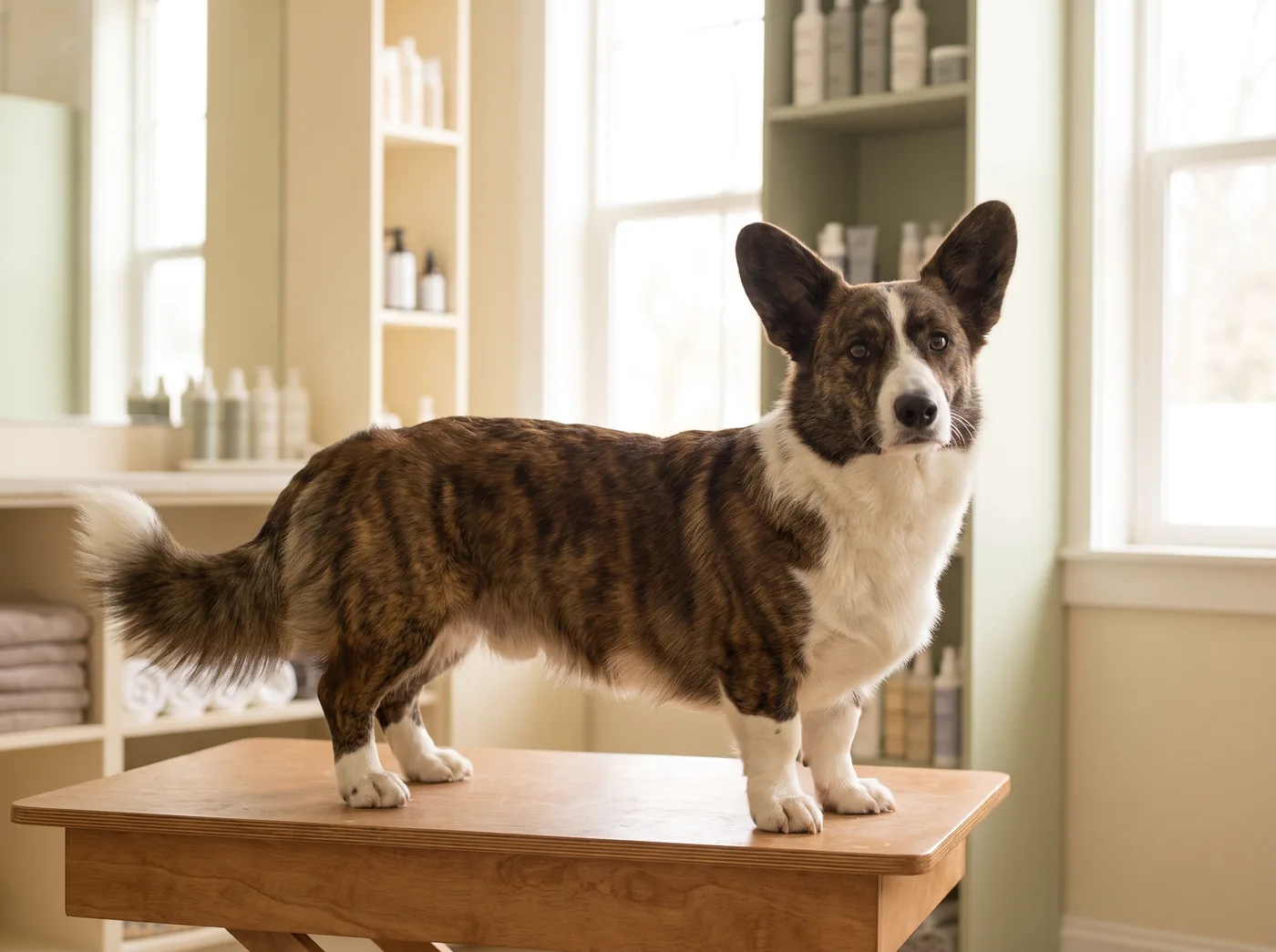
About the Cardigan Welsh Corgi
The Pembroke Welsh Corgi page covers most of what applies to both: a dense weather resistant double coat, very heavy seasonal shedding, and an absolute rule against shaving it.
The Cardigan is the older of the two and they are genuinely separate breeds, kept in one show class until 1934 and separated because they are separately descended. The visible difference is the tail, which a Cardigan has in full and carries low like a fox brush.
The difference that matters at a grooming table is the coat. A Cardigan carries slightly more of it, with a coarser outer coat and a thicker undercoat, and it is a larger and heavier dog underneath. Everything the Pembroke page says about undercoat, blowing and shave downs applies here with a little more of everything.
The Cardigan Welsh Corgi has a double coat that regulates its own temperature. Shaving it does not keep the animal cooler, removes the protection against sun and insects, and the top coat often grows back patchy or never returns correctly. A thorough deshed takes out the undercoat and does the job the owner was actually asking for.
The coat, and how it differs from a Pembroke
A Cardigan carries a double coat of medium length: a harsh, slightly coarse outer coat that sheds water and dirt, over a short dense undercoat that does the insulating. It is thicker and a little longer than a Pembroke coat, particularly around the neck, the back of the legs and the underside of the tail.
The tail is the part a Pembroke owner has no experience of. It is fully feathered, it hangs low, and it sweeps everything the dog walks past. On a low dog that means mud, seeds and burrs collect there first, along with the trousers on the back legs.
There is also a long coated variety, sometimes called a fluffy. It is a recessive coat, not a separate breed and not a fault of care, and it produces a noticeably longer softer coat with heavy feathering. A fluffy needs real brushing rather than deshedding, and it does mat behind the ears and in the trousers where a standard coat does not.
For a standard coat, matting is genuinely a low risk. The work here is shedding, and there is a great deal of it.
Brush every two or three days year round with an undercoat rake, working with the lie of the coat, then a slicker over the feathering on the tail and legs. In a coat blow, daily.
Shedding, blowing the coat, and the deshedding groom
A Cardigan sheds all year and then twice a year it blows the undercoat, usually in spring and autumn, over two to three weeks. The volume surprises every first time owner. A dog this size holds a remarkable quantity of undercoat and it comes out in sheets.
The tool that matters is an undercoat rake, not a slicker. A slicker tidies the surface and a rake reaches the dead undercoat that is actually the problem. Work in the direction the coat lies, in sections, and stop when the rake comes through clean rather than when the dog looks finished.
Many owners book a bath and blow out twice a year for exactly this, and it is worth it. A high velocity dryer drives the loose undercoat out in a way no brushing at home matches, and a proper deshedding groom takes a bag of coat off the dog in about ninety minutes.
Bathe roughly every eight weeks, more often around a coat blow. The one rule is that the dog must be dried thoroughly to the skin. A double coat that is left damp underneath grows yeast and smells, and on a low dog with a broad chest the underside is the part that stays wet.
Feeding, parasites and skin disease all change how a coat sheds, so a sudden increase in loose hair outside the usual seasons is worth a veterinary conversation rather than a better brush.
Why the coat is never shaved
This is the same rule as for any double coated breed and it is worth repeating, because a heavily shedding dog is exactly the dog an owner asks to have shaved.
The outer coat and the undercoat do different jobs and grow at different rates. Clipping takes off the outer coat, which is the part that blocks sun and repels water, and leaves the insulating undercoat in place. The dog is not cooler. It is less protected, and now it sunburns.
It also frequently grows back wrong. Clipped guard hairs on a double coat often return patchy, softer and duller, sometimes with permanent bare areas, and on some dogs they never return properly at all. There is no way to know in advance which dog will be one of those.
What actually reduces the hair in the house is undercoat removal: rake it out, bathe and blow it out properly, and keep the interval short during a blow.
Trimming is fine where it is functional: the hair between the paw pads, the sanitary area, and tidying the feathering on the back of the legs and the tail so it collects less. That is all a Cardigan needs.
If a groomer offers to shave a corgi to help with shedding, that is a reason to find another groomer.
The back, and how this dog is handled
A Cardigan is a dwarf breed. The legs are short because of a cartilage growth gene, and the same build gives the breed a long spine over short supports, which puts it at real risk of intervertebral disc disease.
That is a grooming fact and not only a veterinary one, because the highest risk moments in this dog's week may well be on a grooming table.
Never let a corgi jump down from a table, a bath or a car. Lift it, and lift it correctly: one hand or forearm under the chest, the other supporting the hindquarters, so the spine stays level. Picking a corgi up under the front legs alone lets the whole back end hang from the spine.
Say this to a groomer at the first appointment and check the table has a ramp or that the dog is lifted on and off. A calm dog that is used to being lifted is a much easier proposition than one that leaps.
Weight is the other half of it. A heavy corgi loads a back that is already at a mechanical disadvantage, and this is a breed that gains weight easily and hides it under a thick coat. Feel for the ribs rather than judging by eye, because a full winter coat will hide a great deal.
Sudden reluctance to jump or use stairs, a hunched back, yelping when picked up, wobbling in the back legs or dragging a foot needs a veterinarian the same day.
What to tell your groomer
Say the dog is a Cardigan rather than a Pembroke if it is booked by breed, because the coat is heavier and the tail needs work a Pembroke groom does not include.
Ask for a deshedding groom: bath, high velocity blow out and a full undercoat rake, not a haircut.
Say clearly that the coat is never to be clipped or shaved, including if the dog looks uncomfortable in summer.
Ask for the feathering on the tail and the back legs tidied, the paw pads cleared and the sanitary area trimmed.
Say that the dog must be lifted on and off the table and never allowed to jump down, and mention any back history.
Book the two coat blows in advance if you can predict them, because that is when a professional dryer earns its money.
Keeping the coat between grooms
Rake the undercoat out
An undercoat rake with the lie of the coat, not a slicker. Daily during a coat blow.
Every two to three days
Bathe and dry to the skin
A double coat left damp underneath grows yeast. The broad chest is what stays wet.
Every eight weeks
Check the tail and trousers
The low feathered tail collects mud, seeds and burrs before anything else does.
Weekly
Lift, never let it jump
A long spine on short legs. Chest and hindquarters supported, back level.
Every time
Common Questions About the Cardigan Welsh Corgi
What is the difference between a Cardigan and a Pembroke Welsh Corgi?
They are separate breeds that were shown as one until 1934, and the Cardigan is the older of the two. The obvious difference is the tail: a Cardigan has a full low set brush and a Pembroke does not. A Cardigan is also a little larger and heavier with bigger rounded ears, and it comes in more colors including brindle and blue merle. For grooming the difference is that the Cardigan coat is slightly longer and coarser with a thicker undercoat, so there is more of everything, plus a feathered tail that collects debris.
Can I shave my corgi in summer to stop the shedding?
No. The double coat is two coats doing two jobs, and clipping removes the outer one that blocks sun and repels water while leaving the insulating undercoat behind, so the dog is not cooler and is now at risk of sunburn. It also often grows back patchy, softer or not at all, and there is no way to predict which dog that happens to. What genuinely reduces loose hair is undercoat removal: rake it out regularly and book a bath and high velocity blow out during the two annual coat blows.
Is grooming risky for a corgi because of its back?
Handling is, and it is worth being explicit about it. A Cardigan is a dwarf breed with a long spine on short legs and a genuine risk of disc disease, and jumping off a grooming table, a bath or a car is exactly the kind of impact that causes trouble. Ask that the dog is lifted on and off with one arm under the chest and one under the hindquarters so the back stays level, never picked up by the front legs alone. Keeping the dog lean matters too, and a thick coat hides weight, so feel for the ribs.
Similar breeds
Same coat, same schedule, or the breeds this one is crossed from.

Pembroke Welsh Corgi
A large dog's coat on a small dog's legs, and one of the heaviest shedders there is
Pembroke Welsh Corgi
Shetland Sheepdog
An enormous coat on a small dog, and the one most often shaved by mistake
Shetland Sheepdog
Australian Cattle Dog
A short coat that sheds like a long one, on a dog that needs a job more than it needs a salon
Australian Cattle DogFind a groomer who knows this coat
Search 37,863 groomers by town, or keep reading the breed guide.
Find a Local Groomer View All Breeds