Keeshond Grooming
A standing spitz coat and a set of face markings that must never be tidied away
About the Keeshond
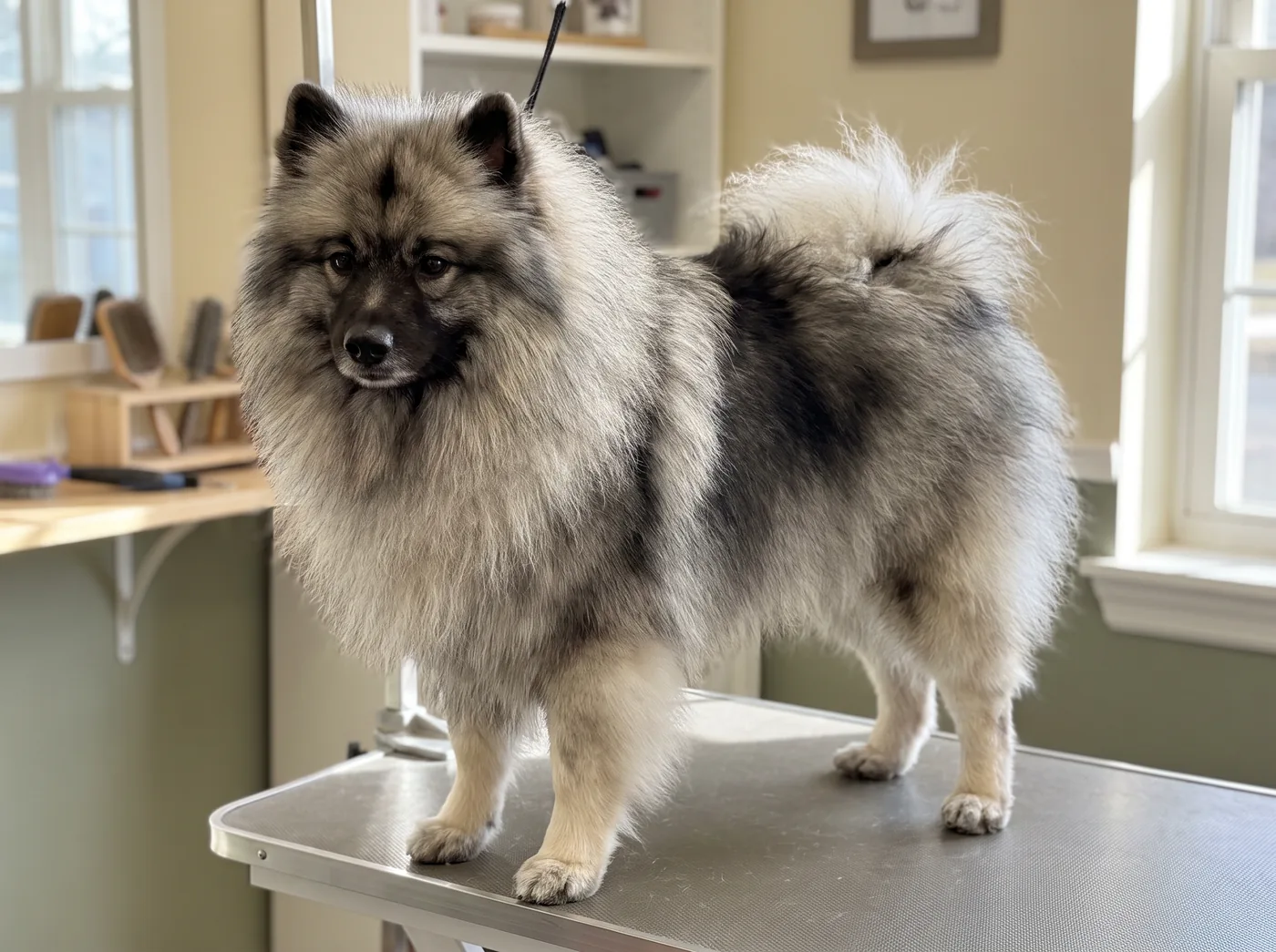
The Keeshond is a spitz that never worked sleds or herded anything. It rode Dutch canal barges as a watchdog and companion, and it carries the full spitz coat regardless: a long, harsh, straight outer coat standing away from the body over a thick pale undercoat, with an enormous lion like ruff, heavy trousers on the hind legs and a tail curled tight over the back.
So everything the Samoyed and Chow Chow pages say applies here: line brushing every two or three days, a professional appointment every six to eight weeks, twice yearly coat blows on a serious scale, and it is never shaved.
Two things are specific to this breed and both are things an unfamiliar groomer gets wrong. The coat is supposed to stand off the body rather than lie flat, so it is brushed in a way that keeps it standing. And the dark markings around the eyes, the spectacles, are a breed hallmark that must not be trimmed or tidied.
The Keeshond has a double coat that regulates its own temperature. Shaving it does not keep the animal cooler, removes the protection against sun and insects, and the top coat often grows back patchy or never returns correctly. A thorough deshed takes out the undercoat and does the job the owner was actually asking for.
A coat that has to stand off the body
This is the part a groomer used to long coated breeds gets wrong, and it is worth saying plainly.
A Keeshond outer coat is harsh and straight and is meant to stand out from the body at close to a right angle, which is what gives the breed its round, full, distinctly spitz silhouette. Brushing it flat, or brushing only in the direction it lies as you would on a Collie, produces a dog that looks sleek and wrong.
The technique is line brushing with the coat lifted: part the coat down to the skin in sections and brush the hair outward and upward from the part, so each layer is worked from the root and finishes standing. A slicker for the body and an undercoat rake for the dense areas, then a metal comb to check that it reaches skin.
Every two or three days. The places that fail are the ruff at the neck and chest, behind and under the ears, the armpits, the trousers, and around the tail where it curls against the back.
The tail is worth naming because it is easy to skip: it lies tight against the body, so the coat underneath it is compressed and out of sight.
Never bathe a matted coat, and never brush a dry coat hard, which breaks harsh hair.
The undercoat is pale, often noticeably lighter than the outer coat, so a Keeshond that is blowing coat looks strange as light undercoat shows through the dark guard hairs. That is normal.
The spectacles, and what never gets trimmed
The Keeshond has distinctive dark markings radiating from the outer corner of each eye, with pale shading around them, together called the spectacles. They are a defining breed characteristic and the standard treats their absence as a serious fault.
They are made of coat rather than skin pigment, so they can be damaged. A groomer tidying the face, trimming stray hair around the eyes or neatening the cheeks can remove or blur them, and it takes months to grow back.
So the instruction is simple and it has to come from you: nothing on the face is trimmed. No tidying around the eyes, no shaping of the cheeks, no neatening of the ruff line at the throat.
More generally, a Keeshond is not a scissored breed at all. The only trimming that belongs on one is the feet, cleared to a neat round outline, the hair between the pads taken flush, the hocks tidied, and the sanitary area kept short. That is the complete list.
Ask for it explicitly, because a groomer who works mostly on doodles and spaniels will reach for scissors on the face by habit.
The ears are small, upright and well furred, which is the easy version for airflow. A weekly look is enough, and the long hair around the base wants combing rather than cutting.
Blowing coat, and never shaving
Twice a year the whole undercoat releases over two to four weeks, and on a coat this dense the volume from a forty pound dog is startling. It comes out in sheets and clumps, and the pale undercoat shows through everywhere while it happens.
An undercoat rake worked in sections, then a slicker to lift what the rake loosened, daily during a blow and outdoors.
A bath and a high velocity dry at the start of each blow is the most effective single thing available and removes more than a fortnight of brushing. On this breed it is worth booking as a standing twice yearly appointment even if nothing else is done professionally.
Dead undercoat left in place is what mats: it packs against the skin, binds with the growing coat and becomes a felted layer that traps moisture and produces hot spots underneath.
And shaving, which happens to Keeshonden for the usual reason: the coat looks excessive and the shedding is exhausting. It removes the harsh outer coat that blocks sun and holds insulating air while leaving the undercoat that traps heat, so the dog gets hotter, and the regrowth is frequently permanently woolly, patchy and mat prone.
It also destroys the standing silhouette that is the entire look of the breed, and on a spitz coat that may never come back properly.
The right answer to a hot Keeshond is a thoroughly deshedded coat, shade, water and walking at the ends of the day.
The appointment, and a friendly dog with a loud opinion
Two and a half hours is normal and much of it is drying, because a coat this dense holds water for a long time and a Keeshond that goes home damp underneath is a hot spot risk.
The order is: line brush through dry and deal with any felting, bathe, high velocity dry with brushing throughout, then feet, hocks, nails and sanitary area. Nothing else is cut.
Nails every three to four weeks.
On temperament, this is one of the easier heavily coated breeds to handle. Keeshonden were bred as companions rather than as working or guarding dogs, and they are typically friendly, outgoing and genuinely fond of people including strangers, which is a real difference from the Chow or the Akita.
What they are is vocal. The breed was a barge watchdog and it barks readily and loudly, which is worth mentioning to a salon so nobody assumes a distressed dog.
They are also sensitive to atmosphere and to being separated from their people, so a long appointment in a busy room is harder on them than on a more independent breed.
Introduce the dryer early, because a puppy that grew up with the noise treats a two and a half hour appointment as normal.
What to tell your groomer
Say nothing on the face is to be trimmed, and explain the spectacles. This is the instruction most likely to be got wrong.
Say the coat should stand off the body and is brushed outward from the part, not smoothed flat.
Ask whether they have a high velocity dryer and have booked two and a half hours.
Ask for a deshedding treatment rather than a bath and brush, and book one at the start of each coat blow.
Say when the ruff, behind the ears and under the curled tail were last brushed to the skin.
Ask for nothing cut beyond feet, pads, hocks and the sanitary area, and decline any offer to shave.
Keeping the coat between grooms
Line brush outward, not flat
Part to the skin and brush up and out so the coat finishes standing. Brushing it flat produces the wrong dog.
Every two or three days
Nothing on the face is trimmed
The spectacles are coat, not pigment, and a routine face tidy removes them for months.
Every appointment
Deshed at each coat blow
A standing twice yearly booking, worth having even if nothing else is done professionally.
Spring and autumn
Brush under the curled tail
It lies tight against the back, so the coat underneath is compressed and completely out of sight.
Every two or three days
Common Questions About the Keeshond
Should I shave my Keeshond in summer?
No. It removes the harsh outer coat that blocks sun and holds an insulating layer of air while leaving the dense undercoat that traps heat, so the dog gets hotter and burns, and the regrowth is frequently permanently woolly, patchy and mat prone. On a spitz it also destroys the standing silhouette that is the entire look of the breed, and that may never return. Deshed thoroughly instead, and use shade, water and walks at the ends of the day.
What are the spectacles on a Keeshond?
The dark markings radiating from the outer corner of each eye with pale shading around them, and they are a defining breed characteristic whose absence is a serious fault under the standard. They are made of coat rather than skin pigment, so a groomer tidying the face, trimming around the eyes or neatening the cheeks can blur or remove them, and they take months to grow back. Nothing on a Keeshond face should ever be trimmed.
How much do Keeshonden shed?
Heavily year round, and then enormously twice a year when the whole undercoat releases over two to four weeks. The undercoat is pale and often much lighter than the outer coat, so a Keeshond blowing coat looks odd as the light layer shows through. An undercoat rake then a slicker every two or three days, daily and outdoors during a blow, plus a bath and high velocity dry at the start of each one.
Similar breeds
Same coat, same schedule, or the breeds this one is crossed from.

Samoyed
The heaviest coat in the working group, and the one most often ruined by a summer shave
Samoyed
Pomeranian
A northern double coat on a five pound dog, and the breed shave downs ruin most often
Pomeranian
Chow Chow
One of the densest undercoats in dogs, on a breed that will not tolerate being rushed
Chow ChowFind a groomer who knows this coat
Search 37,863 groomers by town, or keep reading the breed guide.
Find a Local Groomer View All Breeds