Russell Terrier Grooming
The shortest legged of the three Russells, and the same three coats again
About the Russell Terrier
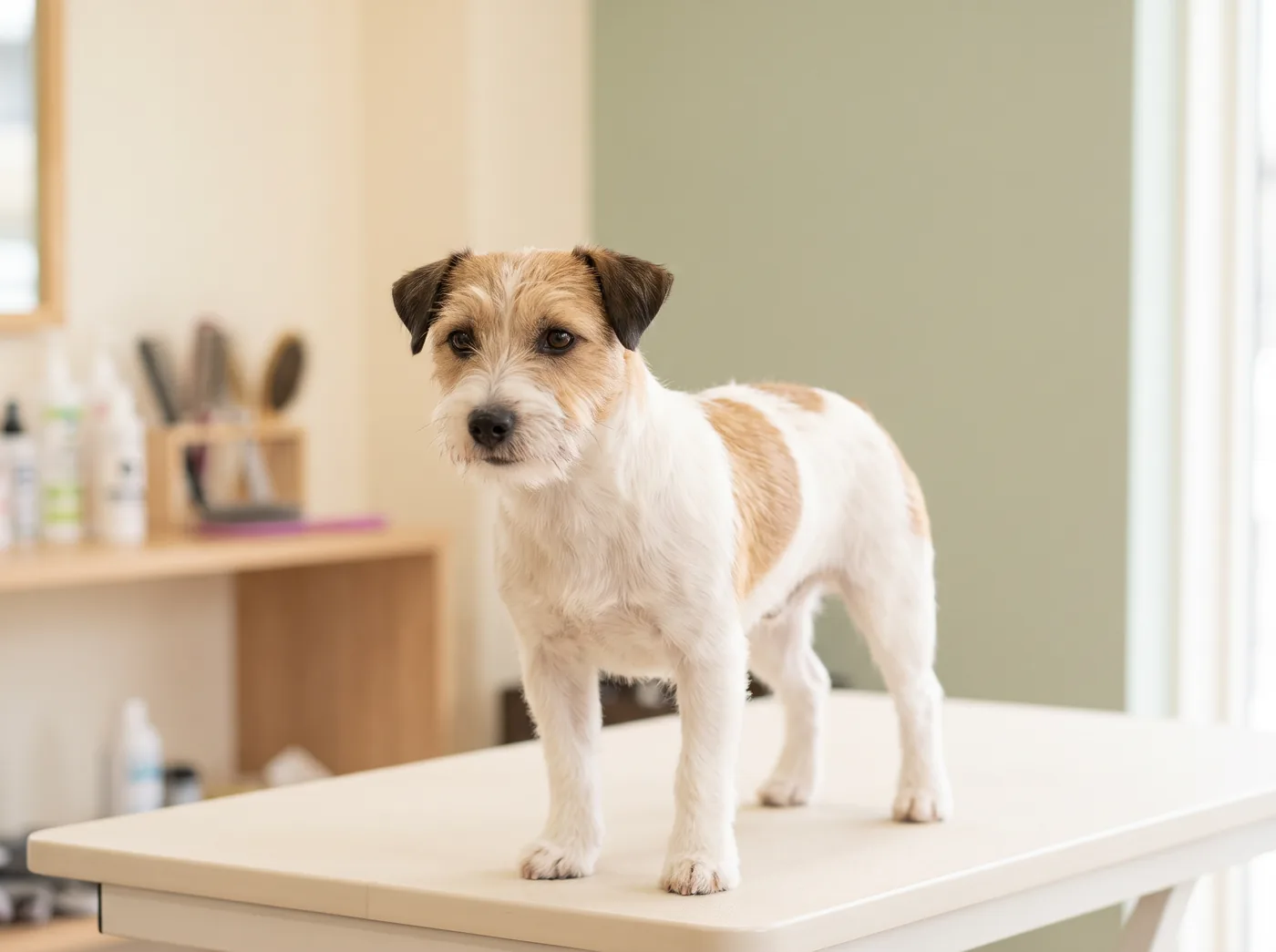
The third of the Russells and the smallest: shorter in the leg than a Parson Russell, rectangular rather than square, and roughly ten to twelve inches at the shoulder.
Registries recognize it separately, developed largely in Australia from English stock, which is why some places still call it the English Jack Russell.
Everything the Parson page says about the coat applies here without change, because the coat varies within this breed too.
Smooth, broken and rough, all correct, and they can appear in one litter.
So the name on the paperwork does not decide the appointment, and that is the single most useful thing to know about any Russell.
Look at the muzzle: bare is smooth, a full beard is rough, stubble is broken.
The Russell Terrier has a double coat that regulates its own temperature. Shaving it does not keep the animal cooler, removes the protection against sun and insects, and the top coat often grows back patchy or never returns correctly. A thorough deshed takes out the undercoat and does the job the owner was actually asking for.
The three Russells
The naming confuses almost everybody, so it is worth laying out once.
Parson Russell Terrier: the tallest and squarest, roughly twelve to fifteen inches, with a body about as long as it is tall.
Russell Terrier: shorter in the leg and rectangular, roughly ten to twelve inches, and the smallest of the three.
Jack Russell: as most people use the term, a working type rather than a show breed, with a wide range of heights and shapes and no single standard.
All three descend from the same nineteenth century working terriers bred by the Reverend John Russell, and registries split them on height and proportion.
None of the splits is about coat, and all three come in all three coats.
So the breed name tells a groomer nothing useful and the coat tells them everything.
Give a groomer the coat type and the weight.
Which coat, and what each needs
Smooth. Short, flat and hard all over, with no beard, eyebrows or leg furnishings. A rubber curry mitt once a week and a bath every couple of months. It sheds most noticeably of the three and the short hard hairs weave into fabric.
Rough. A harsh dense jacket with a full beard, eyebrows and leg furnishings. Hand stripped two or three times a year or rolled every few weeks, plus a comb through the soft furnishings every few days.
Broken. Mostly short and harsh with modest face and leg furnishing. Weekly brush, comb the face and legs, light strip once or twice a year.
None of the three is clipped, for the usual reason: cut hairs regrow softer and paler and the undercoat takes over, so a soft jacket mats where a harsh one did not.
The furnishings are the only part that mats, on any of them.
Bathe every ten weeks or so. Over-bathing softens a harsh coat.
Trim the pads and sanitary area, and nothing else.
A short legged working terrier
The Russell is rectangular and lower than a Parson, but the proportions are moderate rather than extreme, so the back is not the concern a Dachshund's is.
Still lift it on and off a table rather than letting it jump, since patellar luxation occurs in the breed and a small dog landing badly is easy to hurt.
Keep it lean. Fifteen pounds is the top of the range.
Nails every three to four weeks.
Ears are small and folded, which covers the canal, so check weekly.
Teeth brushed. A terrier living to fourteen accumulates a lot of tartar in a small mouth.
Primary lens luxation and deafness both occur and both have tests, so ask a breeder.
Temperament is the usual Russell: bold, fast, extremely high energy, prey driven and entirely convinced of itself. On a table that reads as busy rather than frightened, and it will take a chance to jump off.
An easy coat on a demanding dog
Worth saying about every Russell, because the coat is what sells them and the dog is what surprises people.
A smooth Russell needs five minutes a week, which reads as a low commitment small dog. It is neither low commitment nor really a small dog in the way people mean.
These are working terriers bred to be dropped down a hole after fox. They are fast, extremely high energy, prey driven, noisy, and they dig. A Russell without a genuine outlet finds one, usually in a garden or a sofa.
At a salon that shows up as a dog that will not stand still because it is bored rather than frightened, and one that will take any chance to get off a table.
Tire the dog out before the appointment. It does more for the groom than anything the groomer can do.
The other half of the trap is the same one the German Pinscher page describes: a dog whose coat needs nothing may reach adulthood having never been handled by a professional, and the first time is then at a vet.
Do the weekly session anyway, even on a smooth. It is about the handling, not the hair.
What to tell your groomer
Say which coat it is, smooth, broken or rough, before you say the breed name.
If it is broken or rough, say hand strip or roll, not clip.
Ask for the beard and eyebrows combed clear of the eyes but left on.
Say the dog is bold and busy rather than nervous, and will jump off a table.
Ask for ears checked, nails and pads.
Mention any known deafness, so nobody approaches from behind.
Keeping the coat between grooms
Check the muzzle first
Bare is smooth, beard is rough, stubble is broken. It decides everything.
Before booking
Strip or roll, never clip
On broken and rough coats. The smooth needs a rubber mitt and nothing.
Every few weeks
Comb the furnishings
The soft face and leg hair is the only part of any Russell that mats.
Every few days
Lift it off the table
Slipping kneecaps occur, and a small dog landing badly is easy to hurt.
Every time
Common Questions About the Russell Terrier
What is the difference between the three Russells?
Height and proportion, not coat. The Parson Russell is the tallest and squarest at roughly twelve to fifteen inches with a body about as long as it is tall. The Russell Terrier is shorter in the leg and rectangular at roughly ten to twelve inches. "Jack Russell" as most people use it is a working type with no single standard and a wide range of shapes. All three descend from the same terriers and all three come in smooth, broken and rough coats.
How do I know which coat my Russell has?
Look at the muzzle. Bare and short means smooth, a full beard with pronounced eyebrows means rough, and a bit of stubble with stray whiskers means broken. That is the quickest reliable test, and it matters far more than the breed name when booking, because the three are completely different appointments: a mitt, a light strip, or a full hand strip with furnishings to comb.
Should a Russell Terrier be clipped?
Not if it is broken or rough coated. Clipping cuts the harsh outer hairs rather than removing dead ones at the root, so the regrowth is softer, paler and thinner, the undercoat comes to dominate, and a soft jacket mats where a harsh one did not. Hand strip or roll instead. For an old dog, an ill dog or one that genuinely hates stripping it is a fair decision made knowingly, but it is a poor default.
Similar breeds
Same coat, same schedule, or the breeds this one is crossed from.

Parson Russell Terrier
Three different coats under one breed name, and the name does not tell you which
Parson Russell Terrier
Jack Russell Terrier
Three coats in one breed, and only one of them behaves the way a terrier coat should
Jack Russell Terrier
Rat Terrier
A ten minute coat on a working farm terrier, in two sizes and two coat lengths
Rat TerrierFind a groomer who knows this coat
Search 37,863 groomers by town, or keep reading the breed guide.
Find a Local Groomer View All Breeds