Jack Russell Terrier Grooming
Three coats in one breed, and only one of them behaves the way a terrier coat should
About the Jack Russell Terrier
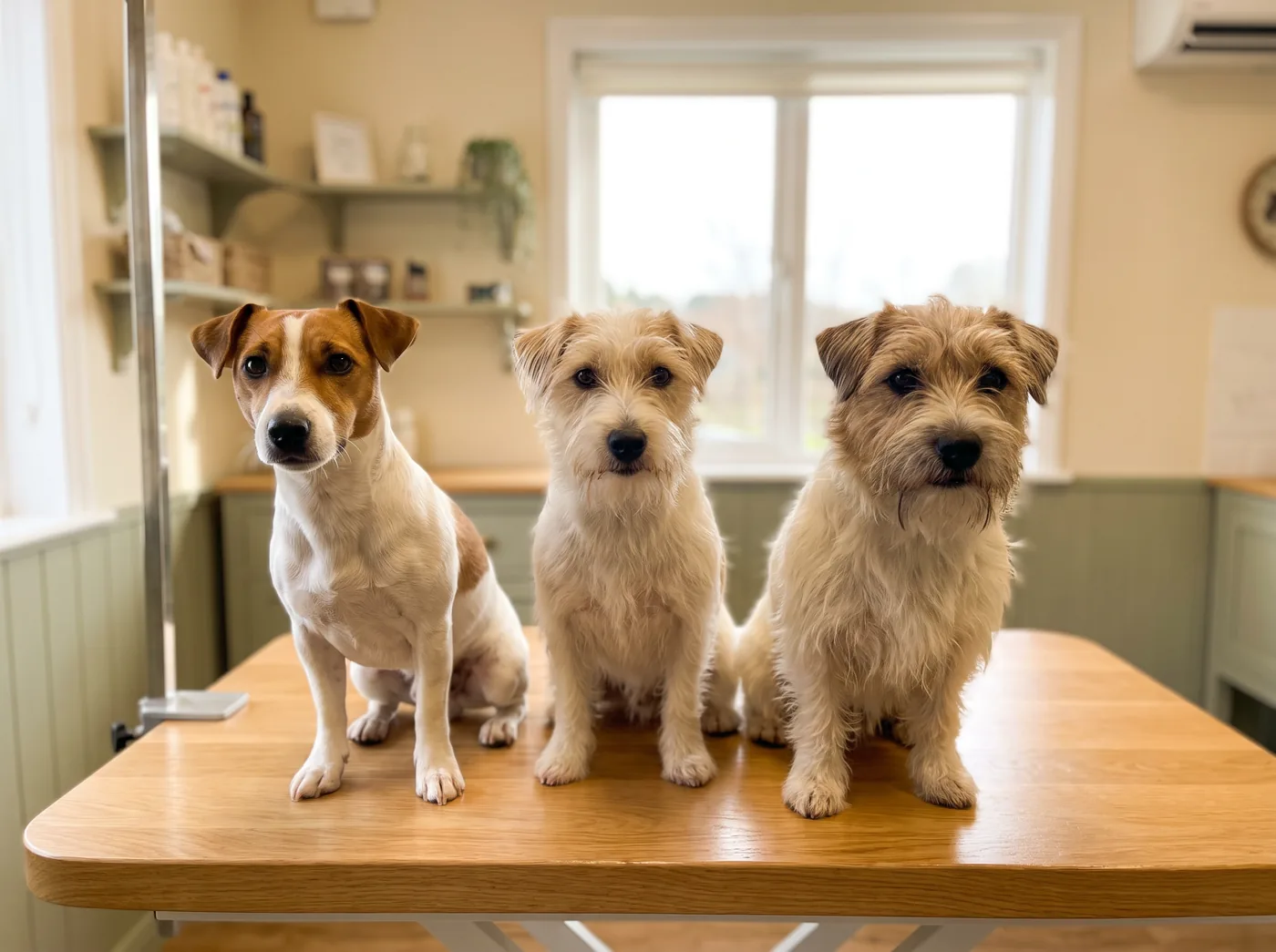
The Jack Russell comes in three coat varieties, all one breed, all appearing in the same litters: smooth, broken and rough. The Dachshund and the Chihuahua also carry more than one coat, but this is the only one where the three varieties want three genuinely different routines.
A smooth Jack Russell has a short, hard, flat coat and is curried, never stripped. A rough one has a longer harsh wire jacket with a beard and eyebrows, and is stripped like any other terrier. A broken coat sits between the two, mostly short with longer harsh patches and light face furnishings, and takes a bit of both.
All three shed, and here is the part that catches people: the smooth coat sheds the most by a wide margin. Those short, stiff, white hairs work into fabric point first and are close to impossible to lift out. A dog this small should not produce this much hair, and it does.
This coat can be clipped, but the texture or the color may change and it will not always come back the same. Talk it through with your groomer before the first one.
Three coats, and what each one wants
Work out which you have first, because the advice diverges completely.
The smooth coat is short, dense, hard and lies flat, with no beard, no eyebrows and no furnishings anywhere. It is not a wire coat and it must not be stripped: there is no dead outer jacket sitting loose in the follicle, so stripping means pulling live hair. Curry it weekly and leave it alone.
The rough coat is a proper wire jacket: harsh, dense, an inch or more long, with a full beard, eyebrows and leg furnishings. It behaves exactly like the Schnauzer and Airedale coats. Each hair grows, dies and waits in the follicle, and stripping it out by hand keeps the jacket harsh, dark and weatherproof. Clipping it instead is fine and permanently softens the texture and fades the color.
The broken coat is the confusing one. It is mostly short like a smooth, with longer harsh hair in patches, usually a light beard and eyebrows and some hair on the legs and along the back. Treat the short parts like a smooth and the longer harsh parts like a rough, tidying and stripping the furnishings while currying the rest.
Naming is genuinely muddled, and it is worth knowing that Jack Russell, Parson Russell and Russell Terrier are now separate registrations in some registries, differing mainly in leg length and proportion rather than coat. All three carry all three coat types, and for grooming purposes what matters is the coat in front of you rather than the paperwork.
The shedding, which nobody warns you about
Jack Russells shed heavily, all three coats, all year round, and the smooth coat is the worst.
The reason is the hair itself. A smooth Jack Russell coat is short, dense, and made of stiff, straight, needle like hairs, mostly white. Rather than lying on fabric they work into it point first, exactly as a Dalmatian hair does, and once in they do not come out easily. On dark clothing and upholstery they are as visible as hair gets.
The rough coat sheds less noticeably, because dead wire hair tends to stay in the jacket until it is stripped rather than dropping. That is one honest argument for keeping a rough coat stripped: it takes the shedding out on your schedule instead of the dog's.
The tool that works on all three is a rubber curry or a hound glove, in circles against the lie then along it. Ten minutes twice a week, outdoors, removes a genuinely surprising amount for a fifteen pound dog.
A deshedding bath a few times a year helps, since warm water and a proper dry release hair brushing leaves behind.
What does not help is a shave. There is nothing to take off, and on a rough coat clipping simply softens the jacket permanently while the dog carries on shedding.
Stripping a rough coat, and whether to bother
If you have a rough or broken coat, you have a choice, and unlike the Airedale it is a fairly low stakes one because there is much less coat involved.
Hand stripping pulls the dead outer hairs out at the root, a small pinch at a time. It does not hurt when the coat is ready, because a dead wire hair sits loose in the follicle. It keeps the jacket harsh and the color rich, and it stimulates the same coat to grow back.
Clipping cuts the hair at the surface and leaves the dead root, so the softer undercoat gradually dominates. The jacket goes woolly, the tan and black markings fade, the coat loses its weather resistance and it starts to hold dirt rather than shedding it. On a working terrier that is a functional change.
Practically, for a pet Jack Russell, either is defensible. Many owners of rough coats simply pluck the longest hairs out by hand over the course of a few evenings, which is called rolling the coat, and never book a salon at all. It is a small dog and the jacket is not large.
Where a professional earns their money on this breed is a full strip on a coat that has been left, tidying a broken coat into a sensible outline, and nails.
The beard and eyebrows on a rough or broken coat need combing and the beard needs drying after meals, exactly as on any bearded terrier.
A working terrier on a grooming table
The Jack Russell was bred to go to ground after fox, which means it was selected for being fast, determined, physically fearless and entirely unwilling to back down. Two hundred years later it is a fifteen pound dog with the temperament of a much larger one, and that is what a groomer meets.
Most are fine. What they are not is patient, and a Jack Russell that has decided it has had enough is quick, wriggly, and perfectly prepared to use its teeth about it. They are also strong for their size and surprisingly hard to hold still.
The two things that help are both owner side. Exercise the dog properly before the appointment, because a Jack Russell with unspent energy is a different animal. And handle the feet, ears and mouth daily from puppyhood as an ordinary non-event, because a terrier that learned young is straightforward for fifteen years.
Nails are the job that matters and the one most often fought over. Every three to four weeks, small amounts, and a grinder often works better than clippers once accepted.
Ears are small and folded, and want a weekly lift and smell. A dog that goes to ground, or through hedges, needs checking for grass seeds in ears and between the toes.
The teeth are worth mentioning: this is a long lived breed, commonly reaching sixteen, and dental disease over that many years is a genuine welfare issue.
What to tell your groomer
Say which coat you have: smooth, broken or rough. It is the whole appointment and the words are not interchangeable.
If it is rough or broken, say whether you want it stripped or clipped, and understand that clipping permanently softens the jacket.
If it is smooth, say explicitly that it is not to be stripped.
Ask for a deshedding bath, which is where the value is on a smooth coat.
Ask for the nails, and say honestly how the dog is about having its feet held.
Say how the dog is generally, because a terrier that has decided it is finished is quick, and a groomer who knows works differently from one who does not.
And walk the dog first. It genuinely changes the appointment.
Keeping the coat between grooms
Rubber curry, outdoors
All three coats. Stiff white hairs work into fabric point first, so removing them before they land is the whole game.
Twice a week
Clip the nails, little and often
The job most fought over on this breed. A grinder often works better than clippers once the dog accepts it.
Every three to four weeks
Exercise before the appointment
A working terrier with unspent energy is a genuinely different animal on a table.
Every visit
Check ears and toes for seeds
A dog that goes to ground and through hedges. Grass seeds in summer are the routine hazard.
After walks
Common Questions About the Jack Russell Terrier
What is the difference between smooth, broken and rough coated Jack Russells?
All three are one breed and appear in the same litters. A smooth coat is short, hard and flat with no beard or furnishings, and is curried rather than stripped. A rough coat is a proper wire jacket, an inch or more long with a beard, eyebrows and leg furnishings, and is hand stripped like any terrier. A broken coat sits between them: mostly short with longer harsh patches and light face furnishings, so it gets a bit of both. Identify which you have before following any advice.
Do Jack Russells shed a lot?
Far more than a fifteen pound dog should, and the smooth coat is the worst of the three. The hairs are short, stiff, straight and mostly white, so instead of resting on fabric they work in point first and will not lift out, which makes them punishing on dark upholstery and clothing. Rough coats shed less visibly because dead wire hair stays in the jacket until stripped. A rubber curry twice a week, done outdoors, is the practical answer for all three.
Should my Jack Russell be hand stripped?
Only if it has a rough or broken coat. A smooth coat has no dead outer jacket to remove, so stripping it means pulling live hair from the follicle, which hurts and achieves nothing. On a rough coat, stripping keeps the jacket harsh, dark and weather resistant, while clipping permanently softens the texture and fades the markings. Many owners simply pluck the longest hairs out by hand over a few evenings, which is called rolling the coat, and never book a salon for it.
Similar breeds
Same coat, same schedule, or the breeds this one is crossed from.

Dachshund
One breed with three completely different coats, and three different appointments
Dachshund
Miniature Schnauzer
A wire jacket and a set of furnishings, and one decision that cannot be undone
Miniature Schnauzer
Soft Coated Wheaten Terrier
The terrier that carries a silky single coat, which reverses every rule the group page states
Soft Coated Wheaten TerrierFind a groomer who knows this coat
Search 37,863 groomers by town, or keep reading the breed guide.
Find a Local Groomer View All Breeds