Singapura Grooming
The smallest breed there is, with a coat that takes about five minutes a week
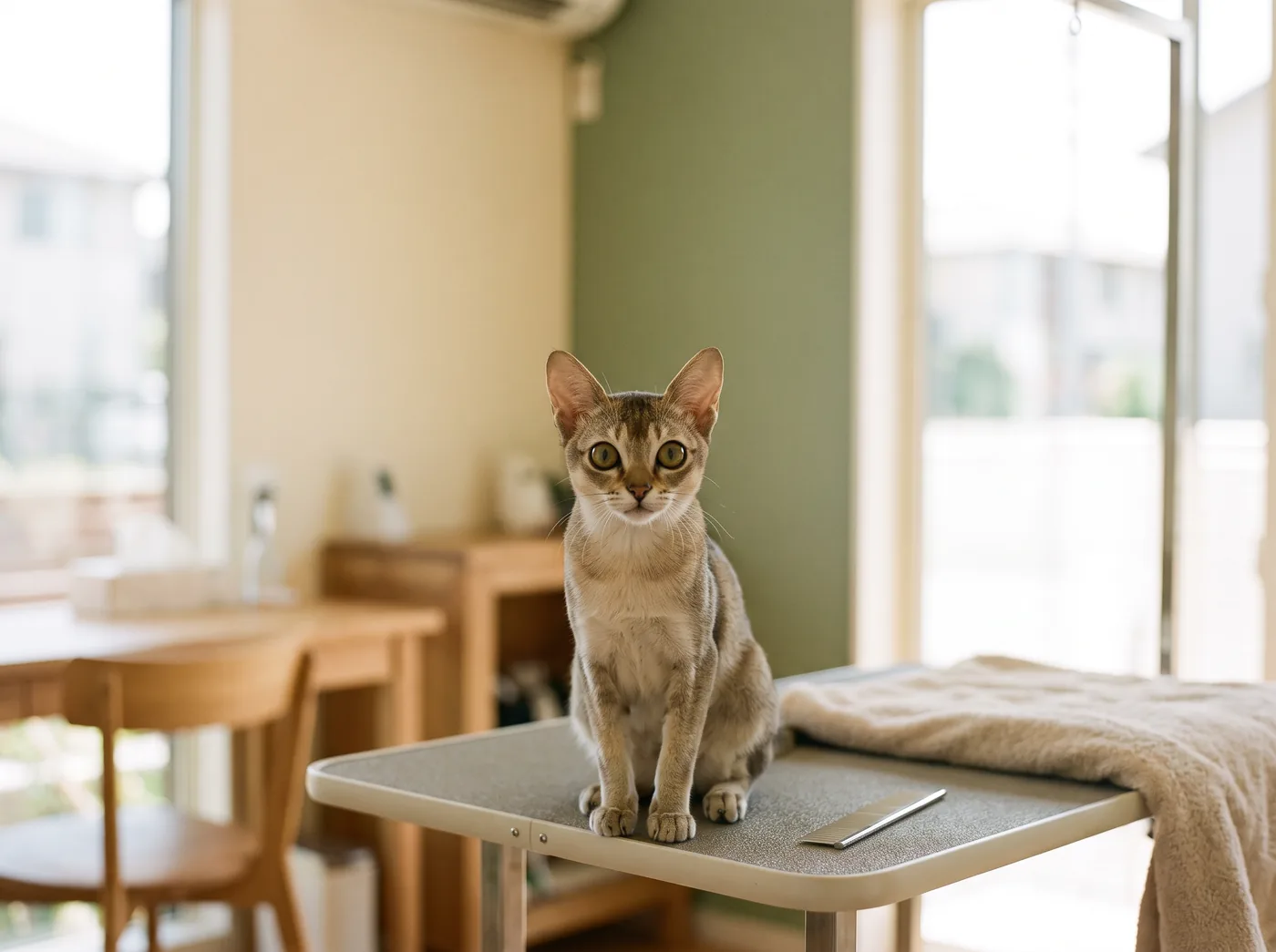
About the Singapura
The smallest recognized cat breed, and one of the simplest grooming propositions there is. An adult female can weigh four pounds and a male rarely exceeds eight, which is roughly half the size of a British Shorthair.
The coat is very short, fine and close lying, in a single color pattern: sepia agouti, meaning each hair is banded with dark and light so the cat appears ticked rather than striped or spotted, in a warm ivory and brown.
It takes about five minutes a week and nothing else. There is no matting, no clipping, no bathing and no seasonal drama.
What the size does affect is everything around the coat: warmth, weight, handling and how easy it is to miss a change in a cat this small.
The Singapura has a double coat that regulates its own temperature. Shaving it does not keep the animal cooler, removes the protection against sun and insects, and the top coat often grows back patchy or never returns correctly. A thorough deshed takes out the undercoat and does the job the owner was actually asking for.
Five minutes a week
The coat is very short and lies flat, with almost no undercoat, and the ticking comes from each individual hair being banded rather than from any pattern in the coat itself.
Go over the cat once a week with a rubber grooming mitt or a fine comb. It removes the small amount of loose hair and spreads the skin oils that give the coat its sheen.
Shedding is low and there is no seasonal blow worth the name.
Matting does not happen. Bathing is not needed on a healthy cat and strips a fine short coat. Clipping has no purpose.
Some breeders finish a coat like this with a chamois or a soft cloth for shows, which adds shine for a day and does no harm.
Because there is so little to do, the weekly session is really a hands-on health check, and on a cat this small it is more valuable than usual: a lump, a scab or a change in weight is easy to miss visually on four pounds of cat and easy to find with your hands.
What being this small actually means
Warmth first. A four pound cat with a very short coat and little body fat has a lot of surface area for its mass and loses heat quickly. Singapuras seek out warm places constantly, and that is normal behavior rather than a symptom.
If a bath is ever necessary, keep the room and water warm, work fast and dry thoroughly, because a cat this size chills alarmingly quickly when wet.
Weight in the other direction matters too. On a cat with a healthy weight of five pounds, half a pound is ten percent of its body weight, so gains and losses that would be trivial in a larger cat are significant here. Weigh rather than eyeball, and use the same scales.
Medication dosing is similarly sensitive, which is a veterinary point worth raising rather than assuming.
Handling should be gentle and supported. These are agile, confident cats that climb and perch, but they are physically slight and a fall or a rough grip does more damage than it would to a larger animal.
Adults are frequently mistaken for kittens, including by people who then handle them like kittens.
Claws, teeth and ears
With no coat work at all, the routine is the rest of it, and the risk is that it gets neglected because the cat never looks like it needs anything.
Claws want tipping every two to three weeks, the sharp tip only and well clear of the quick, which on a cat this small is closer to the tip than you might expect, so take less rather than more.
Provide a post. Never consider declawing.
Ears are very large in proportion to the head and quite open, so they collect a little dust. Wipe the visible part weekly with a soft damp cloth and never push anything into the canal.
Teeth are worth brushing, and small breeds generally carry more dental risk because of crowding.
Eyes are large and prominent, so wipe any discharge outward and away, and never spray anything toward the face.
Singapuras are curious, active, people focused cats that involve themselves in everything, which makes weekly handling easy if it starts in kittenhood.
A small gene pool, and what to ask a breeder
The breed descends from a very small number of founding cats, and its origin story, cats brought from Singapore in the 1970s, has been disputed for decades.
What matters practically is the small gene pool, which brings a higher risk of inherited conditions.
Singapuras have a documented risk of pyruvate kinase deficiency, an inherited condition affecting red blood cells that causes anemia, and there is a DNA test for it. A responsible breeder tests and will show you the results.
Uterine inertia, difficulty giving birth, is also reported in the breed, which matters to breeders rather than pet owners.
For an owner the practical points are to buy from someone who tests, and to take lethargy, pale gums or unexplained weakness seriously rather than waiting.
None of that changes the grooming, and it is the kind of thing a weekly hands-on session helps you notice early, which is the argument for having a routine at all on a cat that needs almost none.
What to tell your groomer or vet
Say the cat needs a mitt or comb only, with no bathing and no clipping.
Say it chills very quickly for its size, so warmth matters during and after anything wet.
Ask for claws tipped conservatively, since the quick is close to the tip on a cat this small.
Ask them to weigh the cat rather than judging by eye, because small changes are proportionally large.
Say it is an adult rather than a kitten if it is, since it will be mistaken for one.
Mention pyruvate kinase testing status if you know it.
Keeping the coat between grooms
Mitt or comb, five minutes
The whole coat routine, and a hands-on check that matters on a cat this small.
Weekly
Weigh, do not eyeball
Half a pound is ten percent of this cat. Use the same scales each time.
Monthly
Keep it warm
A lot of surface area for four pounds. Getting wet is a genuine chill risk.
Always
Tip the claws conservatively
The quick sits close to the tip on a cat this size. Take less rather than more.
Every two to three weeks
Common Questions About the Singapura
How much grooming does a Singapura need?
About five minutes a week. The coat is very short, fine and close lying with almost no undercoat, so a rubber mitt or fine comb once a week removes the small amount of loose hair and spreads the skin oils. Matting does not happen, bathing is unnecessary on a healthy cat and strips the coat, and clipping has no purpose. The weekly session is really a hands-on health check, which matters more than usual on a cat this small because changes are easy to miss by eye.
Does being the smallest breed change anything practically?
Yes, in three ways. Warmth: four pounds of cat with a very short coat loses heat fast, so seeking out warm places is normal and getting wet is a real chill risk. Weight: half a pound on a five pound cat is ten percent of its body weight, so weigh rather than eyeball and use the same scales. Handling: they are agile but physically slight, and adults are constantly mistaken for kittens, including by people who then handle them carelessly.
Are there health issues to ask a breeder about?
Yes. The breed descends from a very small number of founding cats, and a small gene pool raises the risk of inherited conditions. The main one is pyruvate kinase deficiency, an inherited condition affecting red blood cells that causes anemia, and there is a DNA test for it, so a responsible breeder will test and show you results. As an owner, take lethargy, pale gums or unexplained weakness seriously rather than waiting, and use the weekly hands-on session to notice changes early.
Similar breeds
Same coat, same schedule, or the breeds this one is crossed from.

Abyssinian
A ticked coat that needs almost nothing, on a cat that would not sit still for it anyway
Abyssinian
Burmese
A satin coat over a cat considerably heavier than it looks, and two head types worth telling apart
Burmese
Munchkin
A normal cat body on legs that cannot reach everywhere, which is the entire grooming story
MunchkinFind a groomer who knows this coat
Search 37,863 groomers by town, or keep reading the breed guide.
Find a Local Groomer View All Breeds