Tibetan Mastiff Grooming
An enormous double coat that blows once a year and sheds very little in between
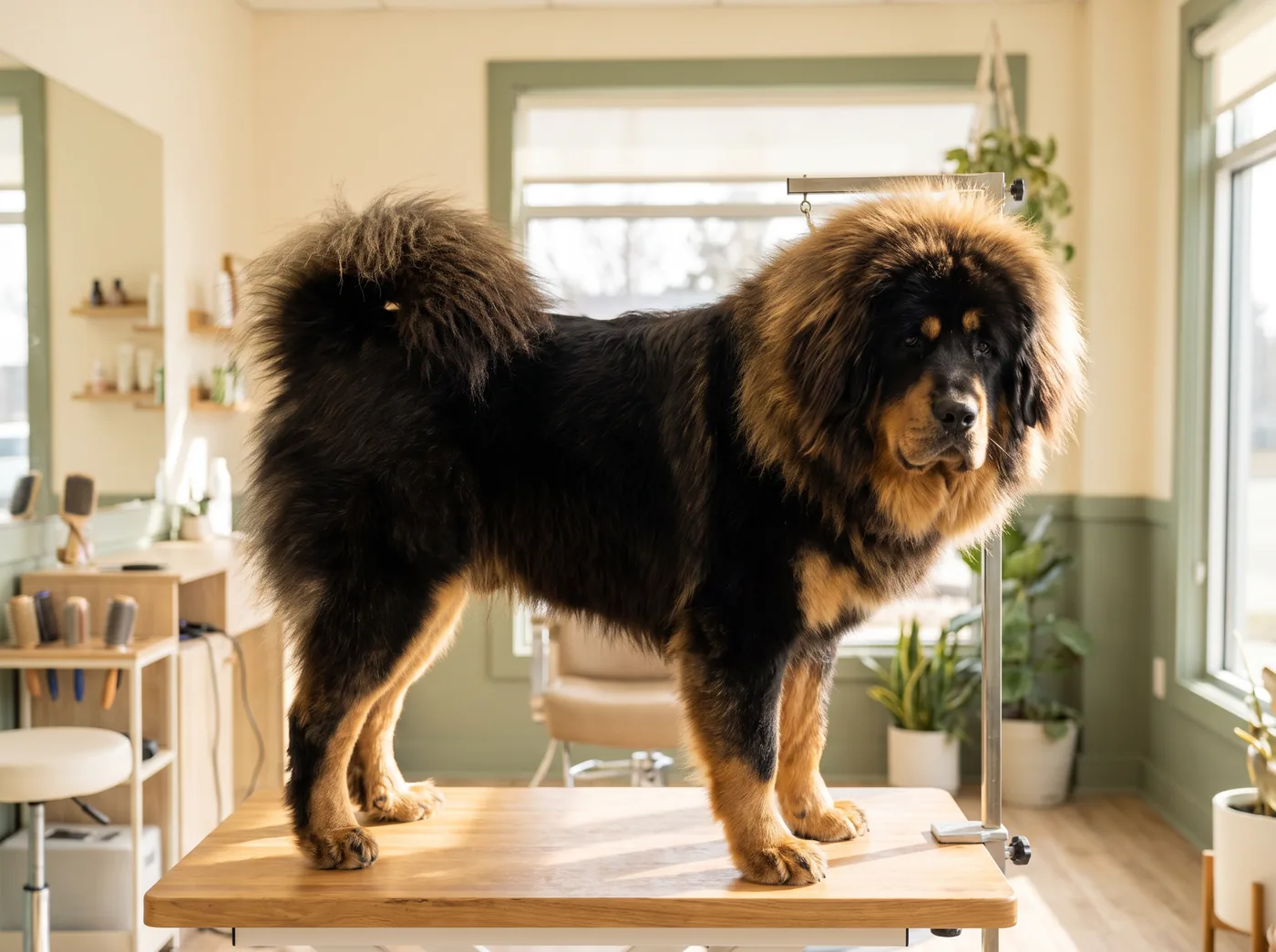
About the Tibetan Mastiff
Most double coated breeds blow their undercoat twice a year, in spring and autumn. The Husky, the German Shepherd and the Great Pyrenees pages all describe that cycle.
A Tibetan Mastiff does it once. The breed keeps a primitive annual cycle from the Himalayan plateau, so the entire undercoat comes out over a few weeks, usually in late spring, and then the dog sheds remarkably little for the rest of the year.
The consequence surprises people: for eleven months a giant dog with a lion's mane leaves less hair on the furniture than a Labrador does. For the twelfth, it produces more coat than almost any other breed, in quantities owners describe in bin bags.
The Tibetan Mastiff has a double coat that regulates its own temperature. Shaving it does not keep the animal cooler, removes the protection against sun and insects, and the top coat often grows back patchy or never returns correctly. A thorough deshed takes out the undercoat and does the job the owner was actually asking for.
The annual blow, and what it actually takes
Once a year, usually in late spring as the days lengthen, a Tibetan Mastiff sheds its entire undercoat. It runs for roughly three to six weeks and it is unlike anything a first time owner has seen: the undercoat lifts away in sheets and pads, the dog looks patchy and moth eaten for a while, and the volume is genuinely startling.
Daily work during the blow, and there is no shortcut. An undercoat rake through the whole dog, then a slicker over the mane and feathering, working in sections down to the skin. Expect to fill a bag each time.
The single most useful thing is a bath and high velocity blow out at the start of the blow, and often a second one partway through. A professional dryer pushes the loosened undercoat out in an hour or two in a way that days of raking at home does not match, and it shortens the whole process.
Book that appointment in advance, because it takes a long slot on a large dog and salons that take giant breeds fill up.
Outside the blow, weekly brushing is enough. That is the part nobody believes until they live with one.
A blow that does not happen, or hair that comes out patchily outside the season, is worth a veterinary conversation, since thyroid disease is not rare in the breed and shows up in the coat first.
The mane, the trousers and where it mats
The coat is long and coarse on the outside over a very heavy undercoat, and it is not uniform. The mane around the neck and shoulders is the heaviest part, more pronounced on males, and there is thick feathering on the backs of the legs, a heavily plumed tail carried over the back, and dense hair between the toes.
Those are the places that mat, and they mat at the skin where nobody is looking.
Behind and under the ears goes first, then the deep part of the mane where a collar sits, then the trousers on the back legs and around the rear, then the tail plume and between the toes.
A collar on a maned dog is a mat generator. If a collar is worn constantly, take it off and check under it every week.
Work with a rake and a long pinned slicker in sections, lifting the coat and brushing down to the skin, rather than sweeping over the top. A coat this deep will look brushed while being solid underneath, and the only test that means anything is a comb reaching skin.
Bathe every eight to twelve weeks, and drying is the real job: a coat this dense left damp at the skin will grow yeast and hot spots. A high velocity dryer is not a luxury here, it is the only practical way.
Why it is never shaved, even at this size
The rule is the same as every double coat and the temptation is larger, because this is an enormous quantity of hair on a dog that often lives somewhere much warmer than Tibet.
The coat is insulation in both directions. It keeps heat in during a Himalayan winter and it keeps heat and sun out in summer, and the layer of still air it traps is doing that work. Removing the outer coat leaves the dog hotter in real terms, not cooler, and exposes skin that has never seen sun.
Regrowth on a giant double coat is also slow and unreliable, and a badly regrown coat on a dog this size is a years long problem rather than a season's.
What actually helps a Tibetan Mastiff in heat: undercoat removal, shade, water, cool floors, and exercise at the ends of the day. A properly raked out coat is dramatically cooler than a neglected one.
Trimming for function is fine: the hair between the pads, the sanitary area, and tidying the feathering where it drags.
If a groomer suggests shaving a Tibetan Mastiff for the summer, decline, and be aware that this breed carries enough coat that the suggestion gets made more than once.
Handling a guardian breed at a salon
This is a livestock guardian, bred for centuries to make its own decisions about strangers approaching at night without waiting for instruction. That is not aggression, it is the job, and it changes how grooming has to be set up.
Many Tibetan Mastiffs are reserved and slow to accept unfamiliar handling, and a stranger leaning over a dog of this size in a strange room asking it to stand still is a big ask. The breed is also strong enough that a dog which decides it is finished is finished.
So: start young, groom at home constantly from puppyhood so handling is completely routine, and choose a groomer who will meet the dog before the first appointment rather than starting cold.
Ask for a quiet slot with no other dogs in the room, and expect to stay if that helps. Many owners of this breed do the coat at home and use a salon only for the annual blow out.
Nails are a genuine two person job on a dog of this weight and are much easier if started early.
Be honest with a groomer about temperament rather than hoping it goes well. A groomer who knows what they are taking on can plan for it; one who is surprised by it may refuse the dog afterwards.
What to tell your groomer
Say the dog blows its coat once a year rather than twice, and book the bath and blow out for that window.
Ask for a deshedding groom: bath, high velocity dry and a full undercoat rake. Never a clip.
Say that the coat must not be shaved under any circumstances, including for heat.
Point out the mane under a collar, behind the ears, the trousers and the tail plume as the places that mat at the skin.
Say how the dog is with strangers, honestly, and ask for a quiet slot and a meeting first.
Ask for pads cleared, sanitary trimmed and nails done, and expect nails to need two people.
Keeping the coat between grooms
Rake the whole dog, in sections
Weekly most of the year. Daily for the three to six weeks of the annual blow.
Weekly, then daily
Book the blow out in spring
A high velocity dryer does in two hours what days of home raking will not.
Once a year
Check under the collar and mane
The deep mane and behind the ears mat at the skin while the surface looks fine.
Weekly
Handle it from puppyhood
A guardian breed at full size cannot be persuaded. Routine handling has to come first.
Ongoing
Common Questions About the Tibetan Mastiff
Do Tibetan Mastiffs shed a lot?
Once a year, enormously, and very little the rest of the time. Unlike most double coated breeds, which blow their undercoat in both spring and autumn, a Tibetan Mastiff keeps a primitive annual cycle and drops the whole undercoat over three to six weeks in late spring. During those weeks it produces more hair than almost any other breed. For the remaining eleven months a giant dog with a full mane leaves less hair around the house than a Labrador does, which is the part nobody believes in advance.
Can I shave a Tibetan Mastiff in a hot climate?
No. The coat insulates in both directions, trapping a layer of still air that keeps heat and sun out as well as keeping warmth in, so a shaved dog is hotter in real terms and has skin exposed that has never seen sun. Regrowth on a giant double coat is slow and often comes back patchy or soft, and on a dog this size that is a problem measured in years. What genuinely cools the dog is getting the dead undercoat out: rake it, bathe and blow it out properly, and give shade, water and cool floors.
Why will some groomers not take a Tibetan Mastiff?
Size and temperament together. This is a livestock guardian bred to assess strangers on its own initiative, so many are reserved about unfamiliar handling, and a hundred and thirty pound dog that decides the appointment is over cannot be talked round. It is not aggression, it is what the breed was built to do. The answer is to start grooming at home in puppyhood so handling is routine, choose a groomer who will meet the dog first, ask for a quiet slot, and be honest about temperament when booking rather than hoping.
Similar breeds
Same coat, same schedule, or the breeds this one is crossed from.

Great Pyrenees
A white weatherproof coat built to live outdoors, on a dog that must not be clipped
Great Pyrenees
Chow Chow
One of the densest undercoats in dogs, on a breed that will not tolerate being rushed
Chow Chow
Newfoundland
A half day appointment, two groomers, and a coat that holds a bathtub of water
NewfoundlandFind a groomer who knows this coat
Search 37,863 groomers by town, or keep reading the breed guide.
Find a Local Groomer View All Breeds