Toyger Grooming
Bred to look like a tiger, with none of the wild ancestry the name and the group suggest
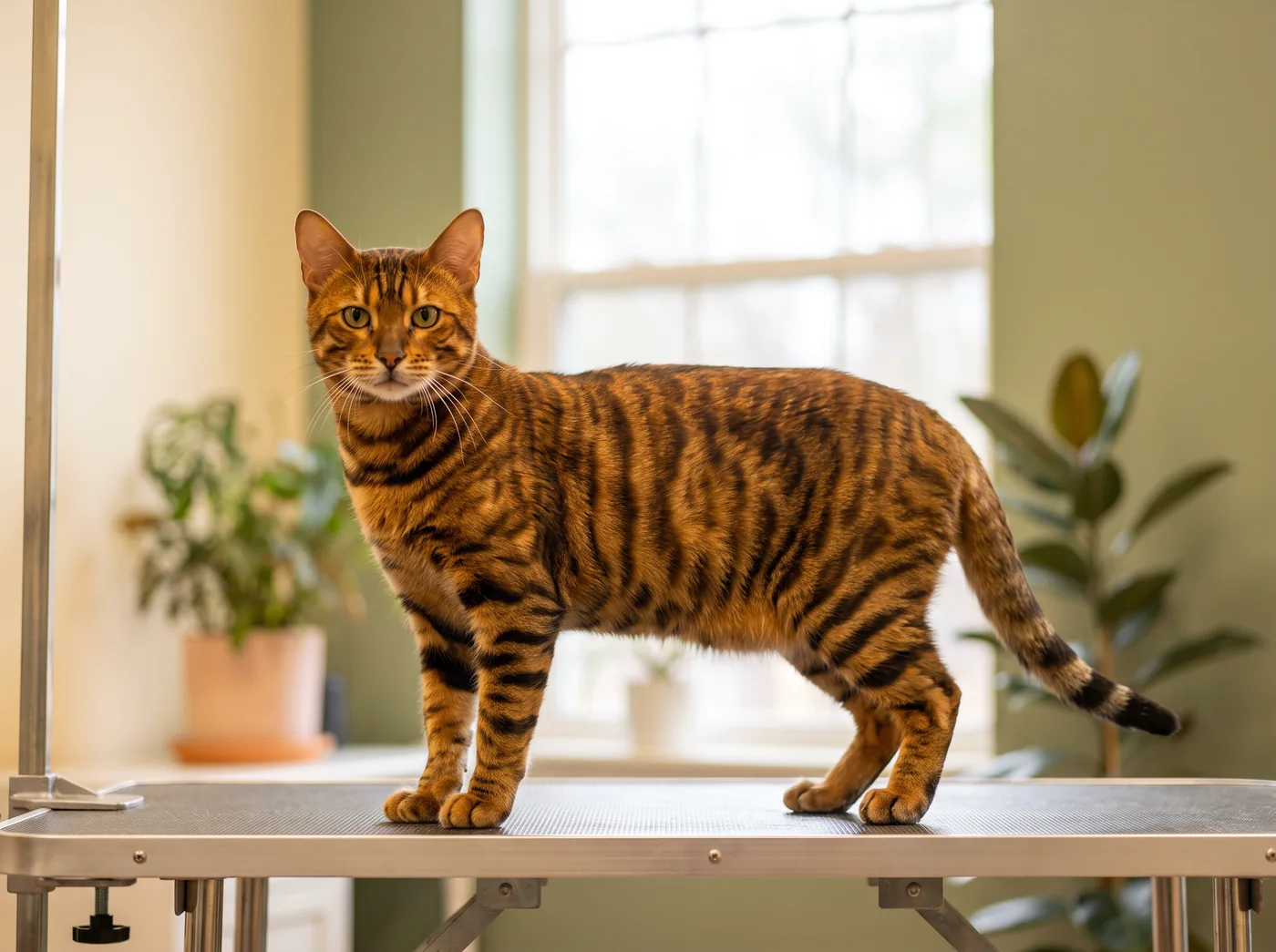
About the Toyger
The Toyger was created deliberately, from the 1980s onward, to look like a small tiger: bold dark vertical stripes on a rich orange ground, a long muscular body and a confident rolling walk. It was developed from Bengal stock crossed with domestic shorthairs, and the breeding program selected hard for the striping.
It is filed here with the hybrid cats because of that Bengal ancestry, and the most useful thing this page can say is what that does not mean.
A Toyger is a fully domestic cat. There is no recent wild ancestry, no filial generation number, and none of the ownership restrictions that the Savannah page sets out at length. Somebody reading the hybrid group page and finding warnings about state bans and groomers refusing bookings needs to know that those apply to early generation Savannahs and not to this breed.
This coat can be clipped, but the texture or the color may change and it will not always come back the same. Talk it through with your groomer before the first one.
Domestic, despite the group it sits in
The distinction matters practically rather than academically, so it is worth being precise.
A Savannah is a serval cross, and early generations are half wild. That is why its page carries warnings about size, handling, groomers declining bookings and, in several states and cities, outright bans or permit requirements.
A Bengal descends from the Asian leopard cat but is now many generations removed and is treated as fully domestic almost everywhere.
A Toyger is a further step again. It was built from Bengals that were already domestic generations, crossed with ordinary domestic shorthairs, and selected on appearance. There is no wild parent anywhere near it.
So a Toyger is legal wherever ordinary cats are legal, no veterinary practice will decline it, no insurer treats it differently, and no groomer has any reason to refuse one.
It also behaves like a domestic cat, which is the point of the breed: the aim was a tiger to look at and a housecat to live with. Toygers are typically friendly, confident, people oriented and easy to handle, and many are notably tolerant of being picked up and worked on.
The one thing they share with the Bengal is energy. They are active, athletic and intelligent, they climb, and a bored Toyger finds something to do.
The coat, and the glitter
Short, dense, plush and lying close to the body, thicker than a Burmese coat and softer than a Bengal pelt. It does not mat and there is nothing to cut.
Many Toygers carry glitter, inherited from the Bengal side: a genuine sparkle in the coat caused by hollow or translucent sections in the individual hairs that catch light. It looks as though the cat has been dusted with gold, and it is a real structural feature rather than a trick of photography. Nothing you buy adds it and nothing you do removes it, though a dull coat shows it less.
The routine is a rubber grooming glove or a soft brush once a week, along the lie, which lifts what is loose and spreads the skin oils. Five minutes.
Shedding is moderate, more than a Bengal because the coat is denser, and a weekly glove handles most of it. Twice a week during a seasonal drop reduces hairballs, since combed hair is never swallowed.
Bathing is rarely needed, though like Bengals a good many Toygers are unbothered by water and some actively enjoy it, which makes the occasional bath easier than it usually is with cats.
Nails every three to four weeks, and this matters on an athletic cat that climbs. Ears are small, rounded and open, so a weekly look is enough. Teeth as with any long lived cat.
Do not clip this coat. There is no reason to and cat skin is thin.
The stripes, and what they mean for grooming
Almost nothing, which is worth saying because the pattern is the whole reason people want the breed and it is easy to assume it needs protecting.
The markings are ordinary coat pigment. They do not need special shampoo, they do not fade with normal washing, and nothing an owner does at home will improve or damage them.
The pattern does deepen and clarify over the first year or two as the adult coat comes in, so a kitten whose stripes look vague is usually fine.
What does affect how the pattern looks is coat condition generally. A cat in poor condition has a dull, flat, slightly rough coat, and bold markings on a dull coat look muddy. So the answer to a Toyger whose stripes seem to have lost definition is to look at the cat rather than at the coat: weight, teeth, mobility and age all show up as coat quality first, exactly as on every other cat page here.
Seasonal change is normal. Many Toygers carry a slightly denser winter coat that softens the contrast, and it sharpens again in summer.
One genuine grooming point: on a densely patterned cat, skin problems are moderately hard to spot, in the same way they are on a black cat though less severely. Use the weekly glove as a hands-on check, feeling along the spine, ribs and belly rather than only looking.
A young breed, and what that means when buying
The Toyger is one of the newest cat breeds there is, developed from the 1980s and given full recognition by TICA in 2007, and it is still uncommon and expensive.
Two consequences for an owner, neither of which is grooming but both of which come up.
The gene pool is small and the breed is young, so health screening matters more than usual. Heart murmurs and hypertrophic cardiomyopathy have been reported in the breed, as they have across many pedigree cats, and reputable breeders screen. Ask.
And because the look is desirable and the price is high, cats are sold as Toygers that are simply well marked mackerel tabbies. That matters practically only in that an ordinary tabby is an ordinary cat, which is not a bad outcome at all, but it is worth knowing what you are paying for. Registration paperwork from a recognized registry is the only real check.
For grooming purposes none of it changes anything: a well marked tabby and a registered Toyger need exactly the same five minutes a week.
A cat with a diagnosed heart condition should not be stressed by a long or forceful appointment, which is worth mentioning to a groomer if it applies.
What to tell your groomer
Say it is a Toyger and that it is fully domestic, because the name and the tiger markings invite the assumption that it is a wild hybrid and that the Savannah cautions apply. They do not.
Say the coat is short and dense and needs a glove rather than a comb or a slicker used hard, and that nothing needs cutting.
Ask for the nails, a few claws at a time, since this is an athletic climbing cat.
Ask them to check the skin by feel along the spine, ribs and belly, since a busy pattern hides scabs and thin patches.
Mention any diagnosed heart condition.
And ask whether they take cats and keep them away from dogs, which is the question on any cat booking.
Keeping the coat between grooms
Glove along the lie
Five minutes once a week, twice during a seasonal drop. The coat is denser than a Bengal pelt and sheds a little more.
Weekly
Check the skin by feel
A busy striped pattern hides scabs and thin patches. Feel along the spine, ribs and belly rather than looking.
Weekly
Clip the nails
An athletic climbing cat with Bengal energy. A few claws at a time rather than fighting for all eighteen.
Every three to four weeks
Say it is fully domestic
The name and the group invite the assumption that Savannah restrictions apply. They do not, on any of them.
When booking
Common Questions About the Toyger
Is a Toyger part wild cat?
No. It was developed from Bengal stock that was already many generations domestic, crossed with ordinary domestic shorthairs and selected on appearance, so there is no recent wild ancestry anywhere in it. It is filed with the hybrid cats because of that Bengal lineage, but unlike an early generation Savannah it is fully domestic: legal wherever ordinary cats are legal, with no permits, no restrictions and no reason for a vet or groomer to decline it.
Do Toygers need grooming?
Almost none. A rubber grooming glove or soft brush once a week along the lie takes five minutes, twice a week during a seasonal drop to cut down hairballs. The coat is short, dense and plush, it does not mat, and there is nothing to cut. Nails every three to four weeks matter more, since this is an athletic climbing cat. Use the weekly session as a hands-on check, because a busy striped pattern hides scabs and thin patches.
Why does my Toyger coat sparkle?
That is glitter, inherited from the Bengal side, and it is a genuine structural feature rather than a photographic effect: hollow or translucent sections within individual hairs catch and scatter light, so the coat looks dusted with gold. Nothing you buy adds it and nothing removes it, though a cat in poor coat condition shows it less. If the sparkle seems to have faded, look at the cat's general condition rather than reaching for a product.


Find a groomer who knows this coat
Search 37,863 groomers by town, or keep reading the breed guide.
Find a Local Groomer View All Breeds