Ukrainian Levkoy Grooming
Hairless skin, plus the folded ear that this time really is the Scottish Fold gene
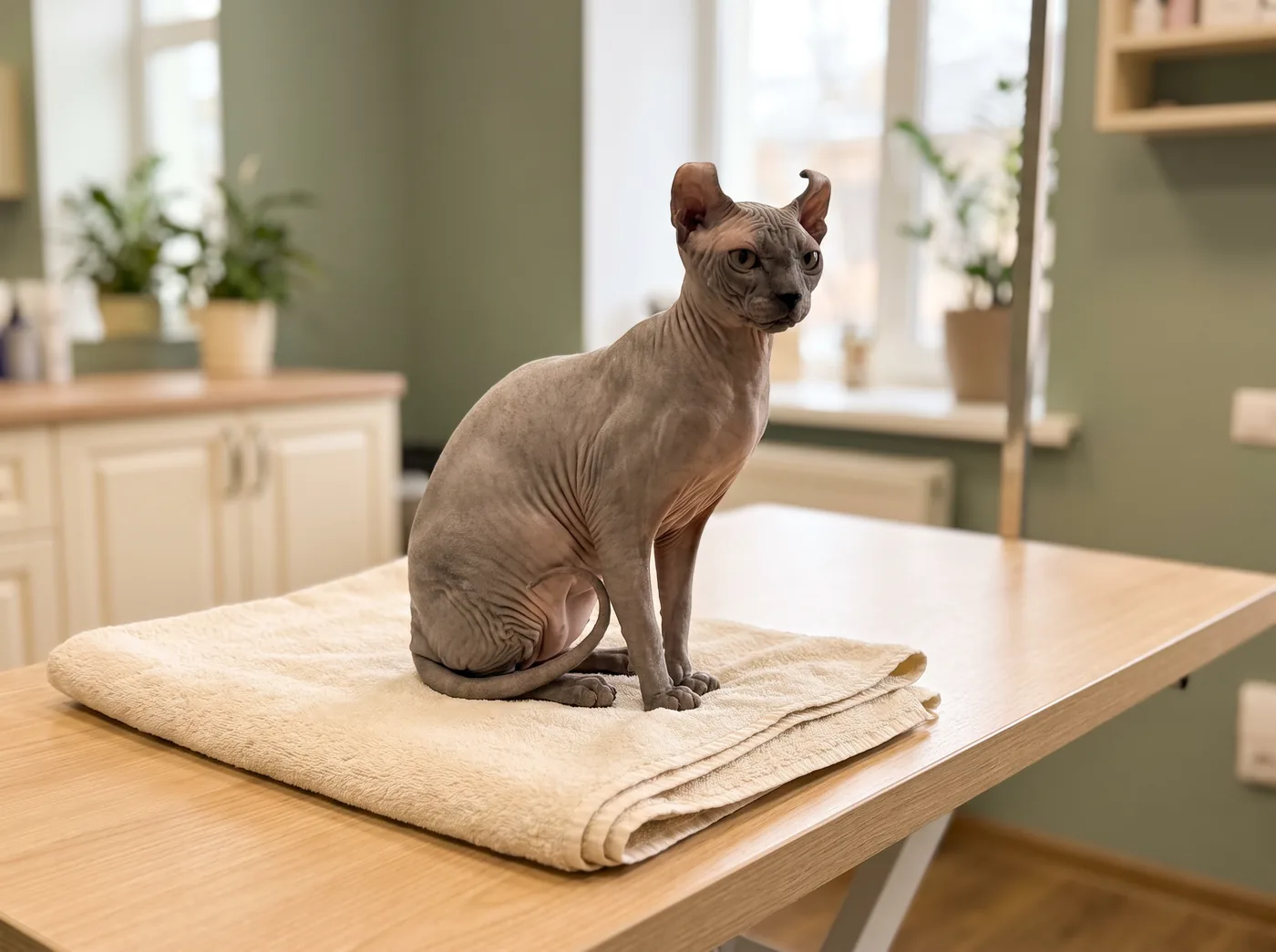
About the Ukrainian Levkoy
A distinctive ear usually does not mean the Scottish Fold cartilage disease. The American Curl curls backward from a different mutation, and the Highlander does the same.
Those corrections are only honest if the site also says clearly where the Fold mutation genuinely is present, and here it is.
The Ukrainian Levkoy was created in the early 2000s by crossing the hairless Donskoy with the Scottish Fold. The bare skin comes from one parent and the inward folding ear comes from the other, and the ear gene is the real one.
That gene affects cartilage throughout the body, not just the ear, and cats carrying it can develop a painful degenerative joint disease.
So this page is two routines in one: hairless skin care, and honest information about the joints.
The Ukrainian Levkoy has a double coat that regulates its own temperature. Shaving it does not keep the animal cooler, removes the protection against sun and insects, and the top coat often grows back patchy or never returns correctly. A thorough deshed takes out the undercoat and does the job the owner was actually asking for.
What the Ukrainian Levkoy is crossed from
The fold, stated honestly
Osteochondrodysplasia is the condition, and it is worth naming.
The mutation that folds the ear affects cartilage development throughout the skeleton. In cats carrying it, cartilage and bone can develop abnormally at the joints, particularly in the tail, ankles and knees, producing a stiff or reluctant gait, a thickened inflexible tail, difficulty jumping and, in bad cases, real pain.
Cats with two copies of the gene are severely affected and it can appear in kittenhood. Cats with one copy are affected variably and often later in life, and there is disagreement about how mild "mild" really is.
The practical grooming consequence is specific: handle a Levkoy's tail, hind legs and ankles gently and never force a joint through its range. If a cat resists having a leg extended or its tail lifted, treat that as information rather than as bad behavior, and mention it to a vet.
Never force the ear either. The cartilage there is abnormal by definition.
A cat that stops jumping onto furniture, walks stiffly, or sits oddly needs a veterinary assessment, and pain relief exists.
This is not a reason to treat an existing cat differently in affection. It is a reason to handle it carefully and to watch.
The skin, which is the Donskoy half
Levkoys range from completely bare to a light fuzz, and some carry a thin coat that changes seasonally, which is a Donskoy trait rather than a Sphynx one.
Whatever the degree, the skin needs the same care as any hairless cat: sebum builds up because there is no coat to absorb it, so bathe every one to two weeks with a gentle cat shampoo in a warm room and dry the cat completely.
Wipe the folds every few days with a soft damp cloth: the neck, armpits, groin, between the toes and the base of the tail.
The skin is notably elastic and heavily wrinkled on this breed, which means more folds to get into.
Ears fill with wax quickly, since there is no hair inside to catch dust. Clean only the visible outer part weekly with a soft cloth, gently, given the abnormal cartilage. Do not push anything into the canal.
Nail beds accumulate waxy residue for the same reason and want wiping when you trim, every two to three weeks.
Sunburn is real on bare skin and warmth is a genuine need rather than a preference.
The three ears, side by side
Worth putting together, because three breeds have a distinctive ear and only one of them carries disease.
American Curl: the ear curls backward from a mutation that shapes the ear specifically. No skeletal disease. Firmer cartilage, so never force it.
Highlander: the same kind of backward curl, again with no joint disease attached.
Scottish Fold and the Ukrainian Levkoy: the ear folds forward and downward from a mutation affecting cartilage everywhere, and the joint disease is a consequence of the same gene, not a coincidence.
So the shape of the fold tells you which one you are looking at: backward and outward is a curl, forward and downward is a fold.
The handling instruction is the same for all four, which is never to force the ear.
The difference is everything else: with a curl you are protecting an ear, and with a fold you are watching a whole skeleton.
Say which you have. Vets and groomers cannot tell by breed name alone on an uncommon breed.
Buying one, and what to ask
The Levkoy is rare outside Ukraine and Russia and has limited international registry recognition, and the gene pool is small.
If you are considering one, the questions are specific.
Ask whether folded eared cats are ever bred to each other. In responsible Scottish Fold programs they are not, because two copies of the gene produce severe early disease, and the same logic applies here.
Ask what the breeder does about joint screening and what they tell buyers about osteochondrodysplasia.
Ask about hypertrophic cardiomyopathy, which is a concern across hairless breeds.
A breeder who tells you the fold here is harmless, or the same as an American Curl, is either misinformed or not being straight with you.
For a cat already in a home, none of this changes the affection owed to it. It changes how carefully it is handled and how quickly a change in movement gets looked at.
What to tell your groomer or vet
Say the folded ear IS the Scottish Fold mutation, since this is the case where the reassurance does not apply.
Ask for the tail, ankles and hind legs handled gently and never extended by force.
Say the cat needs bathing like a Sphynx, warm room, gentle shampoo, complete dry.
Ask for the folds, nail beds and visible ear wiped, all of which fill without hair.
Say never force the ear open to look inside it.
Ask them to note any stiffness, reluctance to jump, or a tail that does not flex normally.
Keeping the coat between grooms
Handle the joints gently
This fold is the real Fold gene. Tail, ankles and knees can be painful.
Every time
Bathe it like a Sphynx
Bare skin, no coat to absorb the sebum. Warm room, complete dry.
Every one to two weeks
Wipe the outer ear only
Wax builds fast without hair, and the cartilage is abnormal by definition.
Weekly
Watch how it moves
Stiffness, a rigid tail or stopping jumping are veterinary signs, not moods.
Weekly
Common Questions About the Ukrainian Levkoy
Does a Ukrainian Levkoy have the Scottish Fold health problems?
Yes, and this is the case where the reassurance does not apply. The breed was created by crossing the hairless Donskoy with the Scottish Fold, so the inward folding ear comes from the genuine Fold mutation, which affects cartilage throughout the skeleton rather than just the ear. Cats carrying it can develop osteochondrodysplasia, a painful degenerative joint disease affecting the tail, ankles and knees. Handle those areas gently and treat stiffness or reluctance to jump as a veterinary matter.
How do I tell a folded ear from a curled ear?
By direction, and it is the reliable test. A fold goes forward and downward, lying against the head, and that is the Scottish Fold mutation with the skeletal disease attached. A curl goes backward and outward, as on the American Curl and the Highlander, and comes from a different mutation with no joint disease. The handling rule is the same for both, which is never to force the ear, but with a curl you are protecting an ear and with a fold you are watching a whole skeleton.
How much skin care does a Levkoy need?
The same as any hairless cat, and more than a coated one. Sebum builds up on bare skin because there is no coat to absorb it, so bathe every one to two weeks with a gentle cat shampoo in a warm room and dry the cat completely. Wipe the folds every few days, and the skin on this breed is notably elastic and wrinkled so there are more of them. Ears and nail beds fill with waxy residue quickly, and both just need gentle wiping rather than anything pushed into them.
Similar breeds
Same coat, same schedule, or the breeds this one is crossed from.


Scottish Fold
A plush coat, folded ears that need checking, and a health question worth knowing
Scottish Fold
Find a groomer who knows this coat
Search 37,863 groomers by town, or keep reading the breed guide.
Find a Local Groomer View All Breeds