What to Ask For at the Groomer
Why a puppy cut means nothing, and how to describe the haircut you actually want
Most disappointing haircuts start at the front desk. The groomer heard one thing, you meant another, and neither of you found out until the dog came out two inches shorter than you had pictured.
The reason is that almost none of the words owners use have fixed meanings. Puppy cut, teddy bear, summer cut and short but not too short all sound specific, and none of them are. Below is what those words actually do and do not tell a groomer, the ones that carry real measurements, and how to describe a haircut so both of you picture the same dog.
Why a Puppy Cut Does Not Mean Anything
It is probably the most requested haircut in the country and there is no agreed definition of it. Most groomers will take it to mean one fairly even length over the body with the face rounded off, a little longer than a close shave.
A little longer is where it comes apart. To one groomer that is half an inch. To another it is two. Both are being perfectly reasonable and only one of them matches the dog in your head.
The same problem applies to teddy bear cut, kennel cut, lamb cut, summer cut and puppy trim. There is also no fixed thing as a Shih Tzu cut or a Yorkie cut, even though people ask for both every day. These words are a useful starting point and a bad instruction. Say one, then follow it with a number.
What Do Dog Clipper Blade Numbers Mean?
Blade numbers run backwards from what most people assume. The higher the number, the shorter the cut. A #10 takes far more off than a #4.
Roughly what each one leaves behind:
- #3 about 1/2 inch, or 13 mm
- #4 about 3/8 inch, or 9.5 mm
- #5 about 1/4 inch, or 6 mm
- #7 about 1/8 inch, or 3.2 mm
- #10 about 1/16 inch, or 2 mm
- #15, #30 and #40 shorter again, down to a fraction of a millimeter. These are surgical preparation blades, not body blades.
An F after the number, as in #4F, #5F or #7F, means finish. It cuts a shade closer than the plain blade and leaves a smoother surface behind it, and most salon body work is done with one of those three.
One blade turns up on nearly every dog whatever the body length: a #10 is the standard choice for the sanitary area and the belly, because that skin is thin and a shorter blade sits flatter and safer against it.
You do not need to speak in blade numbers, and plenty of good owners never do. The trouble comes from half knowing them. If you ask for a seven meaning fairly short, and the groomer hears an eighth of an inch, you will both be surprised at pickup.
What Is the Difference Between a Blade and a Guard Comb?
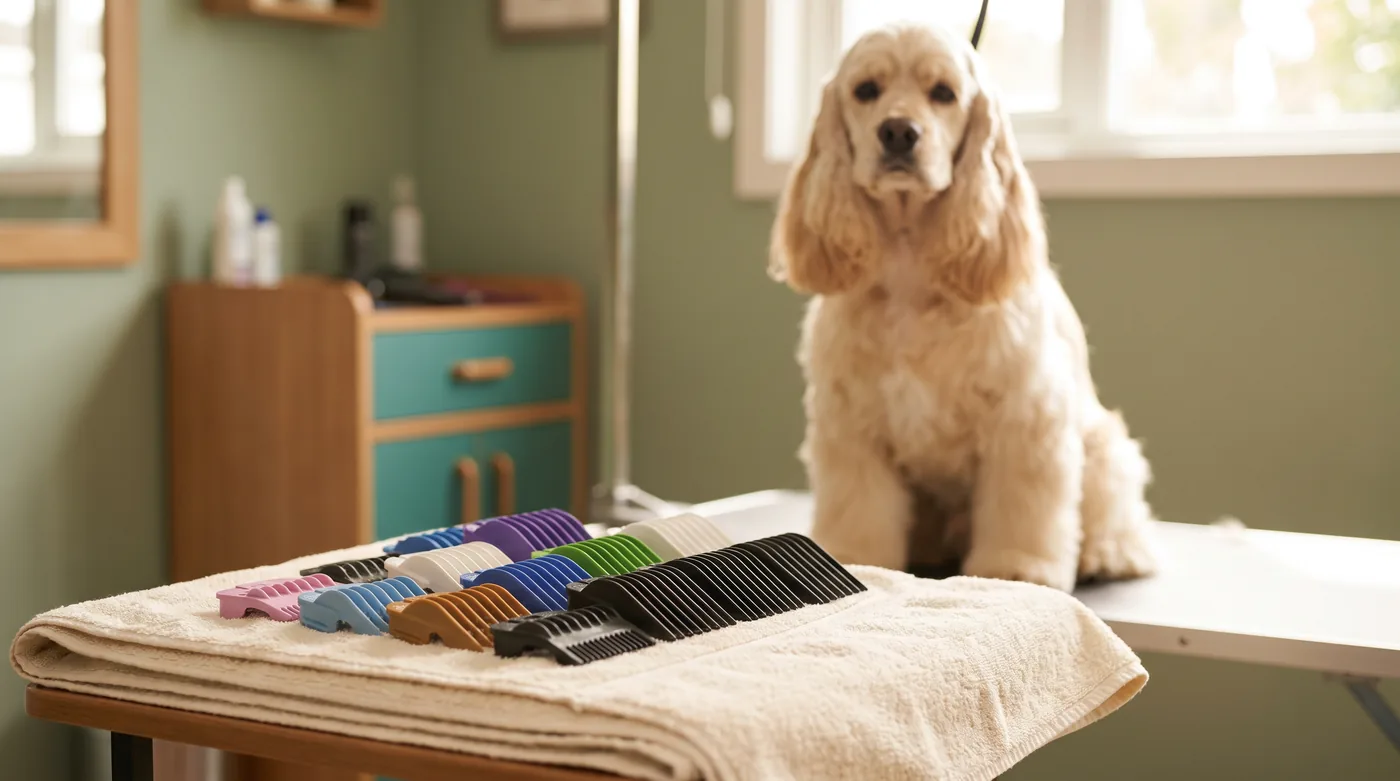
A blade cuts the coat directly. A guard comb, also sold as an attachment comb or a snap-on comb, clips over the top of a blade and holds the clipper further away from the skin, so it leaves the coat longer.
Combs are usually run over a #10, #15 or #30 blade, and the sets go from about an eighth of an inch up to two inches. Anything much longer than half an inch on the body is comb work rather than blade work.
The catch matters to you at the counter. A comb has to travel through the coat to cut it, so it needs that coat clean, dry and brushed clear to the skin. On anything felted it skips, drags and pulls. That is the honest reason a groomer sometimes answers no when you ask for length, and it is not them being difficult.
How Short Is Too Short?
Below a certain length you stop seeing coat and start seeing dog. On a fine or sparse coat, a quarter of an inch can already look pink, and a light skinned dog taken very short can genuinely sunburn.
Double coated breeds are the exception to all of this, because a shave on one of those is not a length you can simply grow back out. Ask before you take a Husky, a Pomeranian, a Golden or a Chow anywhere near short. The matting guide explains what happens and lists the coats it applies to.
A workable rule for a growing coat: if you want to see coat and not skin, ask for half an inch or more. That means comb work, and comb work means arriving with a coat that is clear enough to take it.
The Five Parts That Need Separate Instructions
Owners tend to describe a haircut as one length. Groomers cut five areas, and four of them get decided by default if you do not say anything.
- Body. The length everybody means when they say short. Give a number or a fraction of an inch.
- Legs. Same length as the body, or left fuller so they look like columns. This is the single most common mismatch: people picture full legs and ask for short all over.
- Face. Rounded and soft, shaved close, or shaped to the breed with a beard and eyebrows. A teddy bear face means rounded with the muzzle hair left on.
- Ears. Left full, tipped, which means tidied at the edge only, shaved down the leather, or trimmed to a set length. Long ear hair mats faster than almost anywhere else.
- Tail. Natural, plumed, rounded off, shaped, or taken short. On a curly coated dog the tail is often the longest thing left, and it looks odd if the body goes very short and nobody mentioned it.
Should You Bring a Photo to the Groomer?
Yes. A picture is the most useful thing you can bring, and it fixes more misunderstandings than any amount of describing.
Say what you like about it, though, because a photo carries a dozen decisions at once. Is it the body length you want, the face shape, the ears, or all three? Point at the part you mean. It is just as useful to say which bit you do not want.
Be realistic about what a photo can transfer. The dog in it may be a different breed with a different coat texture and a different build, and the same cut on your dog will land differently. A Bichon photo on a Cockapoo will not come out looking like the Bichon.
The best reference of all is a photo of your own dog after a groom you were happy with. Take one every time. It costs nothing and it ends the conversation instantly.
Named Cuts and What Groomers Usually Mean By Them
None of these are standards, but most salons use them roughly the same way, so they are a reasonable place to start before you add a number.
- Puppy cut. One length all over, face rounded.
- Kennel cut. Shorter and more practical, usually blade work, low maintenance.
- Teddy bear. Usually refers to the face: rounded, full muzzle, soft edges.
- Lamb cut. Short body with the legs left fuller.
- Lion cut. Body taken very short with the mane, tail tip and often the feet left. Most often done on cats.
- Summer cut. Not a cut at all, just a request for shorter. Ask what length they have in mind.
- Sanitary trim. Belly, rear and around the genitals tidied for hygiene, nothing else touched.
- Face, feet and tail. A tidy up between full grooms. Cheap, quick and useful.
- Breed profile. The traditional outline for the breed, which on a Schnauzer, Cocker or Westie is a specific and skilled piece of work.
Why You Might Not Get the Cut You Asked For
Sometimes the answer at pickup is shorter than the conversation at drop-off, and there are only a few real reasons for it.
Matting. A felted coat cannot be combed to length, because there is nothing to comb through. The clipper has to go underneath the mat, against the skin, which sets the length for you. This is the reason in the large majority of cases.
Coat texture. A fine, soft coat will not hold a shape and drops flat. A wiry coat that is clipped rather than stripped goes softer and often paler, and it stays that way until it is stripped out again.
Build. The same length reads differently on a leggy dog than on a low, heavy one. A good groomer cuts to the dog in front of them, not to the photo, and the result is better for it.
Age or health. A detailed cut takes a long time, and an old or unwell dog cannot always stand for it. A faster, simpler haircut is the right call for that dog even when it is not the one you booked.
A groomer who phones you partway through to say the coat will not take what you asked for is doing the job properly. That call is a good sign.
What to Tell the Groomer Before They Start
The haircut is only half the conversation. The rest is the handling, and none of it is obvious from looking at the dog.
- Anything that has changed since last time. New medication, a recent operation, lumps, a sore ear, a limp.
- Where the dog objects to being touched. Feet, tail, back end, face. Almost every dog has one.
- Any bite or attempted bite, honestly. It changes how they work, not whether they take the dog. Finding out the hard way is what stops a salon taking it again.
- Skin problems and allergies, and what shampoo you use if it has to be a particular one.
- Fleas, or anything you found in the coat. Every salon has a policy and would much rather hear it from you.
- How long the dog can comfortably stand. Useful for an old dog or a puppy.
- Whether you are on a deadline. A rushed appointment is where mistakes happen. If you need the dog back by two, say so when you book, not at drop-off.
How to Describe a Length Without Using Blade Numbers
You do not need the jargon. You need to be specific, which is a different thing.
- Use inches or fractions. Half an inch, an inch, a finger width.
- Show it with your fingers. Hold them apart. Groomers read this all day and it is more accurate than the words.
- Describe what you want the coat to do. I want to still see the curl. I want to be able to comb it without a fight. I do not want to see skin.
- Say when you are coming back. This is the most useful sentence available to you. A groomer cutting for six weeks cuts differently from one cutting for twelve, and if you say twelve they will take more off now so the dog is not a felted mess by week nine.
How often to book works through what interval each type of coat actually needs.
Look the Dog Over Before You Leave
Take a minute at the counter in decent light. Run a hand over the whole dog instead of looking at it from the front.
- Even length along the body, with no ridge where two passes met
- Nothing missed behind the ears, under the front legs or in the armpits
- Nails done, and the pads tidy if you asked for it
- Sanitary area clean
- Face symmetrical, which is easiest to see straight on at eye level
If it is not what you asked for, say so there and then. Almost every salon will take a length down on the spot at no charge. Nobody can put coat back on, so the shorter direction is the only one available, and that is exactly why the conversation matters more at the start than at the end.
The counter is also where you say a bit shorter next time or a bit longer next time. Most salons keep a card on every dog and that is where it gets written down.
Keeping the Length You Asked For
A long cut is an agreement about what happens at home. Ask for an inch and then leave the coat alone, and the next appointment is a half inch whether anybody wanted it or not, because a felted coat sets its own length.
Combing right down to the skin two or three times a week is what buys length. A brush is not enough on its own, because it glides over the top of a felted layer quite happily and a comb catches on it.
Keeping a Long Cut Long
The tools that hold a coat at the length you asked for
We earn a commission on these links at no cost to you. How this works


Grooming at home walks through the routine itself, including the drying mistake that turns a bath into a matting problem.
How to Ask for Something Different Next Time
Change one thing at a time and describe it against the last visit. Half an inch longer on the body than last time, same face, same ears. That is an instruction a groomer can act on, and it is why they keep a card on every dog.
Asking for a completely different style every visit makes it hard for anyone to learn what you like. Two or three visits with the same groomer is usually enough for them to have your dog worked out.
Grooming Terms That Mean Something Specific
If you want to be understood at the counter, these are the terms that are precise enough to act on.
- A blade number, which is an exact length
- A comb size in inches, likewise
- Tipped ears, meaning tidied at the edge only
- Clean face, meaning shaved rather than rounded
- Sanitary trim, meaning belly and rear only
- Hand stripping, meaning the dead coat is pulled out rather than cut, which keeps a wire coat harsh and colored
- Blow out, meaning a bath and a high velocity dry to clear dead undercoat, with no cutting at all
- Round feet or tight feet, meaning the outline of the foot is scissored soft or trimmed close
What your dog actually needs is set by the coat rather than by the breed name. The breed guides give the routine, the interval and what typically goes wrong on each type of coat, and the salon directory will show you who is taking bookings near you.
Explore Our Breed Directory
Browse detailed guides for every breed mentioned in this article
View All Breeds