Chausie Grooming
A genuine jungle cat hybrid, with the legal and dietary caveats the others do not carry
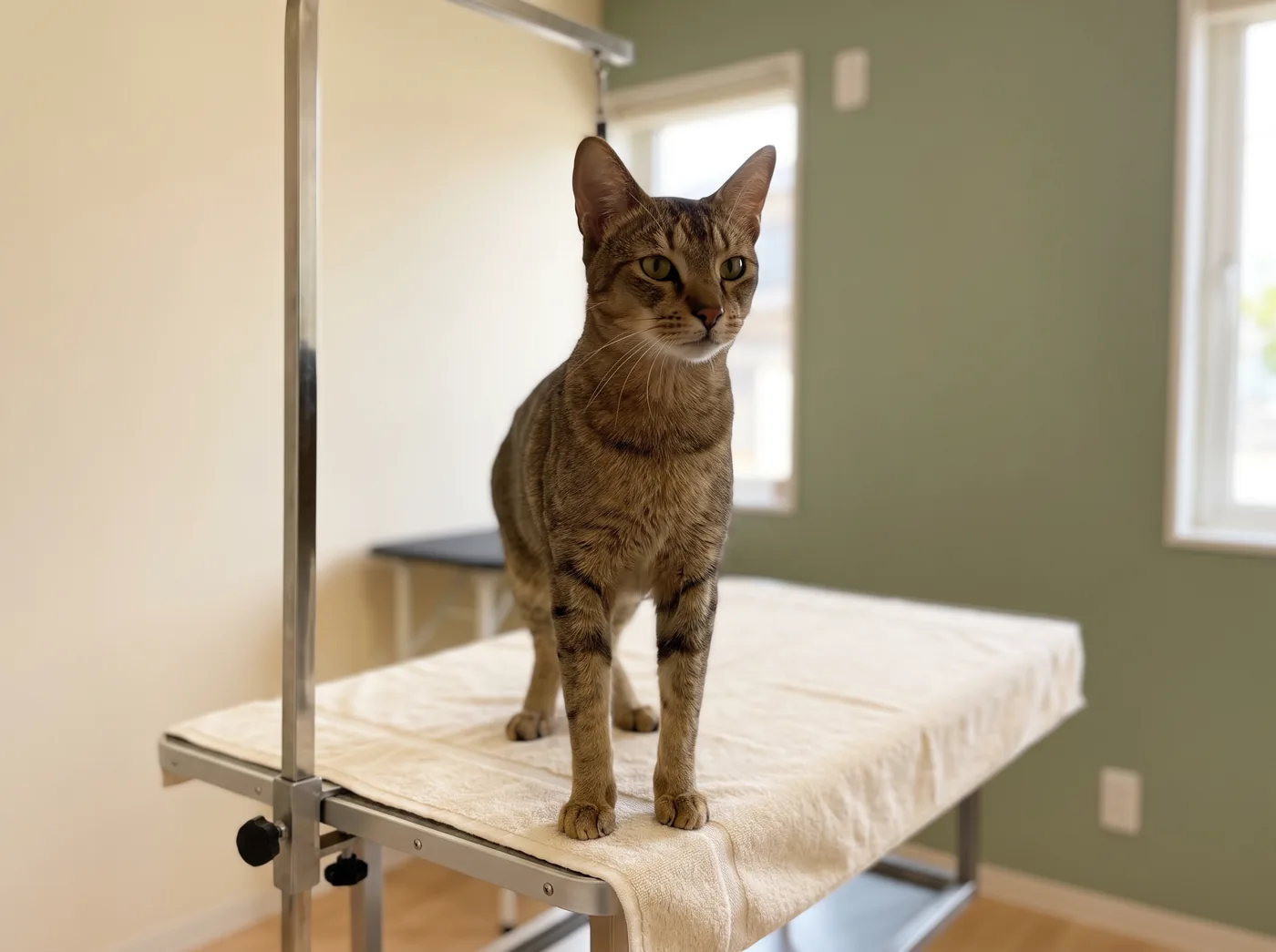
About the Chausie
Three cats are regularly and wrongly assumed to be hybrids. The Egyptian Mau is naturally spotted, the Ocicat is spotted entirely by design from domestic breeds, and the Pixiebob has no proven bobcat ancestry despite its origin story.
Those corrections only mean something if the site is equally clear about a breed where the wild ancestry is real. That is the Chausie: a cross between the jungle cat, a wild African and Asian species, and domestic cats, developed deliberately from the 1990s.
The coat is the least of it. Short, coarse and close lying, needing a comb once a week.
What is real here is everything the other three do not carry: legal restrictions on early generations in a number of states, a documented digestive sensitivity, and a large athletic cat that many groomers and boarding facilities will decline.
The Chausie has a double coat that regulates its own temperature. Shaving it does not keep the animal cooler, removes the protection against sun and insects, and the top coat often grows back patchy or never returns correctly. A thorough deshed takes out the undercoat and does the job the owner was actually asking for.
Generations, and what the law says
Hybrid cats are described by filial generation. An F1 is the direct offspring of a wild jungle cat and a domestic cat, an F2 is one generation further removed, and so on. By F4 and F5 the cats are considered domestic and are what most owners actually have.
The generation matters legally. A number of states restrict or prohibit ownership of early generation hybrids, some by generation number and some outright, and city ordinances add another layer. The rules differ from the Savannah rules in places, so checking specifically for Chausies rather than assuming is the sensible course.
It matters practically too. Early generation cats are larger, more active, more strongly wild in behavior and considerably harder to handle, and they are not suitable for an ordinary household.
For grooming, the honest position is that a groomer or boarding facility is entitled to ask the generation and to decline, and an owner should offer the information rather than wait to be asked.
Insurance is frequently the reason rather than the individual cat.
Later generation Chausies are typically confident, sociable and dog like, and are handled much as any large active domestic cat.
The digestive tract, and why it belongs here
This is the fact most owners are not told and it is genuinely important.
Chausies inherit a shorter intestinal tract from the jungle cat side, and many do not digest plant material well. A significant proportion develop chronic intestinal inflammation on ordinary commercial cat food, particularly food with a high grain or plant content.
The usual answer is a high protein, grain free or raw diet, and it is a veterinary conversation rather than something to improvise.
It appears on a grooming page for a practical reason: a cat with chronic digestive trouble often has a poor coat. Dull, dry, scurfy or thinning fur on a Chausie is frequently a nutritional or intestinal problem showing through, not a grooming failure, and no amount of combing will fix it.
Persistent diarrhea, weight loss, vomiting or a coat that deteriorates despite normal care all point the same way and need a veterinarian.
It is also a reason to be careful with treats and with food given at a salon or a cattery, and worth mentioning when the cat is left anywhere.
The coat, which is five minutes
The coat is short, coarse and close lying with a light undercoat, usually in a ticked tabby, black, or a grizzled pattern inherited from the jungle cat side.
Comb once a week with a fine metal comb or a rubber mitt. It removes the loose hair and spreads the skin oils, and it doubles as the weekly check.
Shedding is moderate with a heavier seasonal change, when a comb through every few days helps.
Matting does not happen on a healthy cat.
Do not bathe routinely and do not clip. There is no reason to, and a coarse coat can come back differently.
The one coat related thing worth watching is condition rather than tangles, for the reason in the previous section.
Claws want tipping every two to three weeks, and this is a large powerful cat that needs a genuinely sturdy post. Never consider declawing.
Ears are large and often tufted. Wipe the visible part weekly and leave the canal alone.
Handling a large athletic cat
Chausies are tall, long legged and powerfully built, weighing up to twenty five pounds in the larger cats, and they are extremely athletic. They jump higher and further than most cats and they are strong.
Later generation cats are usually confident and sociable, which helps enormously, but a nervous twenty five pound cat in a strange room is a serious handling proposition and not every professional will take one.
Handle from kittenhood and make everything routine: nails, ears, mouth, being turned over, being in a carrier.
Harness and carrier training is worth doing properly, since vet visits are unavoidable and a Chausie that cannot be contained safely is a problem for everybody.
Be honest when booking, offer the generation, and expect a quiet unhurried appointment or none at all.
Many owners do everything at home, which is entirely realistic on a coat that needs five minutes a week, and use a vet for nails if needed.
These cats need a great deal of exercise and stimulation, and a bored Chausie is a much harder animal to handle than a satisfied one.
What to tell your groomer or vet
Offer the generation without being asked, since it affects legality, handling and whether a facility can take the cat.
Say the cat may have a shortened intestinal tract and dietary restrictions, and that no treats or food should be given without asking.
Ask for a comb or mitt only, no bathing and no clipping.
Say a dull or scurfy coat on this breed is usually a digestive or nutritional signal rather than a grooming one.
Ask for claws tipped, and mention that this is a large strong cat that jumps.
Ask for a quiet unhurried appointment and be prepared to be declined.
Keeping the coat between grooms
Comb or mitt, five minutes
A short coarse coat that does not mat. Weekly, and a check at the same time.
Weekly
No food or treats without asking
A shortened intestinal tract on many cats, and real dietary restrictions.
Every visit
Watch coat condition, not tangles
Dull or scurfy fur here is usually digestive rather than a grooming problem.
Weekly
Offer the generation up front
It affects legality, handling and whether a facility can take the cat at all.
Every booking
Common Questions About the Chausie
Is a Chausie actually part wild cat?
Yes, genuinely, unlike several other wild looking breeds. It is a deliberate cross between the jungle cat, a wild African and Asian species, and domestic cats. That makes it different from the Egyptian Mau, which is naturally spotted, the Ocicat, which was built entirely from domestic breeds, and the Pixiebob, whose bobcat ancestry is not supported by DNA. The consequences are real: early generations are restricted or prohibited in a number of states, and many groomers and catteries will decline them.
Why does my Chausie have digestive problems?
Because many inherit a shorter intestinal tract from the jungle cat side and do not digest plant material well. A significant proportion develop chronic intestinal inflammation on ordinary commercial food, particularly food with a high grain or plant content, and the usual answer is a high protein grain free or raw diet worked out with a vet. It matters for the coat too: dull, dry or thinning fur on a Chausie is often a nutritional or intestinal problem showing through rather than a grooming failure.
Will a groomer take a Chausie?
Some will and some will not, and it is fair either way. The generation matters: early generation hybrids are larger, more active and considerably harder to handle, and many facilities decline them for insurance reasons rather than because of any individual cat. Offer the generation when booking rather than waiting to be asked. In practice the coat needs five minutes a week and most owners do everything at home, using a vet for nails if the cat objects, which is a perfectly good answer.
Similar breeds
Same coat, same schedule, or the breeds this one is crossed from.


Find a groomer who knows this coat
Search 37,863 groomers by town, or keep reading the breed guide.
Find a Local Groomer View All Breeds