Pixiebob Grooming
A wild looking cat with no bobcat ancestry, and often extra toes to trim
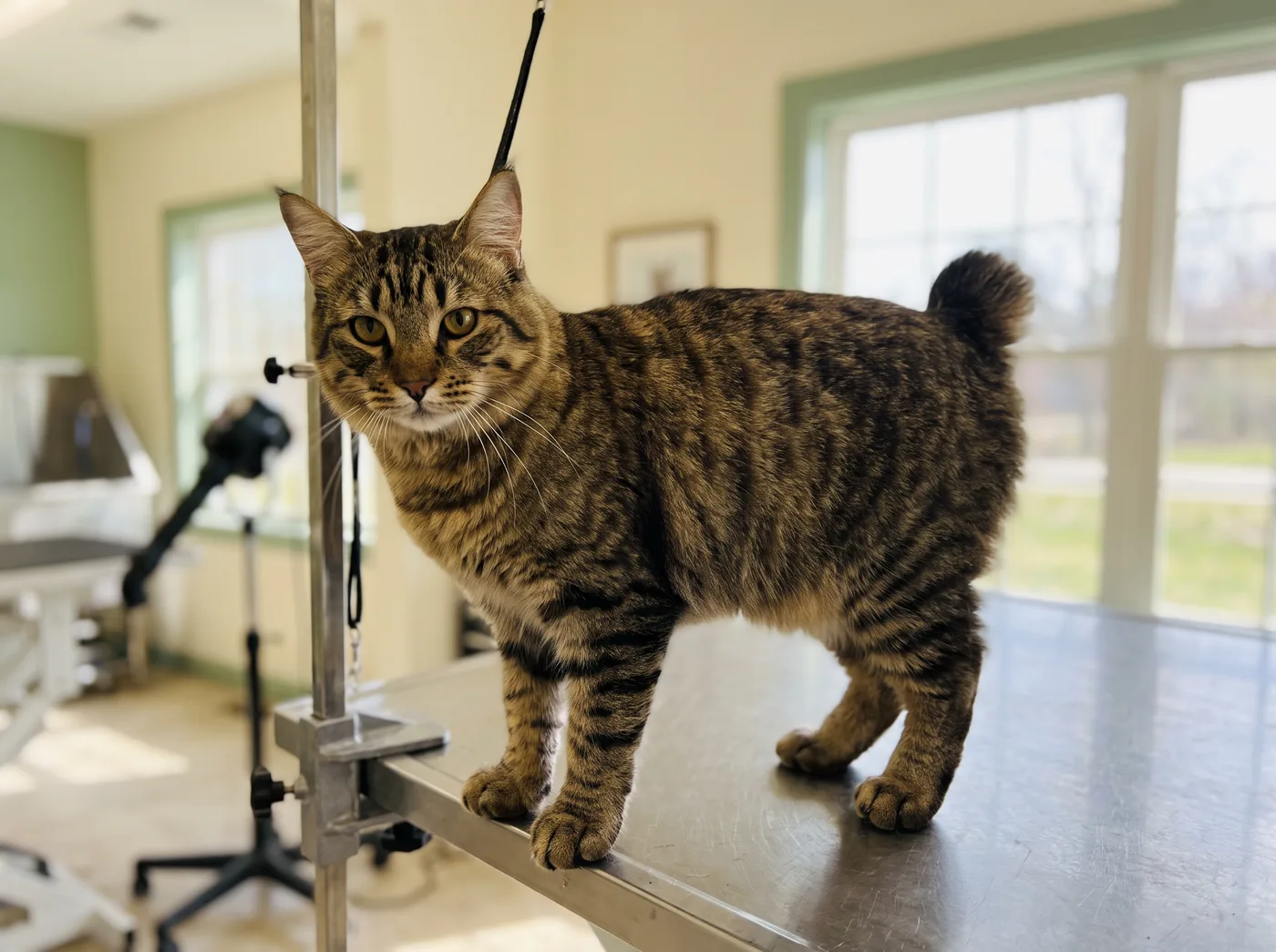
About the Pixiebob
Two things about this breed are widely believed and worth correcting, and the second one is a genuine grooming job.
The first is the origin story. Pixiebobs are said to descend from natural matings between bobcats and domestic cats, and the breed was founded on that claim in the 1980s. DNA testing has not supported it: studies have found no bobcat contribution, and Pixiebobs are considered fully domestic cats that look the part. So none of the warnings on the Savannah and Bengal pages apply, and there are no legal restrictions on owning one.
The second is the feet. Pixiebobs are frequently polydactyl, meaning extra toes, and it is one of very few breeds where the standard permits it, up to seven toes on a foot.
Extra toes come with extra claws, and those claws still grow.
The Pixiebob has a double coat that regulates its own temperature. Shaving it does not keep the animal cooler, removes the protection against sun and insects, and the top coat often grows back patchy or never returns correctly. A thorough deshed takes out the undercoat and does the job the owner was actually asking for.
Polydactyl feet, and the claws nobody trims
A normal cat has five toes on each front foot and four on each back, eighteen in total. A polydactyl Pixiebob can have considerably more, and the breed standard allows up to seven toes per foot, which is unusual: in most breeds extra toes are a fault.
Every one of those extra toes has a claw, and that is the grooming consequence.
Extra claws are frequently set at an odd angle, are often partly hidden between other toes, and do not make contact with a scratching post the way normal claws do, so they are not worn down and are easily missed. Left alone they keep growing in a curve and eventually the tip grows into the pad or the side of the toe, which is painful and becomes infected.
So: count the toes, and check every claw every time you do the nails, every two to three weeks. Spread the toes and look, rather than assuming you would notice.
Some extra toes are fused or partly formed, and the claws on those can be particularly awkward to see and reach.
Tell a groomer and a veterinarian how many toes the cat has, because somebody doing a routine nail trim will do the expected eighteen and stop.
Otherwise polydactyly causes no problems at all, and these cats use their large paws with some dexterity.
Why the hybrid warnings do not apply
The Pixiebob was founded on the belief that its founding cats were bobcat hybrids, and the name, the look and much of the marketing still rest on that.
DNA studies have not found bobcat ancestry. The current understanding is that these are domestic cats whose appearance, the heavy brow, the lynx tipped ears, the ticked spotted coat and the short tail, comes from ordinary domestic genetics.
Practically that means the Pixiebob sits with the Ocicat and the Egyptian Mau rather than with the Bengal and the Savannah: a wild look with no wild consequences.
There are no legal restrictions, no handling caveats beyond ordinary care, and no reason for a salon to decline one on hybrid grounds.
Temperament supports that. Pixiebobs are typically calm, sociable and dog like, often walking on a lead and greeting visitors, which makes them easy to handle.
The short tail, incidentally, is a third bobtail gene story again, and like the American and Japanese bobtails it is not associated with the spinal problems of the Manx. Tail length varies from almost nothing to a few inches.
The coat, in two lengths
The coat is thick, woolly and resilient with a genuine dense undercoat, and it comes in short and long haired varieties.
The shorthair is dense and stands away slightly from the body, needing a comb through once or twice a week.
The longhair is medium long and shaggier, with a ruff and britches, and because there is a real undercoat it does mat. Comb every two or three days with a fine metal comb, to the skin rather than over the surface.
The places that fail are the usual ones: the britches at the back of the hind legs, the ruff, behind and under the front legs, and the belly.
Both varieties shed seasonally, with a heavier change in spring and autumn. Comb daily through it.
Never cut a mat out with scissors, for the reason on every cat page here: cat skin is thin and lifts into the blades.
Do not clip. A woolly double coat that is clipped often returns with a changed texture, and clipping is a rescue for a pelted coat rather than a plan.
Size, weight and the rest of the routine
Pixiebobs are big, muscular, slow maturing cats that take up to four years to reach full size, and males can be substantial.
Feel for the ribs rather than judging by outline, since a woolly coat on a heavy frame hides condition well.
Weight matters for the usual reason: a cat that cannot turn and reach its britches stops maintaining the part of the coat most likely to mat.
Claws every two to three weeks, all of them, however many there are. Provide a substantial post, since this is a strong cat.
Never consider declawing, and it is worth saying that declawing a polydactyl cat is even more of an amputation than usual.
Ears are large with lynx tips on many cats. Wipe the visible part weekly and leave the canal alone.
Teeth as for every cat.
These are sociable, adaptable cats that generally tolerate handling well, so the frequent combing a longhair needs is realistic at home.
What to tell your groomer or vet
Say how many toes the cat has on each foot, and ask for every claw checked, not the expected eighteen.
Point out any extra claw that sits at an odd angle or is hidden between toes.
Say the breed has no proven bobcat ancestry and none of the hybrid restrictions.
Say which coat length it is, since the longhair needs combing twice as often.
Ask for a fine metal comb to the skin, including the belly and britches, and never scissors on a mat.
Say the coat is not to be clipped unless it is genuinely pelted.
Keeping the coat between grooms
Count the toes, check every claw
Extra claws do not wear down on a post and curl into the pad unnoticed.
Every two to three weeks
Comb to the skin
Every two or three days on a longhair. There is a real undercoat under this coat.
Every two to three days
Feel for the ribs
A big slow maturing cat under a woolly coat that hides condition completely.
Monthly
Never scissors on a mat
Cat skin lifts into the blades. Comb early, or a professional with clippers.
Always
Common Questions About the Pixiebob
Do Pixiebobs really have bobcat ancestry?
The breed was founded on that belief in the 1980s, but DNA testing has not supported it and Pixiebobs are considered fully domestic cats. The wild look, the heavy brow, lynx tipped ears, ticked spotted coat and short tail, comes from ordinary domestic genetics. Practically that means none of the warnings attached to the Bengal or Savannah apply: there are no legal restrictions on owning one anywhere and no reason for a salon to decline one on hybrid grounds.
My Pixiebob has extra toes. Does that need special care?
Yes, and it is the most useful thing on this page. Extra toes have extra claws, those claws are often set at an odd angle or partly hidden between other toes, and they do not contact a scratching post the way normal claws do, so they are not worn down and are easily missed. Left alone they curl until the tip grows into the pad, which is painful and gets infected. Count the toes, spread them and check every claw every two to three weeks, and tell your vet and groomer the count.
Does a Pixiebob mat?
The longhaired variety does, because unlike some longhaired cats it has a genuine dense undercoat under a shaggy medium long coat, and undercoat plus length is what felts. Comb it to the skin every two or three days, with attention to the britches, ruff, armpits and belly, and daily through the spring and autumn coat changes. The shorthaired variety is dense but short enough that once or twice a week is enough. Neither should be clipped except as a rescue for an already pelted coat.
Similar breeds
Same coat, same schedule, or the breeds this one is crossed from.


American Bobtail
A short tail from a third gene, with no spinal disease and a shaggy coat
American Bobtail
Maine Coon
A working double coat on a very large cat, and the same rules a Golden Retriever gets
Maine CoonFind a groomer who knows this coat
Search 37,863 groomers by town, or keep reading the breed guide.
Find a Local Groomer View All Breeds