Aussiedoodle Grooming
The first doodle whose other parent is a double coat, which changes the lottery completely
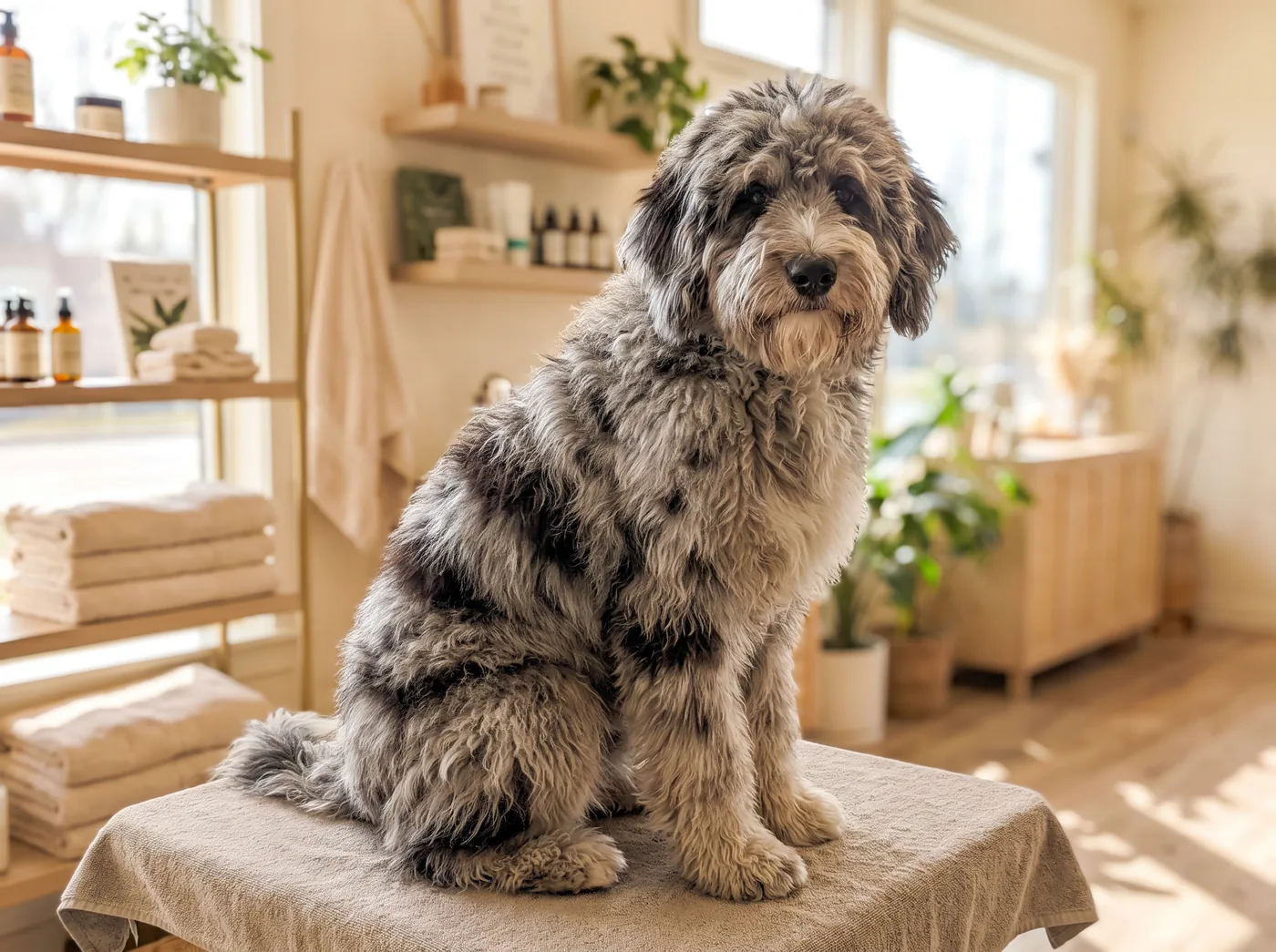
About the Aussiedoodle
The Aussiedoodle is an Australian Shepherd crossed with a Poodle, and it is a genuinely different proposition from the small doodles.
The Maltipoo and Cavapoo both cross a Poodle with a single coated breed, so however the lottery falls you get some version of a non-shedding coat that needs combing. The Australian Shepherd is a working double coat: a weather resistant outer coat over a dense undercoat that sheds heavily twice a year.
So this cross runs between two fundamentally different coat systems, and it can produce a curly non-shedding coat, a shedding double coat, or something in between that neither parent has. That third outcome is the difficult one, and it is why a Cockapoo cannot simply be treated as a Maltipoo in a larger size.
What the Aussiedoodle is crossed from
Three possible coats, and one of them is genuinely hard
Which coat a given Aussiedoodle has decides everything, and there is no way to know from a puppy photograph, because the coat usually settles between about eight and eighteen months.
A Poodle dominant coat is dense and curled, sheds very little, needs combing to the skin daily and a groom every four to six weeks. Demanding but predictable, and everything on the Maltipoo page applies.
An Aussie dominant coat is a straighter double coat with feathering, a real undercoat, and heavy seasonal shedding. It needs line brushing and an undercoat rake, and it must never be shaved, exactly as on the Australian Shepherd page. Owners who bought a doodle specifically to avoid shedding are frequently upset by this one, and there is nothing wrong with the dog.
The intermediate coat is the one to understand, because it is a coat neither parent has and it is harder than either. It carries a dense undercoat that sheds, underneath a wavy or curly outer coat that will not let the shed hair fall out. The undercoat releases, has nowhere to go, and felts into the curl against the skin.
That combination mats faster than a pure curly coat does, and brushing the surface does nothing at all about it, because the problem forms underneath.
If your dog sheds noticeably AND has a wavy or curly coat, you have this version. It needs an undercoat rake as well as a comb, and it needs the interval kept religiously.
Combing, and why the tool depends on the coat
On every coat here, a metal comb to the skin is the test. Work in sections, on a dry coat, from the skin outward. If the comb will not pass freely from skin to tip, that section is not brushed, whatever the surface looks like.
A slicker brush skims the outer coat and feels productive while the felting forms underneath. That is the single most common mistake on any non-shedding coat and it is worse here, because an intermediate coat has dead undercoat actively packing down while the surface stays fluffy.
If the dog sheds at all, add an undercoat rake before the comb, worked in the direction the coat lies. On a pure curly coat it will do nothing and is unnecessary. On an intermediate coat it is what actually removes the problem.
The six places to check every time: behind and under the ears, the armpits, the inside of the back legs, under the collar or harness, the chest, and around the rear. The trousers on the back legs are worst on the coats that inherit Aussie feathering.
Never bathe a matted coat. Water tightens a mat exactly the way it tightens a knot, so any groomer who bathes before dematting is working in the wrong order.
And keep the interval. Four to six weeks, standing. Almost every serious problem on any doodle starts with a gap that quietly stretched, and it stretches fastest when the coat looks fine from outside.
The merle warning, and why it belongs on a grooming page
Australian Shepherds carry merle, the gene that produces the mottled blue and red merle patterns, and Aussiedoodles are frequently bred specifically for it because it sells.
Merle is dominant, and a dog needs only one copy to show the pattern. A dog with two copies, produced by breeding two merle parents together, is a double merle, and the same gene that dilutes pigment in the coat also disrupts the development of the inner ear and the eye.
Double merle dogs are frequently deaf in one or both ears, frequently have serious eye defects including microphthalmia and blindness, and are usually predominantly white. It is entirely preventable: no responsible breeder mates two merles.
It belongs on this page for a practical reason. A deaf dog on a grooming table startles when it is touched, because there was no sound to warn it, and a startled dog is how a calm dog becomes a snapping one. It is exactly the same handling issue as on the Dalmatian page.
If your dog is deaf, or partly deaf, or you are not sure, say so. Approach from the front and within sight, let the dog see and smell a hand before it lands, and never work behind it without keeping a hand in contact.
If you are buying a merle puppy, ask what the other parent was. Two merle parents is the question, and a breeder who will not answer it plainly is the answer.
The trim, the ears and one drug warning
A full groom runs about two hours: comb the whole dog dry, deal with any matting, bathe, dry with a brush or rake working through, then clip and scissor.
Most pet Aussiedoodles wear a short teddy bear trim. That is entirely appropriate on a Poodle dominant coat. On an Aussie dominant coat it is not, and this is where the two halves of the ancestry genuinely conflict: shaving a true double coat damages the regrowth permanently, for all the reasons on the double coat page. A groomer who knows the breed will tell you which coat your dog has and trim accordingly, and it is a fair question to ask directly.
Ears want a weekly lift and smell. Poodle ancestry means hair growing in the canal on many of these dogs, and a coated drop ear seals it in.
Eyes and the beard need wiping and drying, as on any coated cross.
One health point worth carrying from the Aussie side: the MDR1 gene mutation is common in Australian Shepherds and passes to their crosses. Dogs carrying it react severely, sometimes fatally, to a number of ordinary drugs including some sedatives, anesthetics, antiparasitics and anti-diarrheals. That matters directly if a dog ever needs sedating to be groomed or treated. A cheek swab test is inexpensive, and knowing the result before an emergency is worth a great deal. Tell any vet, and mention it if sedation is ever discussed.
What to tell your groomer
Say whether the dog sheds. It is the single most useful sentence, because it tells them which of the three coats they are dealing with before they start.
Book the next appointment before you leave. Four to six weeks, standing.
Bring a photograph rather than saying teddy bear trim, and ask them what trim actually suits the coat your dog has.
Say honestly when the dog was last combed to the skin and where you found mats.
Say if the dog is deaf or partly deaf, or if you are unsure, and ask them to approach from the front.
Mention MDR1 if the dog has been tested, and say so if it has not, in case sedation ever comes up.
And say the dog's age. Between eight and eighteen months the coat is changing, and that is when most of these dogs mat badly for the first time.
Keeping the coat between grooms
Comb to the skin, rake first if it sheds
A metal comb is the test. If the dog sheds at all, an undercoat rake before the comb is what removes the actual problem.
Daily
Keep a standing booking
Four to six weeks. The interval stretches fastest on this cross, because the coat looks fine from outside while it felts underneath.
Every four to six weeks
Approach from the front if the dog is deaf
Merle ancestry carries a real deafness risk. A dog that did not hear you coming startles when touched.
Every time
Check the ears
Poodle ancestry means hair growing in the canal, and a coated drop ear seals it in. Lift the flap and smell.
Weekly
Common Questions About the Aussiedoodle
Do Aussiedoodles shed?
It depends entirely on which coat the dog inherited, and unlike most doodles a shedding coat is a real possibility. A Poodle dominant coat sheds very little. An Aussie dominant coat is a true double coat and sheds heavily twice a year. In between there is a coat with a shedding undercoat under a curly outer coat that will not release it, which is the hardest of the three: the dead undercoat felts into the curl against the skin. If your dog sheds and is curly, that is what you have.
Can I have my Aussiedoodle shaved short?
Only if it has a Poodle dominant coat. If it inherited a true double coat from the Aussie side, shaving damages the regrowth permanently: the undercoat comes back faster than the guard hairs and the coat returns woolly, patchy and more mat prone, exactly as on any double coated breed. This is the one place where the two halves of the ancestry give opposite instructions, so ask your groomer which coat your dog actually has before agreeing to a short trim.
What is a double merle and why does it matter?
Merle is dominant, so one copy gives the mottled pattern. Two copies, from breeding two merle parents together, produce a double merle: the gene that dilutes pigment also disrupts inner ear and eye development, so these dogs are frequently deaf, frequently have serious eye defects, and are usually mostly white. It is entirely preventable and no responsible breeder mates two merles. It matters for grooming because a deaf dog startles when touched without warning, which is how a calm dog ends up snapping.
Similar breeds
Same coat, same schedule, or the breeds this one is crossed from.

Australian Shepherd
A working double coat with feathering, and three places it always mats
Australian Shepherd
Bernedoodle
A doodle coat on a giant frame, which is the most expensive combination in grooming
Bernedoodle
Maltipoo
A coat you cannot predict from the name, which is the whole difficulty with the cross
MaltipooFind a groomer who knows this coat
Search 37,863 groomers by town, or keep reading the breed guide.
Find a Local Groomer View All Breeds