Bedlington Terrier Grooming
A terrier with a wool coat, clipped and scissored where every other terrier is stripped
About the Bedlington Terrier
Almost every other terrier is a stripping conversation. The Airedale, the Scottie, the Cairn, the Border and the Schnauzer all carry a harsh wire jacket whose hairs die in the follicle and are pulled out, and every one of those pages explains what clipping costs.
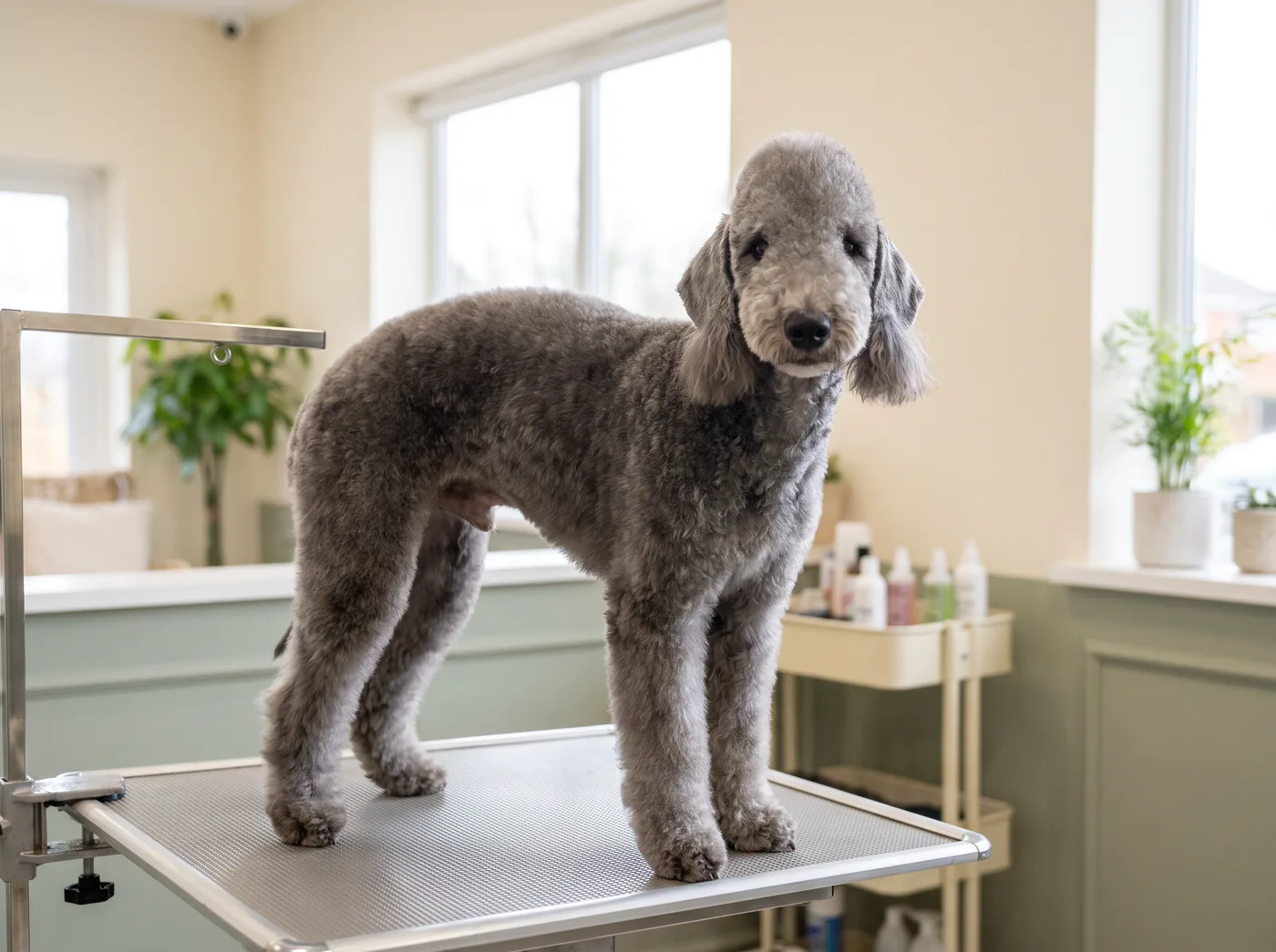
The Bedlington reverses all of it. Its coat is a crisp, linty mixture of hard and soft hair that grows continuously and does not shed, and it is clipped and scissored into the breed's distinctive lamb like outline. Stripping a Bedlington is not a stylistic choice, it is simply wrong: there is no dead outer coat sitting loose to remove.
Functionally it belongs with the Poodle and the Bichon: low shedding, high maintenance, mats if neglected, and needs a professional every six to eight weeks.
Why this terrier is not stripped
The mechanics are worth understanding, because they explain every other difference.
A wire coat grows to a set length, dies, and sits loose in the follicle waiting to be pulled. That is why it is stripped and why cutting it leaves the dead root behind and gradually softens the jacket.
A Bedlington coat does none of that. It grows continuously, like a Poodle coat or human hair, and it does not die in place, so there is nothing loose to remove. Pulling it would mean pulling live hair out of the follicle, which hurts and achieves nothing.
Its texture is unusual and worth knowing: it is described as crisp or linty, a mixture of harder and softer hair that stands away from the skin with a slight curl, particularly on the head and face. It is not soft like a Wheaten and it is not woolly like a Lagotto. It has body.
The consequences follow directly. It sheds very little, which is what makes the breed popular with people who react to dogs. It mats, because a coat that holds every dead hair always does. And it needs cutting on a schedule, every six to eight weeks, because it never stops growing.
Clipping does no damage at all, because there is no harsh texture to lose. That is the exact opposite of the instruction on every other terrier page here.
The lamb trim, which is the whole look
The Bedlington outline is one of the most distinctive in dogs and it is entirely created by scissoring. Without it the dog looks like nothing in particular, which is why this is a breed where the groomer matters.
The elements: a rounded topknot on the pear shaped head, taken up from the eyes and blended back; the muzzle scissored close so the head reads long and narrow; tassels left at the tips of the ears; the body clipped short with the coat following the breed's characteristic arched back and tucked loin; and the legs left slightly fuller than the body.
It takes about two hours and it is skilled scissor work rather than a straightforward clip down.
Bring a photograph. A Bedlington trimmed by somebody who has not seen the breed usually comes back with a flat back line and a round head, and both take months to grow out.
Most pet Bedlingtons wear a shorter, simpler version of the same shape, which is entirely reasonable and much easier to maintain. What matters is keeping the topknot, the ear tassels and the arched outline recognizable.
Every six to eight weeks. Stretching that turns a trim into a dematting job, and the coat grows steadily rather than pausing.
Colors change with age, which surprises owners: Bedlington puppies are born dark, black or brown, and lighten to blue or liver over the first year or two.
Combing, and where it fails
A coat that does not shed holds every dead hair, so combing is the daily job and it is not optional.
Use a metal comb rather than relying on a slicker. A slicker moves the surface and leaves the felting underneath, which is the standard mistake on any non-shedding coat and is exactly how an owner who brushes conscientiously still arrives at a salon with a pelted dog.
Work in sections, on a dry coat, from the skin outward. If the comb will not pass freely from skin to tip, that section is not brushed.
Every two or three days is enough on a short pet trim; daily if the coat is being kept longer.
The places that fail: behind and under the ears, which on this breed carry the tassels and go first; the armpits; the inside of the back legs; under a collar or harness; and around the rear.
The ear tassels deserve specific attention because they are long, fine and constantly moving, and they knot at the base where they meet the ear leather.
Never bathe a matted coat. Water tightens a mat like a wet knot.
Ears themselves are drop and want a weekly lift and smell. Bedlingtons grow some hair around the canal, so ask a groomer to keep it trimmed short for airflow.
Copper toxicosis, which is worth knowing about
This is not grooming, and it is the most important health fact about the breed, so it belongs somewhere an owner will read it.
Bedlington Terriers carry an inherited condition in which the liver cannot excrete copper properly. Copper accumulates over years and eventually causes liver damage, and in its severe form it is fatal.
It is caused by a specific gene mutation, and there is a DNA test. Responsible breeders test their stock and the incidence has fallen considerably as a result, but it has not gone, and dogs from untested lines remain at risk.
The reason it belongs on a care page is that the early signs are vague and easy to dismiss: lethargy, weight loss, poor appetite, vomiting, and in later stages jaundice, which shows as a yellow tinge to the whites of the eyes, the gums and the skin.
A groomer handling the dog regularly is in a reasonable position to notice a yellowing eye or a dog that has lost condition, which is worth mentioning to them.
If you have a Bedlington and do not know its status, ask your veterinarian about testing. It is manageable when caught early, with diet and medication that reduce copper absorption, and much harder once the liver is damaged.
Beyond that they are generally robust, long lived and healthy, and they carry the usual terrier energy under a coat that looks nothing like a terrier.
What to tell your groomer
Say plainly that the coat is clipped and scissored and must not be stripped. A groomer who works mostly on terriers may reach for a stripping knife out of habit.
Bring a photograph of the outline you want, and say whether you want a full lamb trim or a shorter pet version.
Ask for the topknot, the ear tassels and the arched back line kept, because those are what make the breed recognizable.
Say honestly when the dog was last combed to the skin, and where you found mats, particularly at the base of the ear tassels.
Ask them to keep the hair around the ear canal short for airflow.
Book every six to eight weeks, standing, because this coat never stops growing.
Keeping the coat between grooms
Never strip this terrier
The coat grows continuously and nothing dies in the follicle. Stripping means pulling live hair.
Always
Comb to the skin with metal
A slicker moves the surface and leaves felting underneath. Ear tassels and behind the ears go first.
Every two or three days
Keep the six to eight week booking
A continuously growing coat has no natural stopping point, and a stretched interval becomes a dematting job.
Every six to eight weeks
Bring a photograph of the outline
The topknot, ear tassels and arched back are all scissor work, and a wrong trim takes months to grow out.
Every appointment
Common Questions About the Bedlington Terrier
Is a Bedlington Terrier hand stripped?
No, and this is the one terrier here where stripping is simply wrong. A wire coat grows to length, dies in the follicle and is pulled out. A Bedlington coat grows continuously like a Poodle coat and never dies in place, so there is nothing loose to remove and stripping would mean pulling live hair. It is clipped and scissored every six to eight weeks, and clipping does no damage because there is no harsh texture to lose.
Do Bedlington Terriers shed?
Very little, which is why the breed appeals to people who react to dogs. The trade is the one every non-shedding coat makes: dead hair stays in the coat instead of dropping, so it mats and needs combing to the skin every two or three days plus a professional trim every six to eight weeks. Low shedding and low maintenance are close to opposites, and this breed sits firmly on that line despite being a terrier.
What is copper toxicosis in Bedlington Terriers?
An inherited condition where the liver cannot excrete copper properly, so it accumulates over years and eventually causes liver damage that can be fatal. There is a DNA test and responsible breeders screen for it, so incidence has fallen, but dogs from untested lines remain at risk. Early signs are vague: lethargy, weight loss, poor appetite and vomiting, with jaundice later. It is manageable when caught early, so ask your vet about testing if you do not know your dog's status.
Similar breeds
Same coat, same schedule, or the breeds this one is crossed from.

Airedale Terrier
The largest terrier there is, and the biggest hand stripping job a salon will take on
Airedale Terrier

Soft Coated Wheaten Terrier
The terrier that carries a silky single coat, which reverses every rule the group page states
Soft Coated Wheaten TerrierFind a groomer who knows this coat
Search 37,863 groomers by town, or keep reading the breed guide.
Find a Local Groomer View All Breeds