Cavachon Grooming
A cross with no Poodle in it that still does not shed, because the Bichon does that job
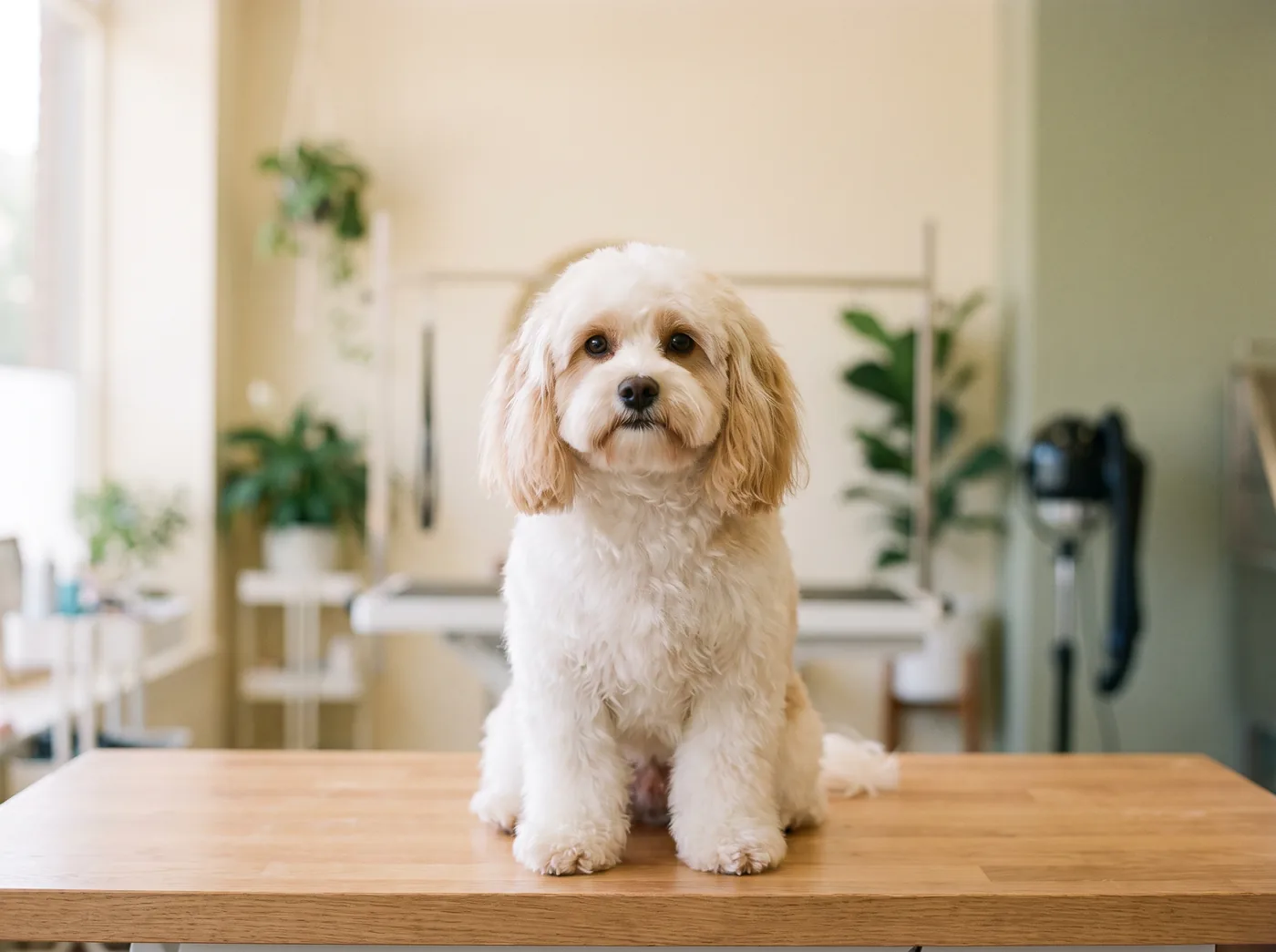
About the Cavachon
The Pomsky and Puggle pages both make the point that a designer cross with no Poodle in it has no low shedding outcome available. That is true of those two crosses, and it is worth being clear that it is not a general rule.
The Cavachon is a Cavalier King Charles Spaniel crossed with a Bichon Frise, and it sheds very little, because the Bichon does exactly the job a Poodle would: it contributes a dense, curly, continuously growing coat that holds its dead hair rather than dropping it.
So the trade is the familiar one rather than an escape from it. Low shedding means the dead hair stays on the dog, which means combing to the skin daily and a professional groom every four to six weeks. What you avoid is Poodle ancestry, not the maintenance.
What the Cavachon is crossed from
What coat to expect, and why the Bichon side matters
A Cavalier carries a silky, medium length, straight to wavy coat that sheds normally. A Bichon carries a dense, soft, curly coat over an undercoat, which grows continuously, sheds almost nothing, and is one of the more mat prone coats in small dogs.
A Cavachon lands somewhere between, and littermates differ. The coat usually settles between about eight and eighteen months as the puppy coat is replaced, and that transition is when most of these dogs mat badly for the first time, because the shedding puppy coat comes out into the growing adult coat and has nowhere to go.
The more Bichon in the coat, the less it sheds and the harder it mats. The more Cavalier, the softer and wavier it is, with feathering on the ears and legs, and slightly more shedding.
Whichever you get, the routine is the same and it is not light: comb to the skin daily with a metal comb, and book every four to six weeks.
Use a comb rather than relying on a slicker. A slicker moves the surface while felting forms underneath, which is how an owner who brushes every day still arrives at a salon with a pelted dog. If the comb will not pass freely from skin to tip, that section is not brushed.
The six places that fail: behind and under the ears, the armpits, the inside of the back legs, under a collar or harness, the chest and around the rear. Behind the ears goes first on this cross, because the Cavalier ear feathering sits where it rubs.
The ears, and what the Cavalier side brings
The ears come from the Cavalier and they are the same architecture the Cavapoo page describes: long, heavy drop ears with dense feathering, lying flat over a canal that runs down and then turns inward and does not drain by gravity.
The one thing a Cavachon avoids is Poodle ancestry, which means hair growing inside the canal is less likely than on a Cavapoo. That genuinely helps, and it makes this the easier of the two crosses for ears.
It does not make them easy. A sealed, feathered, poorly ventilated ear on a dog with a coat that holds water is still the commonest routine problem on this cross.
Lift the flap weekly, look and smell. Healthy is pale and smells of nothing; yeast is sweet, musty and unmistakable. Dry the ears and the feathering after every bath and every wet walk.
Ask a groomer to keep the hair under the flap and around the opening trimmed short at every visit.
Head shaking, scratching an ear, a head tilt, redness or dark discharge means a veterinarian rather than a cleaner.
One other Cavalier inheritance worth mentioning to a groomer, because it looks like a behavior problem: Cavaliers have a high rate of syringomyelia, and crosses can inherit it. Scratching at the neck and shoulder without making contact, yelping for no clear reason, or objecting to the head, neck and ears being handled is a veterinary conversation rather than a training one.
Cavaliers also have a very high rate of heart disease, which matters for an older dog asked to stand for a long appointment.
The face, and staining on a pale dog
Most Cavachons are white or predominantly white with apricot or tan markings, inherited from the Bichon side, and that makes tear and saliva staining the most visible cosmetic issue on the breed.
The cause is porphyrin, an iron compound in tears and saliva that oxidizes on contact with air and permanently stains the hair it dries on. It does not wash out. It has to grow out and be cut off.
So prevention is the entire strategy, exactly as on the Bichon: wipe under each eye daily with a damp cloth or an unscented wipe, and then dry it. Keep the hair around the eyes trimmed short so tears reach air rather than sitting in a fringe, and keep the muzzle dry, because a permanently damp beard stains and smells.
Whitening shampoos brighten a clean coat and do nothing about set staining.
Avoid anything sold as a tear stain supplement that contains an antibiotic. Giving a dog a low dose antibiotic indefinitely for a cosmetic problem is a poor trade and several such products have been withdrawn for exactly that reason.
What is worth escalating: a sudden increase in tearing, squinting, pawing at the face, or a discharge that is thick or colored. Blocked tear ducts, ingrown lashes and eyelids that roll inward all present this way and are common in small breeds.
Cavaliers also have prominent eyes, so the usual caution applies about nothing being sprayed toward the face at bath time.
The trim, the interval and choosing a length
A full groom runs about an hour and a half: comb the whole dog dry and deal with any felting, bathe, dry with a brush working through, then clip and scissor.
The dry comb first is not optional. Water tightens a mat the way it tightens a knot, so a matted coat that goes into a bath comes out worse and cannot then be brushed out without hurting the dog. Any groomer who bathes first and dematts second is working in the wrong order.
Most Cavachons wear a rounded teddy bear trim: a uniform length over the body, a rounded face, scissored legs and tidy feet. Bring a photograph rather than relying on the phrase, and give a length in numbers.
The interval is four to six weeks, which is the point at which daily combing stops keeping up with the growth.
The single most useful decision an owner makes is length. A shorter trim on a six week schedule is a comfortable dog and a manageable routine. A long fluffy trim on a ten week schedule is a pelted dog and a shave down nobody wanted, and the shave down is the kind option once a coat is felted rather than the groomer taking a shortcut.
Choose the length that matches the combing you will actually do, not the one in the photograph.
Keep the sanitary area, the paw pads and the hair around the eyes short whatever else you choose.
What to tell your groomer
Book the next appointment before you leave. Four to six weeks, standing.
Bring a photograph and give a length in numbers rather than saying teddy bear trim.
Say honestly when the dog was last combed to the skin and where you found mats, particularly behind the ears.
Ask for the ears checked and dried and the hair around the opening kept short, and mention any ear history.
Ask for the hair around the eyes kept short, since staining is the visible problem on a pale dog.
Say the dog's age if it is between eight and eighteen months, because the coat is changing and needs more time, and mention any heart or neck sensitivity from the Cavalier side.
Keeping the coat between grooms
Comb to the skin, in sections
A metal comb, not a slicker. Behind the ears first, where the Cavalier feathering rubs.
Daily
Lift, look, smell and dry the ears
A sealed feathered drop ear on a coat that holds water. The commonest routine problem on this cross.
Weekly
Wipe and dry under the eyes
Porphyrin stains permanently once it dries in the hair, and it shows on a pale dog.
Daily
Keep a standing booking
Four to six weeks. Almost every serious problem on this cross starts with an interval that quietly stretched.
Every four to six weeks
Common Questions About the Cavachon
Do Cavachons shed?
Very little, even though there is no Poodle involved. The Bichon side does the same job: a dense curly coat that grows continuously and holds its dead hair rather than dropping it. That is why some crosses without Poodle ancestry, like the Pomsky and Puggle, shed heavily while this one does not. The trade is unchanged though: the dead hair stays on the dog, so it mats, and it needs combing to the skin daily plus a groom every four to six weeks.
How is a Cavachon different from a Cavapoo?
Both are Cavalier crosses and both need daily combing and a four to six week groom, so the coat work is much the same. The practical difference is the ears. A Cavapoo inherits Poodle ancestry, which means hair growing inside the ear canal on many dogs, and combined with the Cavalier drop ear that gives it a notably high rate of ear trouble. A Cavachon avoids that, which makes it the easier of the two for ears, though still not easy.
How do I stop the brown tear stains on my Cavachon?
Prevention, because removal barely works. The staining is porphyrin from tears and saliva, which oxidizes and permanently marks the hair it dries on, so it has to grow out and be cut off. Wipe under each eye daily and dry it, keep the hair around the eyes trimmed short so tears reach air rather than sitting in a fringe, and keep the muzzle dry. Avoid supplements containing antibiotics. Sudden increased tearing or squinting needs a vet.
Similar breeds
Same coat, same schedule, or the breeds this one is crossed from.

Cavalier King Charles Spaniel
A tidy rather than a haircut, and a set of ears that need watching
Cavalier King Charles Spaniel
Bichon Frise
One of the fastest matting coats there is, under one of the most forgiving surfaces
Bichon Frise
Find a groomer who knows this coat
Search 37,863 groomers by town, or keep reading the breed guide.
Find a Local Groomer View All Breeds