Australian Terrier Grooming
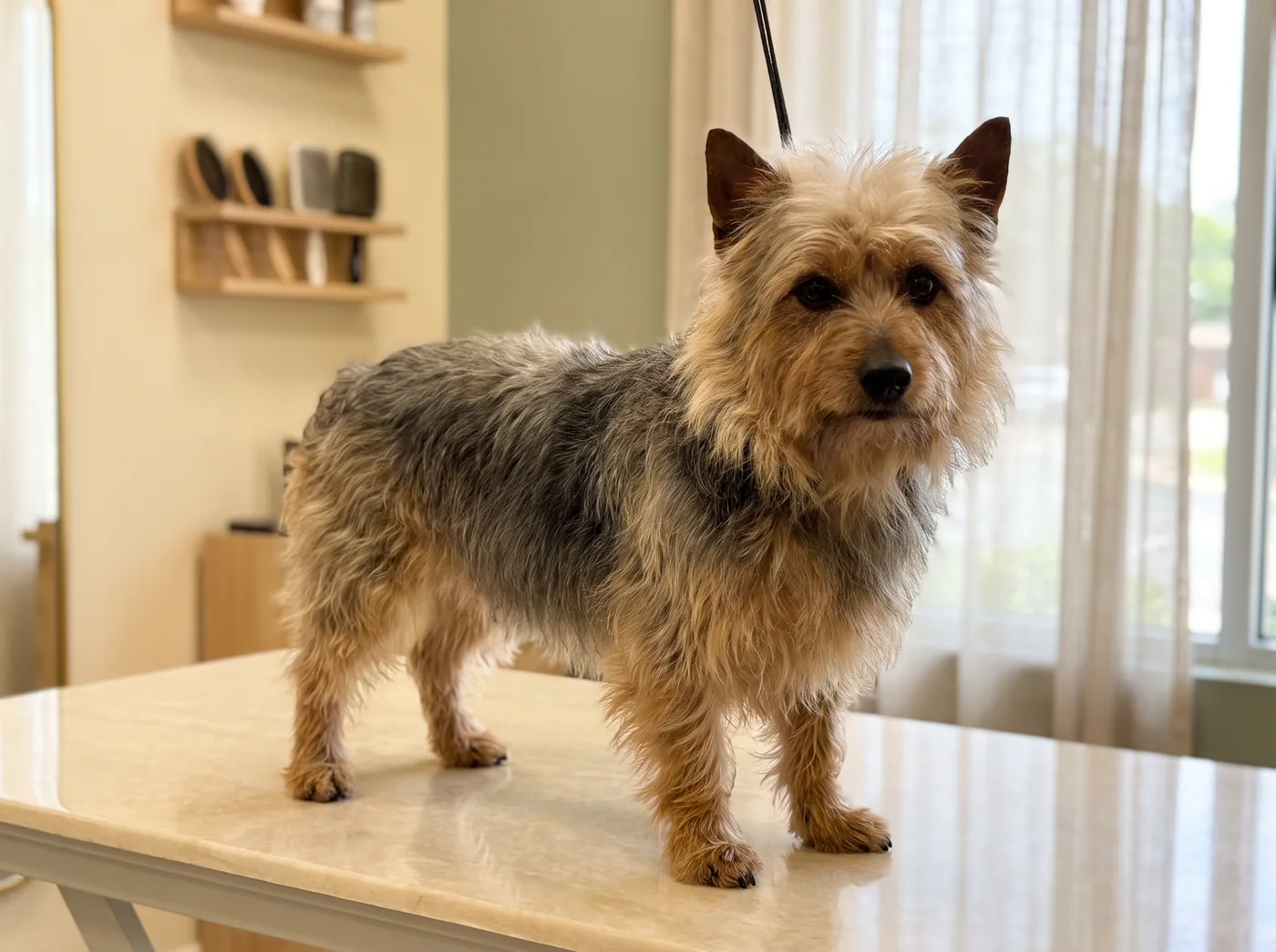
A harsh stripped jacket with a deliberately soft topknot sitting on top of it
About the Australian Terrier
A small hard working terrier from Australia, bred to kill snakes and rodents on remote properties, and one of the first breeds recognized as Australian.
The coat is the interesting part, because there are two textures on one dog and they want opposite things.
The body jacket is harsh, straight and about two inches long, over a short soft undercoat, with a distinct ruff around the neck. That is stripped, like any terrier jacket.
The topknot on the head is deliberately softer and finer than the body coat, and it is a breed characteristic rather than a fault. It is not stripped and not shortened.
So a groomer working through this dog has to change technique halfway up the neck, and one who strips the head has removed a feature that takes a year to come back.
The Australian Terrier has a double coat that regulates its own temperature. Shaving it does not keep the animal cooler, removes the protection against sun and insects, and the top coat often grows back patchy or never returns correctly. A thorough deshed takes out the undercoat and does the job the owner was actually asking for.
Two textures, two treatments
The jacket is worked like any harsh coat. A dead hair comes away easily between finger and thumb; a live one resists and stays.
Roll it every few weeks by pulling out the dead hair as you find it, or strip it out two or three times a year. Either keeps the harsh texture and the depth of color.
The ruff around the neck is the longest and thickest part of the jacket and gets the most attention.
The topknot is different. It is finer and softer by design, and it is combed rather than stripped, kept clear of the eyes rather than shortened.
Soft hair mats where harsh hair does not, so comb the topknot, the beard area and behind the ears every few days.
Do not clip the jacket. Cut hairs regrow softer and paler, the undercoat comes to dominate, and a soft jacket mats where a harsh one did not.
Bathe every ten weeks or so. Over-bathing softens a harsh coat, which is the one thing you are trying to prevent.
Trim the pads and the sanitary area only.
The other Australian terrier, and how to tell them apart
The Silky Terrier is the breed most often confused with this one, and the coats could hardly be more different.
A Silky has a fine, glossy, straight silky single coat that hangs flat and is never stripped. It mats, it is brushed and combed daily, and it is essentially a coated toy dog.
An Australian Terrier has a harsh double coat that is stripped, sheds very little, and mats only in the soft parts.
They share ancestry and a country and nothing about the grooming.
It is the same lesson as the two Fox Terriers, the two Vizslas and the three Russells: similar names and shared origins predict nothing, and the coat is the only thing that does.
If you are not sure which you have, feel the body coat. Harsh and crisp is an Australian Terrier; fine and slippery is a Silky.
Say which at booking, because the two appointments are nothing alike.
A low dog with a long back
Australian Terriers are longer than they are tall on short legs, which is the working shape for a dog going to ground.
The same handling applies as on every long low dog here, in a milder form given the weight: lift it on and off a grooming table, a bath and a car rather than letting it jump.
Keep the dog lean. Twenty pounds is the top of the range and a heavier one is carrying it on a long back.
Nails every three to four weeks.
Ears are small and erect, which is well ventilated, so infections are uncommon. Wipe the visible part weekly and keep the hair around them combed.
Teeth brushed. A small terrier that lives to fifteen accumulates a great deal of tartar.
Check the pads and between the toes, since a low dog collects everything.
Patellar luxation, Legg-Calve-Perthes and diabetes turn up in the breed, and the first two are the ones that make a jump off a table worth preventing.
Where it sits among the stripped terriers
The terrier group splits four ways once you look at the coat rather than the name.
Stripped and sculpted: Wire Fox, Lakeland, Welsh, Schnauzers.
Stripped and left rough: Glen of Imaal, Border, Norfolk and Norwich.
Stripped with a deliberately soft feature on top: Australian Terrier, with its topknot.
Not stripped at all despite being terriers: Wheaten, Kerry Blue, Bedlington, Silky, Yorkshire.
Nothing to strip because the coat is short: Smooth Fox, Rat, Stafford, Boston.
The word terrier in a breed name predicts nothing about the coat. Four incompatible instructions live inside one group.
What to tell your groomer
Say the jacket is stripped or rolled and never clipped.
Say the topknot is meant to be softer than the body coat and is combed, not stripped or shortened.
Say it is an Australian Terrier and not a Silky, since the coats are opposites.
Ask for combing to the skin in the ruff, the topknot and behind the ears.
Say the dog is long and low and should be lifted rather than jump.
Ask for pads and sanitary trimmed and nothing else cut.
Keeping the coat between grooms
Roll the jacket
Harsh, straight and two inches. Dead hair out by hand, never cut.
Every few weeks
Comb the topknot, never strip it
Softer than the body by design. Combed clear of the eyes and left long.
Every few days
Lift it on and off
Longer than it is tall, with slipping kneecaps in the breed.
Every time
Say it is not a Silky
Same country, shared ancestry, and completely opposite coats.
Every booking
Common Questions About the Australian Terrier
Why is the topknot softer than the rest of the coat?
Because it is meant to be, and it is a breed characteristic rather than a fault. The body jacket is harsh, straight and about two inches long over a short undercoat, and it is stripped like any terrier coat. The topknot on the head is finer and softer by design, and it is combed and kept clear of the eyes rather than stripped or shortened. A groomer who strips the head removes a feature that takes about a year to grow back.
What is the difference between an Australian Terrier and a Silky Terrier?
The coat, completely. A Silky has a fine, glossy, straight silky single coat that hangs flat, is never stripped, mats readily and needs daily brushing, which makes it effectively a coated toy dog. An Australian Terrier has a harsh double coat that is stripped, sheds very little and mats only in the soft parts. They share ancestry and a country and nothing else that matters. If unsure, feel the body coat: harsh and crisp is an Australian, fine and slippery is a Silky.
Can an Australian Terrier be clipped instead of stripped?
It can be, and the coat pays for it cumulatively. Clipping cuts the harsh outer hairs rather than removing dead ones at the root, so regrowth is softer, paler and thinner, the soft undercoat comes to dominate, and a soft jacket mats where a harsh one did not. For an old dog, an ill dog, or one that genuinely hates stripping, it is a fair decision made knowingly. It is a poor default for a healthy dog.
Similar breeds
Same coat, same schedule, or the breeds this one is crossed from.

Silky Terrier
A Yorkie sized coat on a bigger leggier dog, and rather less work than it looks
Silky Terrier
Norwich Terrier
One breed with the Norfolk until 1964, and the one with upright ears
Norwich Terrier
Cairn Terrier
A working jacket meant to look natural, and the one terrier where a neat outline is wrong
Cairn TerrierFind a groomer who knows this coat
Search 37,863 groomers by town, or keep reading the breed guide.
Find a Local Groomer View All Breeds